When New York comes online, it doesn't open into a quiet market — it joins a London session already in full swing. For a few hours, the two biggest forex markets in the world trade side by side, and that overlap, supercharged by the day's major US data releases, is where the trading day reaches its peak of liquidity and movement. The New York session is the second-largest of the four, the engine room of US-dollar trading, and the stage for the economic releases that move markets globally. This guide is a deep dive: its hours, what drives it, the powerful London overlap, the quieter afternoon, and how traders approach it.
It's one of the four sessions in the sessions overview, the other half of the day's prime window covered in session overlaps, and the home of much news trading.
Key takeaways
Q: What are the New York session hours?
A: The New York session runs roughly 13:00–22:00 GMT, covering North American trading hours (about 8am–5pm Eastern Time). The exact GMT window shifts with US daylight saving time, so verify the current times for your broker and timezone rather than treating them as fixed.
Q: What drives the New York session?
A: The US dollar and US economic news drive it. Major US data releases — such as Non-Farm Payrolls, CPI inflation and Federal Reserve decisions — typically land in the New York morning and can cause sharp, high-volatility moves across USD pairs and beyond. The dollar's role as the world's reserve currency makes these events globally significant.
Q: When is the New York session most active?
A: In its morning, during the overlap with London (roughly 13:00–17:00 GMT), when the world's two largest forex centres are open at once — the busiest, most liquid window of the day. After London closes around 17:00 GMT, the New York afternoon quietens, with thinner liquidity and often more range-bound, drifting price action.
Hours and character
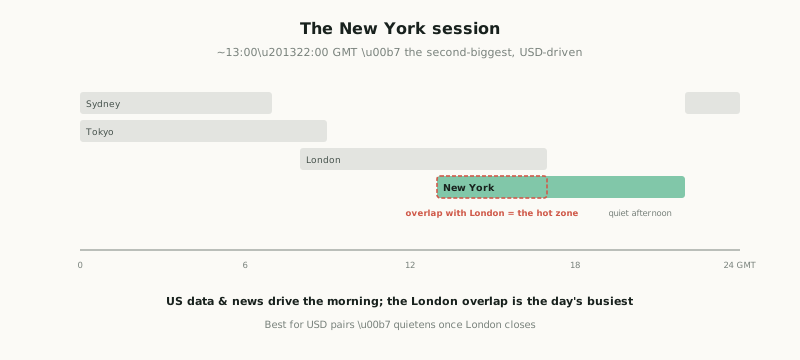
The New York session runs roughly 13:00–22:00 GMT, covering North American trading hours (about 8am–5pm Eastern Time). As always, this is approximate and the GMT window shifts with US daylight saving time, so verify the current times for your situation. New York is the second-largest forex session after London, and its defining quality is that it's USD-driven: the US dollar is the world's reserve currency and one side of most major pairs, and the United States is the world's largest economy, so American flows and news dominate the session. The North American currencies — the US and Canadian dollars — are especially active, making USD pairs (EUR/USD, GBP/USD, USD/JPY) and USD/CAD the session's focus. The session has high liquidity and volatility in its first half (the London overlap) and then tapers off into the afternoon, ending with the New York close around 22:00 GMT — effectively closing the main global trading day before the Asia-Pacific sessions begin the cycle anew.
The London overlap and US data
The most important feature of the New York session is its morning overlap with London (roughly 13:00–17:00 GMT), when the world's two largest forex centres — London and New York — are open simultaneously. This is the single most active, liquid and volatile window of the entire trading day: the most participants, the tightest spreads, and often the biggest moves. What makes it especially potent is timing — the major US economic releases typically land in the New York morning, right in the middle of this overlap. Data like Non-Farm Payrolls (NFP), CPI inflation, and Federal Reserve decisions can cause sharp, immediate, high-volatility moves across USD pairs and well beyond, and because they hit during the overlap, the reaction is amplified by the deep, two-centre liquidity. For many traders, this overlap window is the session that matters — the prime time for movement and opportunity.
This concentration of US news in the New York morning gives the session much of its character. The Federal Reserve's decisions and communications, the monthly employment and inflation data, and other high-impact US releases are among the most market-moving events in all of forex, and they're a New York-session phenomenon. Traders who focus on news trading, or who simply want to be aware of when volatility is likely to spike, watch the US data calendar closely — these releases can move the market violently in seconds, which is both an opportunity and a serious risk (volatility around major news can produce slippage, whipsaws and gaps). The overlap and the US data times are where the session's energy concentrates.
After London closes (around 17:00 GMT), the picture changes markedly. The New York afternoon sees liquidity drop as the European market goes home, leaving New York trading alone. This later part of the session is typically quieter — thinner liquidity, often more range-bound or drifting price action, and fewer major catalysts (the main US data having already been released in the morning). It's a calmer, lower-energy window than the overlap that preceded it.
How traders approach it
The New York session's prime time is unquestionably its morning overlap with London and the US data releases within it — this is where the liquidity, volatility and opportunity concentrate, and where traders seeking movement focus their attention. Strategies that thrive on volatility and liquidity suit this window, and traders who follow US data position around (or deliberately avoid) the high-impact releases, which can dominate the session's price action. The quieter afternoon, by contrast, offers thinner conditions that some traders use for range approaches and others simply sit out. Practically, the New York session suits traders in American timezones and anyone who wants to trade the US data and the overlap, which conveniently falls in the afternoon/evening for European traders and the morning for those in the Americas.
The honest caveats apply here as everywhere. The session's volatility — especially around US news — cuts both ways: the same data release that offers a big opportunity can inflict a fast, large loss, with slippage and gaps that make stops less reliable in the moment, so risk management around news is essential (many traders reduce size or stand aside through the highest-impact releases rather than gambling on the reaction). And the New York session, like all sessions, describes when activity tends to happen — a dependable pattern of an active, US-driven morning and a quieter afternoon — not a guaranteed edge or a prediction of direction. The honest framing: the New York session (~13:00–22:00 GMT, shifting with daylight saving) is the second-biggest session, USD-driven and powered by US data and the Fed, peaking in its morning overlap with London (the day's most active, liquid window) before quietening in the afternoon. It's best for USD pairs, prime for traders wanting the overlap and US-news volatility — but that volatility demands careful risk management (especially around releases), and the session describes when activity happens rather than guaranteeing an edge. Trade it if it fits your schedule and style, with disciplined risk control around the news.
Two halves: the overlap and the afternoon
More than any other session, New York divides cleanly into two distinct halves, and recognising the difference is key to trading it well. The first half — the morning, roughly 13:00–17:00 GMT — is the London overlap: deep liquidity, high volatility, the day's major US data, and the bulk of the session's significant movement. This is New York at full power, and it's where traders seeking opportunity and movement naturally concentrate. The second half — the afternoon, after London closes around 17:00 GMT until the New York close near 22:00 GMT — is a different market entirely: thinner, quieter, often range-bound or drifting, with the main catalysts already behind it. The contrast can be stark, and a strategy that worked in the energetic overlap may simply not function in the listless afternoon (a breakout approach, for instance, has little to break in a drifting, low-volume market).
This two-halves structure has practical consequences. Many New York traders treat the overlap as their real trading window and either ease off or stop in the afternoon, recognising the thinner conditions offer less and cost more (wider spreads). Those who do trade the afternoon often switch to range-style thinking suited to the quieter rotation, with modest expectations. The New York close (~22:00 GMT) carries its own significance: it effectively ends the main global trading day before the Asia-Pacific sessions begin the cycle again, and it's a natural point at which some shorter-term traders flatten positions rather than carry them into the thin overnight hours. A special note applies to Friday's New York session: as the last major session before the weekend close, it's where traders decide whether to hold positions over the weekend — with the attendant weekend-gap risk when the market reopens in Sydney — so the Friday afternoon often sees position-squaring as the week winds down. Understanding that New York is really two sessions in one — a powerful, news-driven overlap and a quiet afternoon — lets you match your approach and expectations to whichever half you're trading, rather than expecting the afternoon to behave like the morning.
The New York session (~13:00–22:00 GMT, shifting with daylight saving) is the second-largest and USD-driven, since the US is the world's biggest economy and the dollar its reserve currency. It's best for USD pairs (EUR/USD, GBP/USD, USD/JPY) and USD/CAD. Its defining feature is the morning overlap with London (~13:00–17:00 GMT) — the day's most active, liquid, volatile window — made potent because major US data (NFP, CPI, the Fed) lands then, driving sharp moves. After London closes (~17:00 GMT) the afternoon quietens (thinner, range-bound). It suits traders wanting the overlap and US-news volatility, but that volatility cuts both ways — manage risk carefully around releases (reduce size or stand aside). Like all sessions, it describes when activity happens, not a guaranteed edge — trade it if it fits you.