After the weekend first stirs in Sydney, the trading day truly gets going in Tokyo — the largest of the Asian sessions and the main hub of Asia-Pacific currency trading. It's the quieter, more range-bound part of the daily cycle, where the day's early character forms in calmer conditions before London arrives to shake things up. Understanding the Tokyo session helps a trader know what to expect from the Asian hours — typically less movement, ranges rather than strong trends, and a focus on the yen and the Australasian currencies. This guide is a deep dive: its hours, character, key pairs, what drives it, and how traders approach it.
It's one of the four sessions in the sessions overview, its quieter conditions often suit range strategies, and it's the prime session for yen pairs.
Key takeaways
Q: What are the Tokyo session hours?
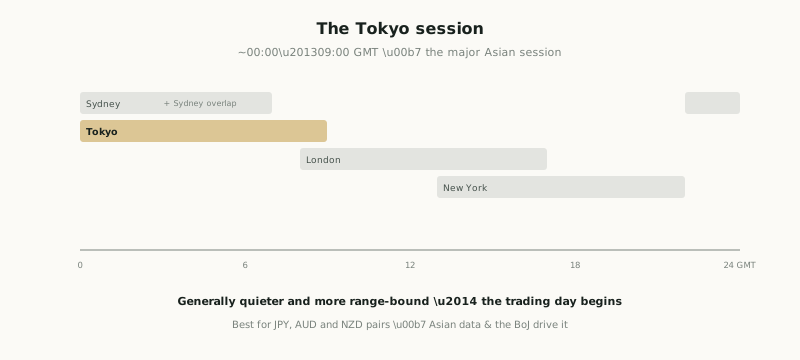
A: The Tokyo session runs roughly 00:00–09:00 GMT, covering the main Asian trading hours (Tokyo is the key hub, alongside Singapore and Hong Kong). As with all sessions, times are approximate and shift with daylight saving in other regions, so verify the current window for your broker and timezone.
Q: What is the Tokyo session like to trade?
A: Generally quieter and more range-bound than London or New York, with lower liquidity and volatility. Ranges often form during Asian hours, and spreads can be slightly wider on non-Asian pairs. It's not always quiet — Asian data, Bank of Japan news or large flows can produce sharp moves — but calmer, ranging conditions are typical.
Q: Which pairs are most active in the Tokyo session?
A: Yen pairs are most active — USD/JPY, EUR/JPY and the other JPY crosses — along with the Australian and New Zealand dollars (AUD/USD, AUD/JPY, NZD/USD), which trade actively in Asia-Pacific hours. Chinese and broader Asian data can move the commodity-linked AUD and NZD in particular.
The session at a glance
The table summarises the Tokyo session's characteristics, with detail following.
Tokyo (Asian) session profile
The Tokyo session runs roughly 00:00–09:00 GMT, covering the main Asian trading hours, with Tokyo as the key financial hub (alongside Singapore and Hong Kong, which extend the Asian trading window). As ever, times are approximate and shift with daylight saving in various regions, so verify the current window. Tokyo is the largest Asian session, and its defining quality is that it's generally quieter than London or New York: lower liquidity and volatility, with price more often range-bound than strongly trending, and spreads that can be slightly wider on non-Asian pairs (fewer participants in those during Asian hours). This calmer character is the norm — but not an absolute rule: Asian economic data, Bank of Japan news, or large regional flows can produce sharp, sudden moves, so "quiet" should never be mistaken for "safe to ignore risk." The session simply tends, on balance, toward calmer, more rotational conditions than the European and US sessions.
Key pairs and drivers
As the Asia-Pacific session, Tokyo is most active for the region's currencies. Yen pairs are the focus — USD/JPY, EUR/JPY, and the other JPY crosses — since this is the home session for the Japanese yen. The Australian and New Zealand dollars also trade actively in Asian hours (AUD/USD, AUD/JPY, NZD/USD, NZD/JPY), as Australasia is within or adjacent to the session. These are the pairs that see their most natural liquidity during Tokyo hours; trading European or US-centric pairs in the Asian session often means thinner conditions and wider spreads. What drives the session is regional: Japanese data and the Bank of Japan (which can move the yen significantly), Australian and New Zealand data (the RBA, RBNZ, and the commodity-linked nature of the AUD and NZD), and — importantly — Chinese data and news, which, given China's economic weight and trade links, can move the commodity currencies (AUD, NZD) and broader risk sentiment during Asian hours. Traders of these pairs watch the Asian data calendar much as USD traders watch the US one.
One characteristic worth highlighting for its practical relevance: the Asian session often builds a range — a relatively contained band of price — during its quieter hours, and that Asian range frequently gets broken at the London open as European liquidity surges in. This is precisely the dynamic the London breakout strategy targets, and it's a useful link between the sessions: the calm of Tokyo often sets up the volatility of the London open. So even a trader who doesn't trade the Asian session may pay attention to the range it forms.
How traders approach it
The Tokyo session suits traders in Asia-Pacific timezones and anyone whose schedule aligns with Asian hours, and it lends itself to particular approaches. Because conditions are often range-bound, range strategies (trading between established support and resistance, fading the edges of a range) frequently fit the session's character better than breakout or strong-trend approaches, which thrive in busier sessions. Traders here naturally focus on the JPY, AUD and NZD pairs that are most liquid in the session, and stay alert to the Asian data and central-bank events that can inject sudden movement into otherwise calm conditions. The quieter environment means smaller moves are typical, which some traders prefer (less violence, more orderly ranges) and others find too slow.
The honest caveats hold. The Tokyo session's quieter, range-bound character is a tendency, not a guarantee — Asian news and flows can and do produce sharp moves, so risk management remains essential even in a session known for calm (complacency in "quiet" conditions can be costly when a surprise hits). The lower liquidity also means slightly wider spreads on many pairs, a real cost to factor in, especially for shorter-term trading. And as with every session, Tokyo describes when certain conditions tend to prevail (calmer, more rotational, Asia-focused) rather than offering a guaranteed edge or a directional prediction. The honest framing: the Tokyo session (~00:00–09:00 GMT) is the major Asian session — generally quieter and more range-bound, with lower liquidity and somewhat wider spreads, best for JPY, AUD and NZD pairs, and driven by Asian data, the BoJ and Chinese news. Its calmer conditions often suit range strategies, and the Asian range it builds frequently breaks at the London open. But quiet isn't risk-free (news can move it sharply), spreads are a consideration, and it describes when conditions tend to occur rather than guaranteeing an edge — trade it if it fits your schedule and style, with risk management intact.
The rhythm of the Asian session
The Asian trading day has its own gentle rhythm, quite different from the European and US sessions. It opens as Sydney hands over to Tokyo — the two overlap (roughly 00:00–07:00 GMT), and this Sydney–Tokyo overlap is the busier part of the Asian day, as Australasia and Japan are both active. Through the Tokyo morning, the session typically settles into its characteristic range-building: with European and US participants absent, price often rotates within a contained band, establishing the Asian range that becomes such a useful reference for the London open. This is the session's defining behaviour — calm, rotational, defining a range rather than driving a strong trend — punctuated by bursts of activity around regional catalysts.
Those catalysts give the session its occasional energy. Japanese data and Bank of Japan news can move the yen sharply; and importantly, Chinese data and news — often released during Asian hours — can jolt the commodity-linked AUD and NZD and shift broader risk sentiment, since China's economic weight ripples through the region. So a "quiet" Asian session can spring to life on a major Chinese release or a BoJ surprise, which is exactly why calm conditions should never invite complacency. As the session matures toward 08:00–09:00 GMT, it winds down and hands over to London in a brief Tokyo–London overlap — the point at which the Asian range so often gets broken by the incoming European liquidity. For the trader, this rhythm shapes the approach: the range-bound character through the Tokyo hours lends itself to range strategies (fading the edges of the established band toward its middle), while staying alert to the Asian data calendar that can break the calm. There's also a quieter structural backdrop worth knowing — the yen's role in carry trades means yen pairs can carry an underlying directional bias from rate differentials — but the session's day-to-day texture is mostly one of calm rotation. Understanding the Asian rhythm — Sydney handover, range-building, regional-news bursts, wind-down into London — lets a trader set realistic expectations (smaller, rotational moves) and choose fitting tactics, rather than expecting London-style trends from a session built differently.
A note on costs in thin conditions
One practical point matters more in the Asian session than in the busier European and US hours: trading costs. Because Tokyo's liquidity is lower, spreads tend to be wider — particularly on pairs that aren't native to the region (European or US-centric crosses see little natural Asian-hours flow). For shorter-term traders especially, that wider spread is a direct, recurring cost that eats into every trade, and it can quietly turn an otherwise sound approach unprofitable if ignored. The sensible response is to favour the pairs that are genuinely liquid in the session — the JPY, AUD and NZD pairs — where Asian-hours spreads are tightest, and to be wary of scalping thin, wide-spread pairs in the quiet hours. It's also worth remembering that liquidity builds as the session progresses toward the Tokyo–London handover, and that conditions improve markedly once London arrives. For a trader whose schedule only allows Asian hours, the practical recipe is to trade the regionally-liquid pairs, respect the wider spreads in position sizing and target selection, lean toward the range-friendly tactics the session rewards, and keep expectations calibrated to its calmer, smaller-move character — with risk management as constant here as in any session.
The Tokyo session (~00:00–09:00 GMT) is the major Asian session — generally quieter and more range-bound, with lower liquidity/volatility and slightly wider spreads on non-Asian pairs. It's best for JPY pairs (USD/JPY, EUR/JPY) and the AUD and NZD, driven by Japanese data and the Bank of Japan, Australian/NZ data, and Chinese news (which moves the commodity-linked AUD/NZD). The Asian session often builds a range that frequently breaks at the London open (the basis of the London breakout). Its calm conditions often suit range strategies, and it suits Asia-Pacific-hours traders. But "quiet" isn't risk-free — Asian news can cause sharp moves — spreads are a cost to watch, and like all sessions it describes when conditions tend to occur, not a guaranteed edge. Trade it if it fits you, with risk management.