When London wakes up, the forex market often does too. The quiet, range-bound Asian session frequently gives way to a sharp directional move as London's enormous liquidity floods in at the open. The London breakout strategy is built to ride exactly that surge: define the range that formed overnight, then trade the breakout when the London open blows price out of it. It's a popular, specific application of the opening-range-breakout idea, exploiting one of the most reliable patterns in the daily forex rhythm — the volatility jump at the London open. This guide explains the strategy: the setup, why it can work, and the false-breakout risk that defines how to manage it.
It's a focused application of breakout trading, tied to the daily rhythm covered in forex trading sessions, and trades the breakout of an Asian-session range.
Key takeaways
Q: What is the London breakout strategy?
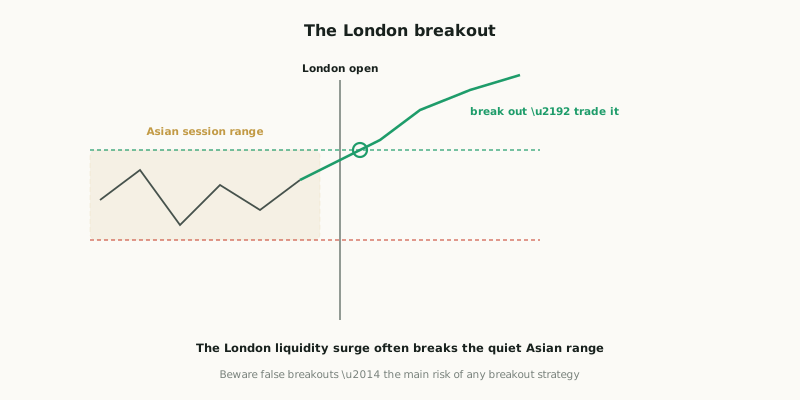
A: It's a session-based breakout strategy. During the quieter Asian session, price often forms a relatively tight range. When the more volatile London session opens, price frequently breaks out of that range with a strong directional move. The strategy marks the Asian-session high and low, then trades the breakout in whichever direction price breaks at the London open.
Q: Why does the London breakout strategy work?
A: The London session is the largest and most liquid, and its open brings a surge of volume and volatility, often producing the day's strongest directional move — especially in London-centric pairs like EUR/USD, GBP/USD and EUR/GBP. The quiet Asian range provides a defined reference level to trade the breakout from.
Q: What is the main risk of the London breakout?
A: False breakouts (fakeouts). Like all breakout strategies, it's prone to price breaking the range, triggering entries, and then reversing — trapping breakout traders. The London open can produce whippy, false moves. Managing this with confirmation, sensible stops, filters and risk management is essential, since some false breakouts are unavoidable.
The idea and the setup
The strategy rests on a recurring pattern in the daily forex cycle. During the Asian session (when Tokyo and the Asian markets are the main players), trading is often relatively quiet, and price frequently forms a comparatively tight range — a period of consolidation as the market waits. Then the London session opens, bringing a major influx of liquidity and volatility (London is the largest forex centre, and its open often produces the day's strongest directional move, especially as it later overlaps with New York). This surge frequently breaks price out of the quiet Asian range with conviction. The strategy aims to capture that move: identify the Asian-session range, then trade the breakout in whichever direction price breaks at or after the London open.
The typical setup is straightforward. First, mark the high and low of the Asian session (the consolidation range) before London opens — these define the levels to watch. Second, as the London session opens, watch for price to break out: a break above the range high signals a potential long (buy), a break below the range low signals a potential short (sell). Third, place a stop on the other side of the range (or a portion of it) — if you go long on an upside break, your stop sits below the range — and set a target (a multiple of the range size, the next significant level, or a trailing exit to ride the move). The logic is that the London surge, once it picks a direction out of the range, often carries price a meaningful distance, so catching the breakout early can capture a strong, fast move. It tends to work best on London-centric pairs — EUR/USD, GBP/USD, EUR/GBP — which see the most action at the London open.
The false-breakout risk
Like all breakout strategies, the London breakout is prone to false breakouts (fakeouts). Price breaks the range — triggering breakout entries — and then reverses, trapping the traders who entered on the break and leaving them with a loss as price snaps back into (or through the other side of) the range. The London open, for all its volatility, can be whippy, producing sharp false moves (sometimes resembling "stop hunts") that break the range only to reverse. This is the central risk of the strategy, and it's unavoidable in part — no breakout method can eliminate false breakouts entirely, since you can't know in advance which breaks will hold. Expect a meaningful proportion of breakouts to fail, and plan for it: the strategy's profitability depends on the winning breakouts (which can run far) outweighing the false ones (kept small by stops), not on every breakout working.
Managing the false-breakout risk is therefore the heart of trading this strategy well. Several measures help. Wait for confirmation rather than entering on the first tick beyond the range — for example, waiting for a candle to close beyond the range (a more committed break than a brief poke), or waiting for a retest of the broken level that holds (the retest approach) before entering — which filters out some fakeouts at the cost of a slightly later entry. Filter the conditions: the strategy works best when there's genuine volatility and a clean Asian range; it's less reliable on unusually quiet days, around major scheduled news (which can cause erratic moves), or when the Asian range is messy. Use sensible stops and accept that some false breakouts will cost small losses — the stop is what keeps a fakeout from becoming a large loss, so it's essential, not optional. And trade with the broader context where possible (a breakout aligned with the higher-timeframe trend is more likely to follow through than one against it). Above all, apply proper risk management — sizing each trade so the inevitable false breakouts are survivable, since the edge lies in the aggregate (winners outrunning losers), not in any single trade.
The honest framing: the London breakout strategy trades the breakout of the quiet Asian-session range at the volatile London open, exploiting the liquidity-and-volatility surge that often produces the day's strong directional move. It can capture powerful, fast moves — but it's prone to false breakouts (the main risk), so it needs confirmation (a close beyond the range, or a retest), sensible filters (volatility, news, range quality), disciplined stops, and risk management. It's a specific, popular application of opening-range breakout, not a guaranteed edge — false breakouts are common, and profitability comes from letting the winning breakouts run while keeping the failed ones small. Traded with that discipline — in the right conditions, with confirmation and tight risk — the London breakout can be an effective way to harness the most reliable volatility window in the forex day; traded naively (chasing every break with no stop or filter), it falls victim to the very fakeouts it must guard against.
Trading it in practice
Turning the idea into a tradeable routine requires pinning down some specifics. First, defining the Asian range: traders typically mark the high and low of a defined window of the Asian session (for example, the hours leading up to the London open) rather than the entire session, focusing on the consolidation that immediately precedes London. The exact window is a parameter to settle through testing, but the principle is to capture the tight, pre-London range that the London surge will break. A cleaner, tighter Asian range tends to give a more meaningful breakout; a sprawling, already-volatile Asian session offers a less useful reference. Some traders also require the range to be within a certain size — skipping days where the "range" is already too wide to offer a sensible breakout level or stop.
Second, the execution specifics. The entry triggers on the break of the range (ideally with the confirmation discussed — a candle closing beyond the range, or a successful retest of the broken level, which the retest approach handles well). The stop sits logically on the opposite side of the range (or just beyond the broken level on a retest entry), and the position is sized so that this stop distance equals your chosen risk (the position-sizing principle) — which is why an over-wide range, implying a wide stop, can make a setup not worth taking. The target can be a multiple of the range's size (a common approach — e.g. aiming for a move equal to one or two times the range height), the next significant support/resistance level, or a trailing exit to ride a strong London–New York trend. Time of day matters: the setup is keyed to the London open, and the move it's trying to catch often develops in the hours around that open (sometimes extending into the New York overlap), so it's a strategy with a specific window rather than an all-day approach. Trade management — moving to break-even once in profit, trailing a strong move, or taking partial profit — helps capture the good breakouts while protecting against the reversal of a fakeout. The honest practical summary: define a clean pre-London Asian range, enter the breakout with confirmation, stop beyond the range, size to your risk, target a multiple of the range or the next level, and trade it around the London window with sensible management — always remembering that false breakouts are common, so the discipline of stops, confirmation and risk control is what makes the strategy viable rather than just appealing.
The London breakout strategy trades the breakout of the quiet Asian-session range at the volatile London open, where a surge of liquidity often drives the day's strong directional move (best on London pairs like EUR/USD, GBP/USD, EUR/GBP). Setup: mark the Asian range high/low; on the London open, go long on a break above / short on a break below; stop on the other side of the range; target a multiple of the range, the next level, or trail. The main risk is false breakouts (fakeouts) — price breaks, traps entrants, then reverses; the whippy London open produces them, and they're partly unavoidable. Manage with confirmation (a close beyond the range or a retest), filters (volatility, news, range quality), sensible stops (accept small losses on fakeouts), and risk management. The edge is winners running while false breakouts stay small — not magic; false breakouts are common.