A single straight line drawn beneath a rising market is one of the oldest and most useful tools in technical analysis — a way to see a trend's direction, its slope, and where price has found dynamic support, all at a glance. Add a second, parallel line and you have a channel, framing the whole move. This guide explains trendlines and channels: how to draw them, the types, how to use them, and the important caveat that they're more subjective than they look.
They're the diagonal, dynamic cousin of horizontal support and resistance, they help read market structure, and they're strongest used with confluence.
Key takeaways
Q: What is a trendline?
A: A trendline is a straight line connecting a series of price points to visualise a trend's direction and slope and to act as dynamic support or resistance. An uptrend line connects rising swing lows (support beneath an uptrend); a downtrend line connects falling swing highs (resistance above a downtrend). You need at least two points to draw one, and a third touch helps validate it.
Q: What is a price channel?
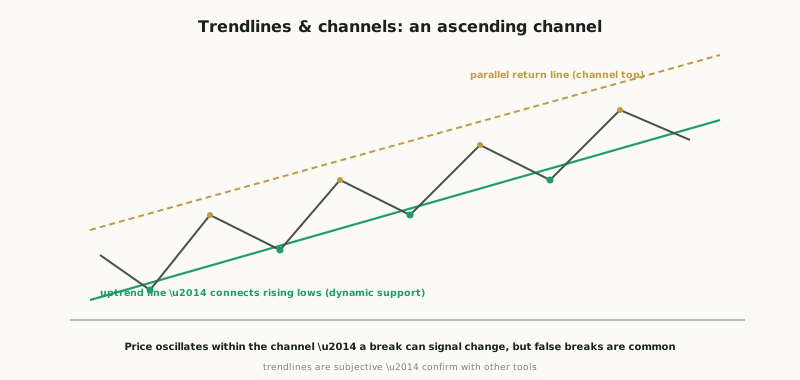
A: A channel is formed by two parallel trendlines that contain price between them — the main trendline plus a parallel 'return line' on the opposite side. Channels can be ascending (up), descending (down) or horizontal (a range). Price tends to oscillate between the two boundaries, which traders use for dynamic support and resistance and to anticipate reactions at the edges.
Q: Are trendlines reliable?
A: They're useful but subjective — a key caveat. The same price action can be drawn with different valid trendlines depending on which points you connect, whether you use wicks or bodies, and linear versus log scale. A trendline break is not a guaranteed reversal either, as false breaks are common. Trendlines work best as a guide used alongside other tools and confirmation, not as a precise predictor.
Drawing trendlines and channels
A trendline connects a series of price points to map a trend and act as dynamic (sloping) support or resistance — dynamic because, unlike a flat support/resistance level, it moves with the trend. An uptrend line is drawn by connecting the rising swing lows beneath an advancing market: it sits below price and acts as support, the level buyers have repeatedly stepped in at. A downtrend line connects the falling swing highs above a declining market: it sits above price and acts as resistance. You need at least two points to draw a line, and a third touch that respects it helps validate the line as meaningful — generally, the more touches, the more significant the trendline (though, paradoxically, also the more "tested" and eventually liable to break). A channel extends the idea: draw a line parallel to the trendline on the opposite side of price (the "return line"), and you frame price within two boundaries. Channels come in three flavours — ascending (up-sloping, an uptrend), descending (down-sloping, a downtrend), and horizontal (flat, a range — essentially the rectangle pattern) — and within any of them, price tends to oscillate between the two lines, bouncing from one boundary toward the other.
Using them — and their limits
Trendlines and channels earn their keep in a few practical ways. As trend identification, the line makes a trend's direction and steepness immediately visible — a steepening or flattening slope hints at accelerating or fading momentum. As dynamic support/resistance, traders watch the boundaries for reactions: in an ascending channel, a pullback to the lower trendline (support) can offer a spot to join the uptrend, with the upper return line as a target or area to take profit — "buy low, sell high" within the channel — and vice versa in a descending channel. As breakout signals, a decisive break of a trendline or channel boundary can flag a potential trend change (a break of the lower line in an uptrend) or acceleration (a break of the upper line). These uses connect closely to chart patterns, since many patterns (flags, wedges, triangles, rectangles) are essentially trendline constructions.
But the honest caveats matter, and the biggest is subjectivity. Unlike a precisely calculated indicator, a trendline is drawn by hand, and the same price action can legitimately be drawn several different ways: which swing points do you connect? Do you use the candle wicks (extremes) or the bodies (closes)? Linear or logarithmic price scale? Each choice produces a different line, and reasonable traders will draw different trendlines on the same chart — so a trendline is a guide, not an objective truth. The second caveat: a trendline break is not a guaranteed reversal. False breaks (where price pokes through and snaps back) and throwbacks (where price breaks, then retests the line from the other side) are common, so a break needs confirmation rather than blind action. The practical resolution is to treat trendlines and channels as one input among several — combine them with horizontal levels, market structure, candlestick signals and other confluence, and wait for confirmation at the boundaries — rather than trading a single hand-drawn line in isolation. The honest framing: trendlines connect swing points (rising lows for an uptrend line = dynamic support; falling highs for a downtrend line = resistance) to show a trend's direction and slope; two points draw a line, a third touch validates it. Channels add a parallel return line, containing price (ascending/descending/horizontal), and price tends to oscillate between the boundaries. Use them for trend ID, dynamic support/resistance (trading bounces off a boundary with the trend), and breakouts (a break can signal change or acceleration). But trendlines are subjective (drawn many valid ways — wicks vs bodies, log vs linear), a break isn't a guaranteed reversal (false breaks common), and they're best used with confirmation and other tools. A useful, foundational way to visualise and trade trend — a guide, not a precise predictor; manage risk.
Drawing trendlines well
Because trendlines are subjective, the difference between a useful line and a misleading one comes down to how you draw them — and a few principles help. First, connect significant swing points: the line should join the obvious, meaningful turning points (major swing lows in an uptrend, major swing highs in a downtrend), not minor wiggles cherry-picked to make the line look good. A trendline that touches three or more genuine swings is far more credible than one forced through whatever points happen to line up. Second, decide on a consistent convention for wicks versus bodies and stick to it: many traders prefer connecting the extremes (wicks) since those mark the true reaction points, while others use closing prices to filter out spikes — either is defensible, but inconsistency leads to self-deception. Third, on volatile or long-term charts, consider a logarithmic price scale, on which percentage moves are represented consistently and trendlines on big moves behave more sensibly than on a linear scale.
Equally important is knowing the common mistakes to avoid. The cardinal error is forcing a trendline — drawing the line you want to see (because it supports your bias) rather than the one the price action actually justifies, even adjusting it repeatedly until it "works." If you find yourself redrawing a line to keep a trade alive, that's a warning sign of bias, not analysis. A second mistake is treating a too-steep trendline as durable: very steep lines (parabolic advances) are unsustainable and break quickly, so a steep line breaking is often just a return to a more normal slope, not a trend reversal — many trends have a steeper inner line and a shallower "primary" line, and it pays to know which you're watching. Third, remember that trendlines evolve: as a trend matures, you may need to redraw to a shallower, more representative line, and an old line that's been decisively broken stops being relevant. The goal throughout is honesty — draw the line the market is showing you, validate it with multiple genuine touches, accept its subjectivity, and let it inform rather than dictate. A well-drawn trendline that you treat as a probabilistic guide (confirmed by other tools) is valuable; a forced line you trust blindly is worse than no line at all.
Trendlines vs horizontal levels
It's worth being clear on how trendlines relate to plain horizontal support and resistance, since the two are complementary rather than competing. Horizontal levels mark fixed prices where the market has repeatedly reacted — a static line at a specific value, often more objective and widely watched. Trendlines mark dynamic, sloping levels that move with the trend, capturing the rhythm of an advance or decline rather than a fixed price. Strong traders use both: horizontal levels to mark the key prices, trendlines and channels to map the trend's structure and slope — and they pay special attention to where the two coincide, since a trendline meeting a horizontal level at the same point is a high-quality confluence zone where a reaction is more likely. If anything, treat the more objective horizontal levels as your primary map and the more subjective trendlines as a supporting read on trend direction and momentum, rather than relying on hand-drawn diagonals alone. The two together give a fuller picture than either by itself.
Trendlines connect swing points to map a trend and act as dynamic support/resistance: an uptrend line joins rising lows (support below); a downtrend line joins falling highs (resistance above). Two points draw a line; a third touch validates it. A channel adds a parallel return line, framing price between two boundaries — ascending, descending or horizontal — with price oscillating between them. Use them for trend ID, dynamic support/resistance (trade bounces off a boundary with the trend, the opposite line as a target), and breakouts (a break can signal change or acceleration). But trendlines are subjective (wicks vs bodies, log vs linear — many valid lines), a break is not a guaranteed reversal (false breaks are common), and they work best with confirmation and other tools. A guide, not a predictor — manage risk.