Classical economics assumes we weigh gains and losses rationally and symmetrically — that £100 gained and £100 lost are simply mirror images. We don't, and they aren't. Prospect theory — the work by Daniel Kahneman and Amos Tversky that helped win a Nobel Prize — describes how people actually decide under risk, and in doing so it explains many of trading's most stubborn, recurring mistakes. It's arguably the single most important theory for understanding trader behaviour. This guide explains prospect theory: its key tenets, and what each one means at the screen.
It's the foundational theory beneath behavioural finance, and directly underpins loss aversion and the disposition effect.
Key takeaways
Q: What is prospect theory?
A: Prospect theory is a behavioural model of decision-making under risk, developed by Daniel Kahneman and Amos Tversky, describing how people actually value potential gains and losses — as opposed to the rational, symmetric weighing assumed by classical economics. Its central findings are that people feel losses more intensely than equivalent gains (loss aversion), judge outcomes relative to a reference point rather than in absolute terms, and weigh probabilities in distorted ways.
Q: What are the key ideas of prospect theory?
A: Four main ones: loss aversion (a loss hurts roughly twice as much as an equal gain pleases), reference dependence (outcomes are judged as gains or losses relative to a reference point, often the status quo or purchase price, not in absolute wealth), diminishing sensitivity (the difference between £0 and £100 feels bigger than between £1,000 and £1,100), and probability weighting (people overweight small probabilities and underweight large ones).
Q: How does prospect theory apply to trading?
A: It explains several common trading errors. Loss aversion makes traders hold losers too long (to avoid crystallising the painful loss) and cut winners too early (to lock in a sure gain) — the disposition effect. Reference dependence makes them fixate on entry price. Probability weighting helps explain chasing low-probability big wins. Recognising these hardwired tendencies is the first step to counteracting them with rules and discipline.
The key tenets
Prospect theory, developed by Kahneman and Tversky, replaces the rational "expected utility" model with a descriptive account of how people really value risky outcomes. Four findings form its core.
Prospect theory's core findings
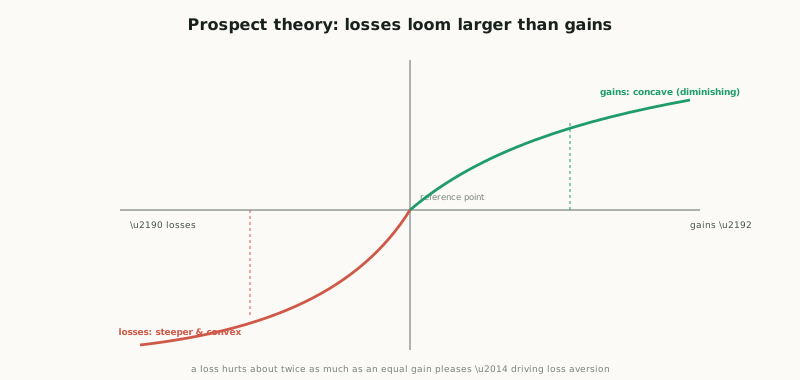
Loss aversion is the headline finding: people feel losses more intensely than equivalent gains — empirically, a loss hurts roughly twice as much as an equal gain pleases. This is why the value function in the diagram is steeper below the reference point than above it. Reference dependence: people judge outcomes as gains or losses relative to a reference point (often the status quo, or a purchase price), not in terms of absolute final wealth — it's the change from the reference that registers, not the total. Diminishing sensitivity: the subjective impact of a change shrinks as you move away from the reference — the difference between £0 and £100 feels far bigger than the difference between £1,000 and £1,100, even though both are £100 (this gives the value function its concave shape in gains and convex shape in losses). Probability weighting: people don't treat probabilities linearly — they tend to overweight small probabilities (which is why lottery tickets and long-shot bets appeal) and underweight moderate-to-high ones. Together these describe a decision-maker who is far from the cool, symmetric calculator of classical theory — and who looks a great deal like a real trader.
What it means for traders
Prospect theory is so valuable to traders because it explains, at a fundamental level, several of the most common and damaging trading errors — they're not random failings but predictable consequences of how human valuation works. Loss aversion is the big one: because losses hurt so disproportionately, traders are powerfully motivated to avoid crystallising them — so they hold losers too long (refusing to "realise" the painful loss, hoping it comes back) while cutting winners too early (grabbing a sure gain to avoid the smaller pain of watching it slip away). That asymmetry — riding losers, snipping winners — is precisely backwards from the "cut losses, let winners run" maxim, and it's the engine of the disposition effect (see also loss aversion in trading). Reference dependence explains the trader's fixation on entry price: the purchase price becomes the reference point, so decisions get anchored to "am I up or down on this trade?" rather than "what's the right decision now?" — the root of holding to break-even and other entry-anchored mistakes. Probability weighting helps explain chasing low-probability big wins (overweighting the small chance of a jackpot) and mis-judging risk. Even the convexity in losses has a dark implication: because people become risk-seeking in the domain of losses (the diminishing pain of an even bigger loss), a trader deep in the red may gamble to get back to even — the psychology behind revenge trading and doubling down.
The practical upshot is empowering: these tendencies are hardwired and universal, so you won't simply "decide" your way out of them — but recognising them is the first step to counteracting them with rules and discipline. Because you know loss aversion will tempt you to hold losers, you use a predefined stop-loss that removes the in-the-moment decision. Because you know you'll cut winners early, you use planned targets or trailing stops and a risk-reward framework. Because you know entry price will anchor you, you train yourself to judge trades on current merits and process, not on whether you're up or down. In short, prospect theory tells you the specific ways your own valuation system will sabotage you, so you can build a rule-based process designed to neutralise exactly those biases — which is a large part of what trading discipline is. Understanding the theory turns vague "control your emotions" advice into targeted countermeasures. The honest framing: prospect theory (Kahneman & Tversky) describes how people really value risky outcomes — loss aversion (losses hurt ~2× equivalent gains), reference dependence (outcomes judged vs a reference point like entry price, not absolute wealth), diminishing sensitivity (an S-shaped value function), and probability weighting (overweighting small odds). It explains core trading errors: holding losers too long and cutting winners too short (the disposition effect), fixating on entry price, chasing long shots, and gambling when deep in losses. These tendencies are hardwired, so the answer isn't willpower but rules — predefined stops, planned targets, judging trades on current merits and process — designed to neutralise exactly these biases; manage risk.
The framing effect
One further implication of prospect theory deserves its own attention, because it's both fascinating and practically important: the framing effect. Since people evaluate outcomes relative to a reference point as gains or losses (rather than in absolute terms), the way a choice is described — its frame — can flip the decision, even when the underlying options are identical. The famous illustration: people offered a treatment described as "saving 200 of 600 lives" tend to choose it (a sure gain), but when the same outcome is framed as "400 will die" they tend to reject it and gamble (avoiding a sure loss) — identical maths, opposite choices, purely because one frame invokes the gain domain and the other the loss domain. Because we're risk-averse in gains but risk-seeking in losses, presenting a decision as a potential gain versus a potential loss systematically changes behaviour.
For traders, framing is both a trap and a tool. As a trap: the frame you put on your own situation drives your behaviour, often badly. Viewing an open trade as "I'm down £200 and must avoid realising a loss" (loss frame) pushes you toward risk-seeking — holding the loser, adding to it, gambling to get back to even — whereas re-framing it as "what's the best decision now for my total capital?" (a neutral, reference-free frame) restores rational risk-aversion and makes cutting the loser easier. Much of the discipline prospect theory recommends is really about deliberately re-framing away from the entry-anchored gain/loss view toward a process-and-total-wealth view. Framing is also weaponised against you: marketing frames trading as easy "gains" while hiding the losses, and the way odds or products are presented exploits these biases — awareness is your defence. The broad lesson, beyond trading, is that how a choice is framed shapes the choice, so a sophisticated decision-maker learns to notice the frame, re-frame deliberately (especially away from emotionally loaded loss frames), and ask what they'd choose if the same situation were described neutrally. That habit — strip the frame, judge the substance — is one of prospect theory's most useful practical gifts. The honest reminder: the framing effect means the way a choice is described as a gain or loss can flip the decision even when the options are identical — so notice the frame you put on your own trades (a "down £200, avoid realising the loss" frame breeds bad risk-seeking), re-frame toward process and total wealth, and watch for framing weaponised in marketing.
More than any other theory here, prospect theory rewards the trader who studies it, because it doesn't just describe the market — it describes you. The biases it identifies are not other people's failings to exploit; they're your own hardwiring, quietly shaping every decision you make under risk. Knowing precisely how your valuation system is built — and how predictably it will mislead you — is the foundation on which rule-based discipline is built, and it's why understanding this theory is time exceptionally well spent.
Prospect theory (Kahneman & Tversky) describes how people really value risky outcomes, not the rational symmetry classical economics assumes. Four findings: loss aversion (a loss hurts ~2× as much as an equal gain pleases), reference dependence (outcomes judged as gains/losses vs a reference point — often entry price — not absolute wealth), diminishing sensitivity (the S-shaped value function), and probability weighting (overweighting small odds, underweighting large). It explains trading's stubborn errors: holding losers too long and cutting winners too early (the disposition effect), fixating on entry price, chasing long shots, and gambling when deep in losses. These tendencies are hardwired — so the fix isn't willpower but rules: predefined stops, planned targets/risk-reward, and judging trades on current merits and process, designed to neutralise exactly these biases.