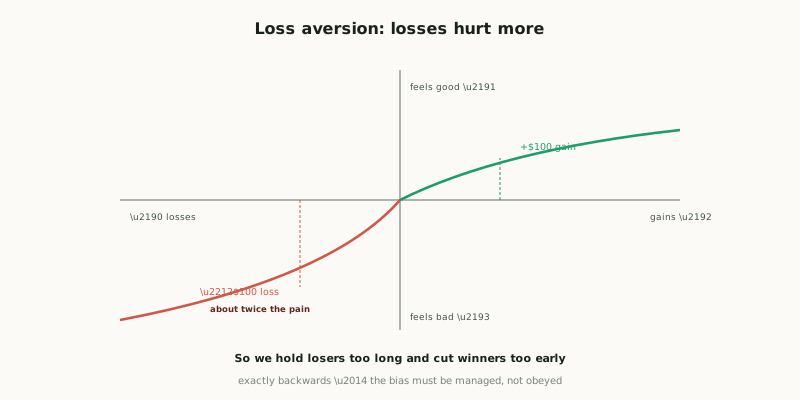
Losing $100 hurts about twice as much as gaining $100 feels good. That single quirk of human psychology — loss aversion, wired deep into all of us — quietly sabotages traders by making them do the exact opposite of what works: clinging to losing trades and bailing out of winning ones. It's one of the most powerful and universal forces in trading psychology, underlying many of the costliest mistakes, and understanding it is the first step to managing it. This guide explains loss aversion: what it is, how it distorts trading, why it's so hard to beat, and how to work against it.
It's the deeper bias beneath the disposition effect, a close relative of fear and greed, and one of the key cognitive biases every trader faces.
Key takeaways
Q: What is loss aversion?
A: Loss aversion is the well-documented tendency for losses to feel about twice as psychologically painful as equivalent gains feel good — a core finding of Kahneman and Tversky's prospect theory. We're wired to avoid losses more strongly than we're motivated to seek equivalent gains, which distorts decision-making under risk.
Q: How does loss aversion affect trading?
A: It pushes traders to hold losing positions too long (to avoid the pain of realising a loss) and to cut winning positions too early (to lock in a gain before it can vanish) — the heart of the disposition effect. It also makes traders risk-seeking when losing (gambling to escape a sure loss), which is exactly backwards for sound trading.
Q: How do you overcome loss aversion?
A: You can't eliminate it — it's wired in — but you can manage it: use predefined stop-losses and honour them mechanically, think in terms of process, probabilities and R-multiples (a loss taken per plan is a good trade), reframe losses as the cost of doing business, keep position sizes small enough to stay calm, and consciously act against the instinct to hold losers and cut winners.
What loss aversion is
Loss aversion is the well-documented psychological tendency for losses to feel roughly twice as painful as equivalent gains feel good. The finding comes from the prospect theory of psychologists Daniel Kahneman and Amos Tversky, and it's one of the most robust results in behavioural science: across countless studies, people consistently weigh a potential loss far more heavily than an equivalent potential gain. We are, in effect, wired to avoid losses more strongly than we're motivated to seek gains — an asymmetry that probably served our ancestors well (a lost meal could mean starvation) but wreaks havoc on modern decision-making under risk, trading very much included. The crucial point is that this is an automatic, emotional response, not a reasoned one; the pain of a loss is felt viscerally, and the mind instinctively seeks to avoid it — which is exactly where the trouble begins.
How it distorts trading
Loss aversion warps trading behaviour in several specific, damaging ways, summarised below.
How loss aversion distorts trading
The two signature distortions are holding losers too long and cutting winners too early — together the heart of the disposition effect. We hold losing trades, hoping they'll come back, because realising the loss means feeling the pain — so we postpone it, even as the loss grows (a direct violation of "cut losses short"). And we exit winning trades prematurely, snatching the gain, because we fear the pain of watching a profit evaporate or turn into a loss — so we lock it in too soon (violating "let winners run"). The result is a portfolio of small winners and large losers: precisely the wrong shape. A third, subtler distortion comes straight from prospect theory: people are risk-averse with gains but risk-seeking with losses. Faced with a sure loss, we'll gamble to avoid it — which in trading means holding or even adding to a losing position (the averaging-down trap) in the hope of escaping, rather than accepting the certain, smaller loss. This asymmetry is exactly backwards for trading, where we should cut losses (accept the sure small loss) and let winners run (tolerate the uncertainty of a larger gain). Loss aversion also drives traders to move stops away or not set them at all — anything to avoid the moment of painful realisation — which is among the most dangerous habits of all.
Why it's hard to beat, and how to manage it
Loss aversion is exceptionally hard to overcome because it's evolutionarily wired, automatic and emotional — it affects everyone, including experienced professionals, and no amount of "just be rational" willpower reliably switches it off in the heat of a losing trade. So the realistic goal is not to eliminate it but to manage it — to build structures and habits that counter its pull. The single most effective tool is the predefined stop-loss, honoured mechanically: by deciding where you'll exit a loser before you enter (when you're calm and rational) and committing to honour it, you bypass the in-the-moment emotional avoidance that loss aversion produces (the stop-loss and risk-limit guides). The rule, set in advance, binds the emotional self that would otherwise hold on.
Several mental tools help too. Thinking in process, probabilities and R-multiples reframes a loss as a routine, expected part of the system — a –1R outcome that the edge accounts for — rather than a personal failure to be avoided (the process-over-outcome and variance material). A loss taken according to your plan is a good trade, regardless of the sting. Reframing losses as the cost of doing business — the unavoidable price of accessing your edge, like inventory costs to a shopkeeper — drains some of their emotional charge. Keeping position sizes small enough that each loss is emotionally tolerable reduces the intensity of the aversion (a loss that doesn't threaten you is easier to take cleanly). And simple awareness is powerful: recognising the urge to hold a loser or snatch a winner as loss aversion — a known bias, not a valid signal — lets you deliberately act against it. The honest framing: loss aversion (losses feeling about twice as painful as equivalent gains, per prospect theory) is a deep, universal bias that distorts trading — making us hold losers too long, cut winners too early (the disposition effect), and turn risk-seeking when losing (the gamble to escape a loss), often by moving or skipping stops. It's wired-in and affects everyone, including pros; it can't be eliminated, only managed — via predefined stops you honour, thinking in process/probabilities/R, reframing losses as the cost of the edge, keeping size small, and conscious awareness of the pull. Recognising loss aversion and deliberately doing the opposite of what it urges — cutting losers, letting winners run — is one of the most important skills in all of trading.
Beyond the trade: how it shapes behaviour
Loss aversion reaches beyond the single decision to hold or cut, colouring a trader's whole pattern of behaviour in subtler ways worth recognising. One is "break-even-itis": the powerful urge to exit a trade the moment it returns to your entry price, simply to avoid the possibility of turning a "winner" back into a loss. The relief of escaping with no loss feels disproportionately good — a direct expression of loss aversion — but it routinely cuts trades short of their potential and degrades your reward-to-risk. Another is hesitation to enter at all: because the prospect of a loss looms so large, loss aversion can make traders freeze, skipping valid setups out of an exaggerated fear of being wrong (closely related to analysis paralysis). The bias doesn't only make us manage trades badly — it can stop us taking good ones.
Loss aversion also interlocks with other biases to compound the damage. It feeds the sunk-cost fallacy — the more you've "invested" (emotionally and financially) in a losing position, the harder loss aversion makes it to walk away, so you throw good money after bad. It amplifies confirmation bias, since admitting disconfirming evidence means admitting a loss, which loss aversion desperately wants to avoid. And it fuses with ego (a loss is an admission of being wrong) and can trigger the emotional spiral into revenge trading after a painful loss. Seeing loss aversion as the common thread running through so many trading mistakes is genuinely clarifying: a great deal of poor trading behaviour, from break-even-itis to holding losers to revenge trading, traces back to this single, deep aversion to the pain of losing. That recognition is itself a tool — when you catch yourself wanting to exit at break-even, freezing on a good setup, clinging to a loser, or needing to "win it back," you can name the underlying force as loss aversion and respond with your rules rather than your instinct. The instinct evolved to keep our ancestors alive; in trading, it quietly works against you, and managing it — through predefined plans, process thinking, and conscious awareness — is among the highest-leverage psychological skills you can develop.
Loss aversion (from prospect theory) is the tendency for losses to feel about twice as painful as equivalent gains feel good — we're wired to avoid losses more than to seek gains. In trading it makes us hold losers too long (to avoid the pain of realising a loss) and cut winners too early (to lock in gains) — the disposition effect — and turn risk-seeking when losing (gambling to escape a sure loss, e.g. averaging down), often by moving or skipping stops. All of this is exactly backwards from "cut losses, let winners run." It's automatic, emotional and universal (even pros feel it), so it can't be eliminated — only managed: use predefined stops and honour them, think in process/probabilities/R-multiples (a loss per plan is a good trade), reframe losses as the cost of the edge, keep size small enough to stay calm, and recognise the pull as bias. Deliberately do the opposite of what it urges.