There's a powerful, almost universal urge in trading to do exactly the wrong thing: to grab small profits quickly while letting losses run in the hope they'll come back. It feels natural — even prudent — in the moment, yet it's precisely backwards, and it quietly destroys accounts. This urge has a name: the disposition effect, one of the most documented and damaging biases in all of trading. It's the enemy of the single most important maxim in trading — "cut your losses, let your winners run" — and learning to recognise and beat it is half the psychological battle. This guide explains the disposition effect: what it is, the loss-aversion psychology behind it, the damage it does, and how to counter it.
It's one of the key cognitive biases, closely tied to handling losses and the ego's difficulty admitting a mistake, and countered above all by the disciplined stop-loss.
Key takeaways
Q: What is the disposition effect?
A: The disposition effect is a well-documented behavioural bias in which traders and investors tend to sell winning positions too early and hold losing positions too long. It's the exact opposite of the sound trading principle 'cut your losses and let your winners run', and it's a major reason many traders lose money.
Q: Why do traders hold losers and cut winners?
A: It stems from loss aversion: losses hurt more than equivalent gains feel good. People become risk-averse with gains (locking in a sure win by selling early) but risk-seeking with losses (gambling to avoid realising a loss by holding on). Closing a loser also means admitting being wrong, which is psychologically painful.
Q: How do you overcome the disposition effect?
A: Use predetermined stops (which force you to cut losers mechanically) and planned targets or trailing stops (to let winners run), decide both exits before entering, focus on following your process rather than avoiding the pain of a loss, and reframe a loss taken per plan as good discipline rather than failure.
What the disposition effect is
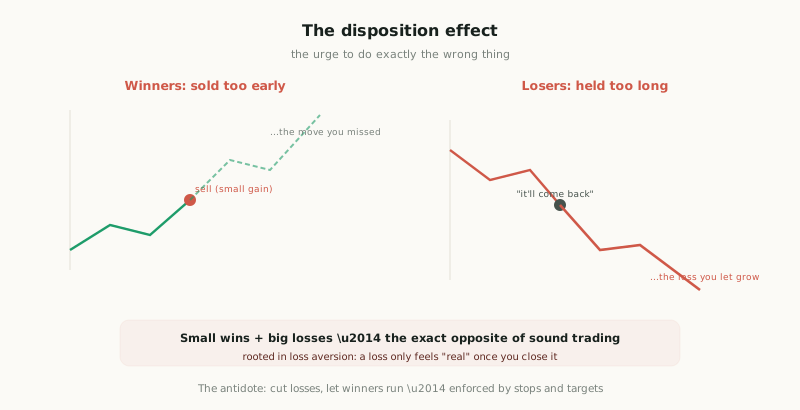
The disposition effect is a well-documented behavioural bias in which traders and investors tend to sell their winning positions too early and hold their losing positions too long. It's been observed repeatedly in studies of real trading behaviour, across markets and types of trader — it's not a quirk of the careless, but a deep, near-universal human tendency. And it is, precisely and exactly, the opposite of the cardinal rule of sound trading: cut your losses, let your winners run. Where good trading says hold winners (let them run to large gains) and cut losers (exit quickly with small losses), the disposition effect makes us do the reverse — cut winners (grab small gains) and hold losers (let losses grow). The table makes the inversion stark.
The disposition effect vs sound trading
| Situation | Disposition effect (the urge) | Sound trading (the rule) |
|---|---|---|
| A winning trade | Sell early — grab the gain | Let it run |
| A losing trade | Hold — hope it comes back | Cut it quickly |
| Result over time | Small wins, big losses | Small losses, big wins |
This inversion is devastating because it produces the worst possible asymmetry: a string of small wins (from cutting winners short) punctuated by occasional large losses (from holding losers as they fall). Sound trading aims for the reverse — small losses and the occasional large win — which is the favourable risk:reward profile that makes trading viable. The disposition effect flips it, so that the rare big loss overwhelms the many small gains, and the account bleeds out. It's a primary, well-evidenced reason that traders lose money, and the fact that it's natural — that the urge feels right in the moment — is exactly what makes it so dangerous. To beat it, you first have to understand why we do it.
The loss-aversion psychology
The disposition effect is rooted in loss aversion — a cornerstone of behavioural economics (from the prospect theory of Kahneman and Tversky). The core finding is that losses hurt more than equivalent gains feel good: the pain of losing, say, £100 is psychologically larger than the pleasure of gaining £100. This asymmetry in how we feel about gains and losses warps our behaviour in a specific way that produces the disposition effect. Faced with a gain, we become risk-averse — we want to lock in the sure profit (take the certain win now) rather than risk it by holding for more, so we sell winners early. Faced with a loss, we become risk-seeking — we'd rather gamble (hold on, hoping it recovers) than accept the certain, painful loss of closing, so we hold losers. The same loss aversion thus drives both halves of the bias: lock in gains (sell winners), avoid realising losses (hold losers).
There's a second, related psychological force: a loss only feels "real" once you close the position. While a losing trade is still open, the loss is just on paper — not yet "realised" — so holding it lets us avoid the pain of admitting the loss, and preserve the hope (however faint) of getting back to break-even. Closing a loser, by contrast, means realising the loss and — crucially — admitting we were wrong, which the ego finds painful (the ego-and-trading link). So we cling to losers partly to avoid the pain of being wrong, telling ourselves "it'll come back" rather than accepting the mistake. Meanwhile, realising a gain feels good — it locks in being "right" — so we're eager to do it, cutting winners to bank the pleasant feeling of a sure win. Understanding this — that the disposition effect is driven by loss aversion, the pain of realising losses, and the ego's difficulty admitting error — is essential, because it shows the bias is an emotional pull that must be actively countered, not a rational judgement to be trusted. The urge feels right precisely because it soothes these emotions in the short term, while harming the account in the long term.
How to counter it
Because the disposition effect is a natural, emotional pull, beating it requires rules and reframes that override the in-the-moment urge — you can't simply will yourself to feel differently about losses, but you can build a system that does the right thing regardless of the feeling. The single most powerful tool is the predetermined stop-loss: a stop, set in advance and honoured mechanically, forces you to cut losers regardless of the emotional urge to hold — the stop does the painful cutting for you, removing the in-the-moment loss-aversion decision (the stop-loss guide). Likewise, planned targets or trailing stops (the take-profit and trailing-stop guides) help you let winners run via a plan, rather than grabbing the gain early out of the urge to lock it in. Crucially, you should decide both exits before entering — set the stop and the target/trailing plan as part of the trade plan, when you're calm and rational, so the loss-aversion emotions of the live trade don't get to make the decision. Pre-commitment is the antidote to in-the-moment bias.
Beyond mechanics, a mental reframe helps enormously. Focus on process over outcome (the process-vs-outcome guide): judge yourself by whether you followed your plan, not by whether you avoided the pain of a loss. And, most importantly, reframe a loss taken per plan as good discipline, not failure: cutting a loser at your stop isn't a mistake or a defeat — it's exactly what a skilled trader does, and admitting you're wrong quickly (and cheaply) is a strength, not a weakness. The trader who can take a small, planned loss without ego or anguish has neutralised the worst half of the disposition effect. Finally, awareness itself is a real defence: simply knowing the disposition effect exists — recognising "I'm feeling the urge to hold this loser / grab this winner early, and that's the bias talking" — lets you catch and counter it. The honest framing: the disposition effect is one of the most documented and damaging trading biases, a natural product of loss aversion that pulls every trader toward cutting winners and holding losers. It can't be wished away, but it can be beaten with predetermined stops and targets (set before entering), a process focus, a healthy reframe of losses as disciplined and being wrong-but-quick as strength, and simple awareness. "Cut your losses, let your winners run" is the antidote — and it's so often repeated precisely because the disposition effect makes it so hard to do. Mastering this one bias is among the most valuable things a trader can achieve.
Catching it in the moment
Rules and reframes do the heavy lifting, but real-time self-awareness is what lets you catch the disposition effect as it happens — and the bias announces itself in fairly recognisable internal language. With a loser, listen for thoughts like "it'll come back," "I'll just give it a bit more room," "I don't want to sell at the bottom," or "it's only a paper loss until I close it." These are the classic rationalisations of loss aversion — the mind manufacturing reasons to avoid the pain of realising the loss. With a winner, listen for "I'll just take the profit before it disappears," "a bird in the hand," or a nagging anxiety about giving back the gain that makes you itch to close early. When you catch yourself thinking these things, that's the cue: the disposition effect is pulling, and the disciplined move is usually the opposite of what the thought wants — honour your stop on the loser, honour your plan on the winner.
A trading journal (covered in its own guide) is invaluable here, because it makes the pattern visible over time. By recording your exits and the reasoning behind them, you can review whether you're systematically cutting winners early or holding losers past their stops — the disposition effect leaves clear fingerprints in the data (a string of small wins and oversized losses, exits that deviated from the plan in the tell-tale direction). Seeing the pattern in your own record is often more persuasive than any abstract warning, and it lets you target the specific half of the bias you're most prone to. The practical loop is: set rules in advance, watch for the bias's characteristic thoughts in the moment, act against them, and review your journal to confirm you're improving. Over time, taking planned losses without anguish and letting planned winners run becomes more natural — not because the loss-aversion instinct disappears (it won't), but because awareness and habit learn to override it. That override, practised consistently, is what separates traders who beat the disposition effect from those it quietly beats.
The disposition effect is the well-documented urge to sell winners too early and hold losers too long — the exact opposite of "cut your losses, let your winners run." It produces the worst asymmetry (small wins, big losses) and is a primary reason traders lose. It's rooted in loss aversion (losses hurt more than gains please, so we lock in sure gains but gamble to avoid realising losses) and the fact that a loss feels "real" only once closed — closing it means admitting we were wrong (the ego resists). Counter it with rules and reframes: predetermined stops (which cut losers for you), planned targets/trailing (to let winners run), deciding both exits before entering, a process focus, reframing a planned loss as good discipline (being wrong quickly is strength), and simple awareness. Beating this one bias is half the psychological battle.