In the short run, a great trader can lose and a reckless one can win. It feels unfair, but it's the mathematical reality of any probabilistic endeavour: because each trade's outcome is uncertain, over a handful of trades luck drowns out skill entirely. Winning streaks and losing streaks appear that have nothing to do with how well you traded. Understanding this — variance, the role of chance in your results — is one of the most important and least appreciated aspects of risk management, because misreading it leads to exactly the wrong decisions. This guide explains variance and luck: why short-term results are noise, how skill emerges only over large samples, and how to think and act accordingly.
It's the deep reason behind expectancy needing a large sample, the threat that risk of ruin guards against, and what you must remember when reading your equity curve.
Key takeaways
Q: What is variance in trading?
A: Variance is the role of randomness or luck in trading results. Because each trade's outcome is uncertain — a probability, not a certainty — short-term results are dominated by chance. You can have winning and losing streaks that are pure noise, unrelated to the quality of your decisions, even when your underlying edge is unchanged.
Q: How do you separate skill from luck in trading?
A: By sample size. Over a small number of trades, luck dominates and results tell you little about skill. Only over a large sample does a genuine edge (positive expectancy) reliably show through the noise. So you judge skill by your process and your results over many trades, not by individual outcomes or short streaks.
Q: Why should you judge process over outcomes?
A: Because variance means a good decision can lose and a bad decision can win on any single trade. Judging yourself by outcomes (outcome bias) rewards luck and punishes good process. A good trade is one that followed your edge with sound process and risk management, regardless of whether it happened to win — and good process, repeated, wins over a large sample.
Skill, luck, and sample size
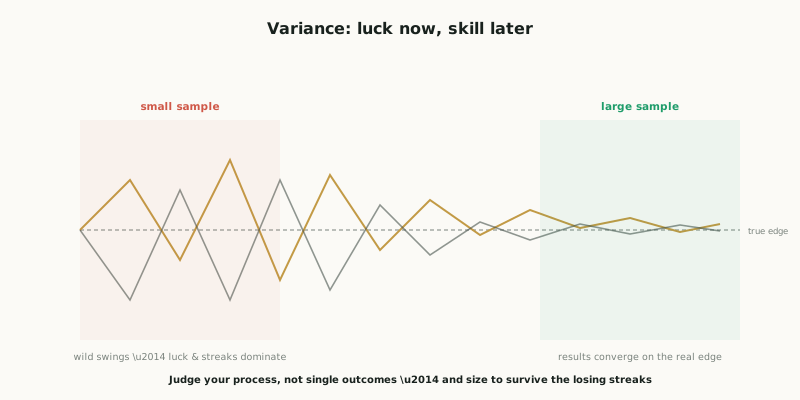
The central truth is the relationship between skill and luck over different time horizons. In the short run, luck dominates: trading outcomes are probabilistic (each trade has a distribution of possible results), so over a few trades, chance — not skill — determines what happens. Over a large sample, by contrast, skill (your edge, your expectancy) dominates and shows through the noise. The practical consequences are stark and humbling: a good trader with a real edge can lose over a small sample (simple bad luck), and a bad trader with no edge can win over a small sample (good luck) — so short-term results are a poor guide to skill. You cannot tell, from a few trades or even a few weeks, whether someone (including yourself) is genuinely skilled or merely fortunate. This is why the loud "I made 80% this month" claims prove almost nothing, and why honest evaluation demands patience.
The key concept is sample size: you need many trades to distinguish a genuine edge from random noise. A handful of wins or losses tells you almost nothing about your system's true expectancy — the results are dominated by variance. Only as the sample grows large do the random swings average out and the underlying edge (or lack of it) become reliably visible. This connects directly to streaks: winning and losing streaks are entirely normal and expected, even with a fixed, genuine edge — random sequences naturally produce runs (flip a fair coin and you'll see streaks of heads and tails). So a losing streak does not mean your edge is gone, and a winning streak does not mean you've become a genius; both are usually just variance doing what variance does. Recognising streaks as normal noise, rather than as signals, is essential to not being whipsawed by them.
Outcome versus process
Because of variance, a profound principle follows: a good decision can lose and a bad decision can win on any individual trade. A perfectly-reasoned trade that followed your edge and your rules can still hit its stop (bad luck), while a reckless, rule-breaking gamble can happen to pay off (good luck). This means you must judge your decisions and process, not individual outcomes — avoiding what psychologists call outcome bias (or "resulting"): evaluating the quality of a decision by how it turned out. In a probabilistic game, judging by outcomes rewards luck and punishes good process, which is exactly backwards. A good trade is one that followed your edge with sound process and risk management, regardless of whether it won; a bad trade is one that broke your process, even if it won (the winning rule-break is the most dangerous, because it reinforces terrible habits). Over a large sample, good process produces good results — so focusing on process, and accepting that any single outcome is partly luck, is both psychologically healthier and the path to long-run success.
The real harm of variance comes from misreading it, in either direction. Mistaking a normal losing streak for a broken system, traders often abandon a perfectly good approach after a run of bad luck — quitting right before variance would have reverted — or, worse, start tinkering and second-guessing a sound method. Mistaking a lucky winning streak for genuine genius, traders become overconfident and over-risk, betting bigger just as variance is about to turn — a classic route to giving it all back and more. And the most dangerous reaction of all: trying to "recover" variance-driven losses through revenge trading — chasing losses with bigger, impulsive, rule-breaking trades, which compounds the damage. Each of these is a case of treating noise as signal — reading meaning into randomness — and each can be costly or even account-ending. Losing streaks are genuinely hard to sit through, but the response that protects you is to keep thinking in probabilities and samples, stick to your tested process, and never let a streak — good or bad — distort your risk or your discipline.
So how do you live with variance? Think in probabilities and large samples, not single trades or short streaks. Focus on process (good decisions) over outcomes. Use proper position sizing and risk management so that the inevitable losing streaks can't ruin you — variance is only survivable if you're sized to survive it (the heart of risk of ruin): even a great edge will bankrupt you if you risk too much and a normal losing streak wipes you out before the edge can express. Keep records (a journal, R-multiples, your equity curve) so you can judge your trading over a meaningful sample rather than by feel. And cultivate the emotional discipline to accept variance — which is also a matter of wellbeing: losing streaks are stressful, and being kind to yourself (recognising that variance, not failure, drives much of the short-term pain), keeping perspective, and not chasing losses or spiralling into self-criticism all help you trade and cope in a healthier, steadier way. If the emotional toll becomes heavy, stepping back and seeking support is sensible. The honest framing: variance (luck) dominates short-term trading results — winning and losing streaks are normal noise even with a real edge, and short-term results poorly reflect skill; only over large samples does skill/expectancy show through. So judge your process, not individual outcomes (a good trade can lose), require a big sample to evaluate anything, and size to survive the inevitable losing streaks. The danger is misreading variance — quitting a good system after bad luck, over-risking after good luck, or revenge trading. You can't eliminate luck; you can only ensure you survive the bad runs and let skill express over time — thinking in probabilities, focusing on process, managing risk, and staying emotionally steady.
The probability mindset
The healthiest way to internalise variance is to adopt the mindset of a professional in any game of skill mixed with chance — poker being the classic comparison. A skilled poker player can play a hand perfectly and still lose it; they can play badly and win. They know this, and so they don't judge themselves by the result of any single hand — they judge by whether they made good decisions with the information available, and they trust that good decisions, repeated over thousands of hands, will win despite the inevitable bad beats. They think in terms of expected value and the long game, treating each hand as one of a very large number of repetitions rather than a standalone event to win or lose. Trading rewards exactly this mindset: each trade is one repetition in a long series, its individual outcome heavily influenced by luck, but the aggregate determined by the quality and consistency of your decisions.
Adopting this perspective has practical and emotional benefits. It detaches your ego from individual outcomes — a losing trade that followed your process isn't a failure or a verdict on your ability; it's just one realisation of a probabilistic process, fully expected to happen a certain fraction of the time. This detachment is liberating and stabilising: it removes the emotional charge that drives the destructive reactions (revenge trading, abandoning good systems, over-confidence) and lets you keep executing calmly through the noise. It also reframes the goal: success isn't winning every trade (impossible) or even having a great week (largely luck), but playing your edge well, consistently, over a large enough sample for skill to express — while managing risk so the variance can never take you out before it does. There's a wellbeing dimension here too: holding this perspective makes the inevitable rough patches far less personally painful, because you understand them as variance rather than as evidence of your inadequacy. Trading is hard enough without flogging yourself for outcomes that were never fully in your control. The professional's serenity in the face of a losing run isn't indifference — it's a deep understanding that, having made good decisions and managed risk, the rest is variance, and variance, given time and survival, favours the skilled. Cultivate that understanding, and you'll both trade better and suffer less.
Variance (luck) dominates short-term trading results — outcomes are probabilistic, so winning and losing streaks are normal noise even with a real, unchanged edge. Only over a large sample does skill (expectancy) show through, so short-term results poorly reflect skill (a good trader can lose, a bad one can win, over a few trades). Judge your process and decisions, not single outcomes (outcome bias): a good trade follows your edge and risk rules whether or not it wins; a winning rule-break is still a bad trade. The danger is misreading variance — abandoning a good system after a normal losing streak, over-risking after a lucky run, or revenge trading to "recover" losses. Survive it by thinking in probabilities and samples, focusing on process, and sizing to withstand losing streaks (risk of ruin). Losing streaks are hard — keep perspective, don't chase losses, and seek support if the toll is heavy. You can't remove luck; just survive the bad runs and let skill express.