Your equity curve is the most honest report card you have — the running line of your account balance that quietly records the cumulative result of every decision you've made. It doesn't care about the one trade you're proud of or the one you'd rather forget; it simply shows where your account has actually gone. Learn to read its shape — its trend, its drawdowns, its smoothness — and it becomes a powerful diagnostic of whether your trading is genuinely working, or whether something has changed. This guide explains equity curve analysis: what the curve shows, how to read it as a diagnostic, and the more advanced (and contested) idea of equity-curve trading.
It's the visual companion to the math of drawdowns, best measured in R-multiples, and must be read with an understanding of variance.
Key takeaways
Q: What is an equity curve?
A: An equity curve is the graph of your account balance (equity) over time or over a sequence of trades — the running, cumulative total of your wins and losses. It's a visual record of your trading results, and its shape reveals whether your account is growing, in drawdown, or treading water.
Q: How do you read an equity curve?
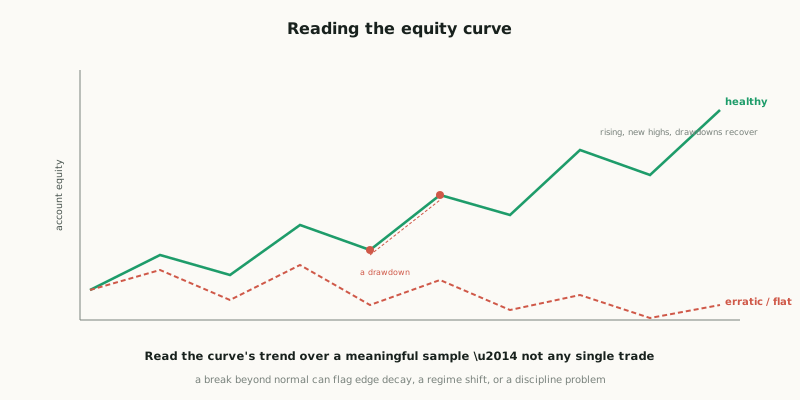
A: Look at the overall trend (rising, falling or flat), the drawdowns (depth and duration of dips from peaks), and the smoothness. A healthy curve rises over time with drawdowns that recover to new highs. An erratic or persistently declining curve, or a drawdown beyond historical norms, can signal high variance, edge decay, a regime change, or a discipline problem.
Q: What is equity-curve trading?
A: Equity-curve trading treats your own equity curve like a price chart — for example, reducing position size or pausing when the curve is in drawdown (or below its moving average) and increasing when it makes new highs. It can help limit drawdowns, but it's contested: because drawdowns often precede recoveries, it can cut your size right before a rebound. It's not a guaranteed improvement.
What the curve shows
The equity curve is the graph of your account equity over time (or over a sequence of trades) — the cumulative running total of all your wins and losses. It's a simple but profound picture: every point is where your account stood at that moment, and the line traces the trajectory of your results. The shape tells the story. A line rising over time means you're making money (positive expectancy being realised); a line falling means you're in drawdown (losing); a line going sideways means you're treading water (churning without progress). Where individual trades are noisy and easy to over-interpret, the equity curve aggregates them into the only thing that ultimately matters — the overall trajectory of your account — which is why it's such a valuable lens.
Reading it as a diagnostic
The equity curve is best used as a diagnostic and feedback tool, read over a meaningful sample rather than trade-by-trade. A healthy curve rises over time, with drawdowns that recover and the curve going on to make new equity highs — a steady upward slope is the signature of a working, positive-expectancy approach. Several features carry information. Drawdowns (the dips from a peak to a trough) are normal and inevitable — every system has them — but their depth and duration matter: a drawdown within your system's historical/expected range is just variance, while one beyond anything you've seen before is a warning worth investigating. Smoothness is telling too: a relatively smooth, steady climb suggests consistency, whereas a wildly erratic curve suggests high variance, inconsistency, or possibly over-risking. And the curve's current state — making new highs versus stuck in an extended drawdown — prompts the key question: is this normal variance, or has something genuinely changed (edge decay, a market regime shift, or a slip in your own discipline)? The curve doesn't answer that alone, but it flags when to ask.
Used this way, the equity curve provides two great benefits. First, perspective: it reminds you that a single trade — win or loss — barely registers on the curve, and that what matters is the trend over many trades. This is steadying; it pulls your attention away from individual outcomes (which are dominated by variance) and toward the bigger picture. Second, early warning: when the curve breaks down beyond its normal behaviour — a deeper or longer drawdown than your system has ever produced, or a clear regime change in its character — it can be the first sign that your edge has decayed, the market has changed, or your execution has deteriorated, prompting you to review (your journal being the place to investigate why). The curve reflects the health of your trading over time, in a way no single trade can.
Equity-curve trading, and the honest caveats
A more advanced and contested idea is equity-curve trading: treating your own equity curve like a price chart and adjusting your trading based on its state. For example, reducing position size or pausing when your equity curve is in drawdown (or has dropped below its own moving average), and increasing size when it's making new highs. The intuition is appealing: trade more aggressively when your system seems "in sync" with the market (winning) and pull back when it's "out of sync" (losing), to dampen drawdowns. It can, in some cases, help limit the depth of drawdowns. But the caveat is significant and must be stated honestly: because drawdowns typically precede recoveries, equity-curve trading can cause you to cut your size right before the rebound — reducing risk at the bottom and increasing it at the top, the opposite of what you'd want if the drawdown was just variance about to revert. The evidence on whether it improves results is mixed, and it is emphatically not a free lunch; it changes the shape of your returns (often trading a smoother curve for lower total return) rather than conjuring extra edge. Approach it as an optional, debatable refinement, tested for your own system, not a reliable enhancement.
The overarching honest point is that the equity curve reflects your results; it doesn't create them. It's a mirror of your edge, your risk management and your discipline over time — invaluable for seeing how you're doing and for spotting when something's changed, but it can't make a losing approach win, and it must be read over a meaningful sample (a short stretch is just noise) and with an understanding of variance (so you don't mistake a normal drawdown for a broken system, or a lucky run for genius). The honest framing: the equity curve is the graph of your account over time — a vital diagnostic of whether your trading works. A healthy curve rises with recovering drawdowns and new highs; the depth/duration of drawdowns and the smoothness reveal variance and consistency; a break beyond normal can flag edge decay, a regime change, or a discipline problem (or simply variance). It gives perspective (the trend matters, not one trade) and early warning. "Equity-curve trading" (scaling by the curve's state) is a contested refinement that can limit drawdowns but may cut size before recoveries — not a free lunch. Use the curve as feedback and perspective, judged over a meaningful sample alongside your journal and an understanding of variance — not as a crystal ball, and remembering it reflects your results rather than creating them.
Comparing your curve to expectations
The equity curve becomes far more diagnostic when you have something to compare it against — a benchmark of what "normal" looks like for your system. This is where backtesting and an understanding of your system's statistics pay off: from testing (and from your own track record), you can establish the expected behaviour of your equity curve — roughly what slope to expect, and crucially, what range of drawdowns is normal (the typical depth and duration of the dips your system produces). Armed with that benchmark, reading your live curve becomes a matter of asking whether it's behaving within its expected range or outside it. A drawdown that's painful but within the historical norm is just variance — unpleasant, but no cause to abandon a sound system. A drawdown deeper or longer than anything your system has produced, by contrast, is a genuine signal that something may have changed and warrants investigation.
A more sophisticated version of this uses simulation: by running many randomised sequences of your system's trades (a Monte Carlo approach), you can map out the range of equity curves your edge could plausibly produce — the lucky paths, the unlucky paths, and the typical ones — and, importantly, the range of worst drawdowns you might realistically face. This is invaluable for two reasons. First, it braces you for the drawdowns to come: knowing in advance that even a good system can, by chance, produce a drawdown of a certain depth means you're far less likely to panic and abandon it when that drawdown arrives (many traders quit perfectly good systems in a drawdown that was entirely within the realm of normal variance, simply because they hadn't expected it). Second, it sharpens the warning signal: if your live results fall outside the range that simulation said was plausible, that's strong evidence the edge has genuinely changed — not just bad luck. The practical discipline, then, is to know your system's expected curve and drawdown range in advance, judge your live equity curve against that benchmark over a meaningful sample, treat in-range behaviour as normal (stay the course), and treat genuine out-of-range divergence as a prompt to review — using your journal to investigate whether it's edge decay, a regime change, or a slip in execution. The curve read against expectations is a far more reliable diagnostic than the curve read in isolation.
The equity curve is the graph of your account balance over time — the cumulative total of your wins and losses, and an honest diagnostic of whether your trading works. Read its shape over a meaningful sample: a healthy curve rises with drawdowns that recover to new highs; the depth/duration of drawdowns and the curve's smoothness reveal variance and consistency; a break beyond normal can flag edge decay, a regime shift, or a discipline slip (or just variance — investigate via your journal). It gives perspective (the trend matters, not one trade) and early warning. Equity-curve trading (scaling size by the curve's state) is contested — it can limit drawdowns but may cut size right before a recovery (drawdowns precede rebounds), so it's no free lunch. The curve reflects your results, it doesn't create them — use it as feedback, read over a sample, with an understanding of variance.