If you measure every trade by the dollars won or lost, you're comparing apples to oranges — a $500 win on a large position and a $500 win on a small one are wildly different achievements, yet they look identical in your account. Measure them in R instead — multiples of what you risked — and suddenly every trade speaks the same language, regardless of size. The R-multiple framework, popularised by trading psychologist Van Tharp, is one of the clearest, most practical ways to measure, compare and understand trading results. This guide explains R-multiples: what R is, how to express outcomes in R, the R-distribution, and expectancy in R.
It builds directly on expectancy and the risk-reward ratio, depends on consistent position sizing, and works hand-in-hand with the trading journal.
Key takeaways
Q: What is an R-multiple?
A: An R-multiple expresses a trade's outcome as a multiple of the initial risk (R) taken on that trade, where R is the amount risked from entry to stop-loss. A trade that makes twice what you risked is +2R; one that hits your stop for a full loss is –1R; a win of three times your risk is +3R. It normalises every result to how much you risked.
Q: What is expectancy in R?
A: Expectancy in R is the average R-multiple across all your trades — the mean of your R-distribution. An expectancy of +0.3R means that, on average, each trade makes 0.3 times what you risked. A positive expectancy in R, realised over many trades, is the goal; it measures your system's edge per unit of risk independent of position size.
Q: Why use R-multiples instead of dollars?
A: Because dollar amounts depend on position and account size, making trades hard to compare or aggregate. R-multiples normalise everything to risk taken, so a +2R trade is a +2R trade whether you risked ten dollars or a thousand. This lets you measure your system cleanly, build an R-distribution, and think and plan in consistent, size-independent terms.
What R is, and outcomes in R
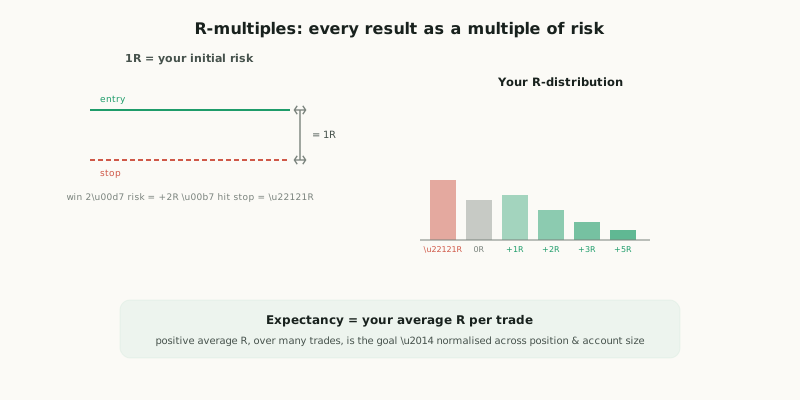
The foundation is R: the initial risk you take on a trade — the amount you stand to lose if the trade hits your stop-loss (the distance from entry to stop, in money or as a percentage of your account). That's your 1R for the trade. Every outcome is then expressed as a multiple of that R. The table shows how outcomes translate.
Trade outcomes in R
So if you risk a fixed amount (your R) on a trade and it hits your stop, that's a –1R loss; if it runs to a profit of twice your risk, that's a +2R win; cut early for half your risk, −0.5R; a runaway winner might be +5R or +10R. The crucial property is normalisation: because every result is measured relative to what you risked, R-multiples are independent of position size and account size. A +2R trade is a +2R trade whether you risked $10 or $1,000, on a $1,000 account or a $1,000,000 one. This is what makes R so powerful for measurement — it strips away the noise of varying position sizes and lets you compare and aggregate trades on a single, meaningful scale.
The R-distribution and expectancy
Once you record every trade's outcome in R, you can assemble your R-distribution — the full set of your trades' R-outcomes (so many –1R losses, so many +1R wins, a few +3R and +5R winners, and so on). This distribution describes your system's performance in a clean, complete way: its shape shows how your wins and losses are spread, where your results cluster, and — importantly — whether your profits come from many modest wins or a few large ones. Many robust systems, especially trend-following ones, have an R-distribution full of small –1R losses punctuated by occasional large-R winners (+5R, +10R) that pay for all the losers; seeing this in your R-distribution helps you understand how your edge actually works.
From the R-distribution comes the single most important number: expectancy in R — the average R-multiple across all your trades (the mean of the distribution). This is your expectancy, expressed in R units. An expectancy of +0.3R means that, on average, each trade makes 0.3 times what you risked; +0.5R means half your risk per trade on average; a negative expectancy means you lose, on average, and the system is unprofitable however appealing it seems. Expectancy in R is the cleanest measure of a system's edge per unit of risk, and a positive expectancy in R, realised over many trades, is the whole goal. It also lets you think about results in size-independent terms: "I made 15R this month" describes your trading performance regardless of how big you were trading, and "my expectancy is +0.4R" lets you reason about likely results over a sample (though always remembering variance — the average emerges only over many trades).
Using R-multiples in practice
Putting R to work is straightforward and disciplined. Define your R on every trade (your initial risk, ideally a consistent percentage of your account — the position-sizing link). Record each trade's outcome in R in your journal. Over time, build your R-distribution and compute your expectancy (average R). This gives you a clear, size-independent picture of whether your system has a genuine edge (positive expectancy in R?), how that edge is structured (the distribution — grind of small wins, or a few big winners?), and how much variance to expect (the spread of R-outcomes, including your worst losing runs — relevant to risk of ruin). Thinking in R also reinforces good habits: it encourages you to risk a consistent R per trade (so each trade is comparable and no single one can do outsized damage), and it shifts your focus from dollar swings to the quality and consistency of your edge.
The honest framing matters. R-multiples are a clarifying measurement framework, not an edge in themselves — they measure your performance with great clarity, but they don't create performance. You still need a genuine positive-expectancy method and the discipline to risk a consistent R and follow your rules; R just lets you see, cleanly, whether you have those things. It's also a tool that only works with a meaningful sample: a handful of trades' R-outcomes tells you little (variance dominates small samples), so expectancy in R is reliable only over many trades. The honest summary: R-multiples express every trade's outcome as a multiple of its initial risk (R), normalising results across position and account size; the R-distribution and the average R (expectancy in R) describe and evaluate a system cleanly, and thinking in R encourages consistent risk and clear, size-independent performance measurement. It's one of the most useful ways to track and understand your trading — a measurement and discipline tool, not a money-maker — best paired with a journal, consistent position sizing, a positive-expectancy method, and a large enough sample to trust the numbers.
Planning and sizing with R
Beyond measuring past results, thinking in R is a powerful tool for planning trades and managing risk going forward. Before entering, you can frame a prospective trade in R terms: where's my stop (defining 1R), and where's a realistic target — does this setup offer, say, a potential +2R or +3R if it works? This reframes trade selection around reward relative to risk (closely tied to the risk-reward ratio): a trade with a sensible chance of +3R for a –1R risk is structurally attractive, while one offering only +0.5R potential for a –1R risk needs a very high win rate to be worthwhile. Many traders set a minimum R-potential they'll accept on a trade, filtering out the low-reward setups that quietly erode expectancy. Thinking in R thus sharpens not just how you measure trades but which trades you take.
R also disciplines position sizing directly. Because 1R is your risk, sizing a position is simply a matter of choosing your R (say, 1% of your account) and then sizing the position so that the entry-to-stop distance equals that R — which automatically gives you a wider stop a smaller position, and a tighter stop a larger one, all for the same risk (the mechanics covered in position sizing). Keeping R constant across trades is what makes your R-multiples comparable and ensures no single trade can do outsized damage — a cornerstone of consistency. And R reframes your goals in a healthy, process-focused way: rather than fixating on dollar targets (which tempt over-risking), you can think in terms of "capturing the R my system offers over many trades." If your expectancy is, say, +0.4R and you take a certain number of trades, you can reason about the R you might accumulate — while always respecting that variance means the average only emerges over a large sample, and any stretch can deviate sharply. Used this way — to assess setups by their R-potential, to size consistently in R, and to frame goals in R rather than dollars — the R framework becomes not just a measurement tool but a complete, disciplined way of thinking about risk, selection and consistency, all anchored to the one thing fully in your control: how much you risk.
An R-multiple expresses a trade's outcome as a multiple of its initial risk (R = entry-to-stop risk). Hit your stop = –1R; win twice your risk = +2R; a big winner = +5R, etc. Because every result is relative to what you risked, R-multiples are independent of position and account size — a +2R trade is +2R whether you risked $10 or $1,000. Record outcomes in R to build your R-distribution (which shows how your edge is structured — e.g. small –1R losses paid for by occasional big winners), and compute expectancy in R (your average R per trade) — a positive average R over many trades is the goal. Thinking in R encourages consistent risk and clean performance measurement. But it measures performance, it doesn't create it — you still need a positive-expectancy method, consistent sizing, discipline, and a large sample. Pair it with your journal.