Once you've decided the market is going up, your mind quietly goes to work building the case for you — collecting every supporting signal, brushing aside every warning, and arranging the evidence into a tidy, reassuring story. Confirmation bias is how good analysis curdles into stubborn conviction, and how a losing trade gets held long past the point of reason. It's among the most pervasive and dangerous biases in trading, precisely because it operates invisibly: it doesn't feel like bias, it feels like being right. This guide explains confirmation bias: how it traps traders in both analysis and open positions, why it's so corrosive, and how to counter it.
It's one of the most important cognitive biases, closely tied to ego, and dangerously amplified by social media echo chambers.
Key takeaways
Q: What is confirmation bias in trading?
A: Confirmation bias is the tendency to seek, favour, interpret and remember information that confirms your existing beliefs or positions, while ignoring or discounting information that contradicts them. In trading, it leads you to build a one-sided case for your view and to dismiss warning signs once you're in a position.
Q: Why is confirmation bias dangerous for traders?
A: Because it destroys the objectivity trading demands. Once you hold a view or a position, you start interpreting all new information as confirming you're right — ignoring evidence the trade is wrong, staying in losers, and explaining away your stop's logic. It keeps you blind to the market telling you you've made a mistake.
Q: How do you overcome confirmation bias in trading?
A: Actively seek disconfirming evidence — ask 'what would prove me wrong?' and genuinely consider the opposite case. Define your invalidation point (your stop) before entering and respect it, use a trading plan and journal that record both your reasoning and the counter-evidence, hold your views loosely, and avoid echo chambers by diversifying your information sources.
How it traps traders
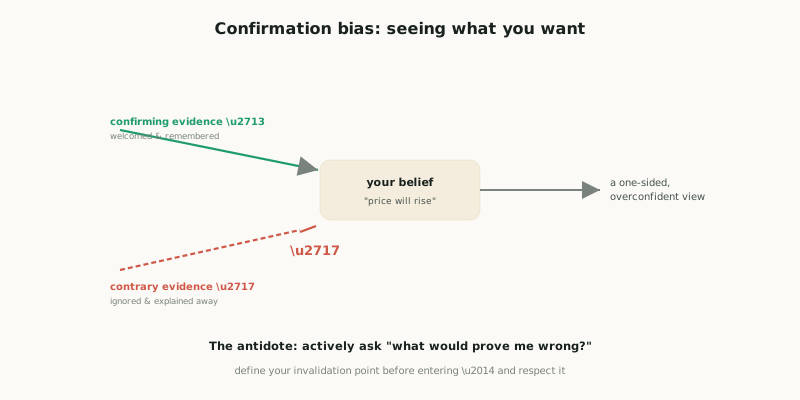
Confirmation bias is the tendency to seek, favour, interpret and remember information that confirms our existing beliefs or positions, while ignoring or discounting information that contradicts them. It's a universal feature of human cognition — we're far more comfortable with evidence that agrees with us than with evidence that doesn't — and in trading it strikes in two especially damaging places. The first is analysis. Once you form a view — say, "EUR/USD is going to rise" — you begin (often unconsciously) to seek out the indicators, chart patterns, news and opinions that support it, while dismissing those that don't. You see the bullish signals and overlook the bearish ones; you find the analyst who agrees and skip the one who doesn't. The result is a falsely confident, one-sided case — you've "confirmed" your view, but only by ignoring half the evidence. You see what you want to see on the chart.
The second, and more dangerous, place is open positions. Once you're in a trade, confirmation bias kicks into overdrive: you interpret incoming news and price action as confirming the trade is right, while explaining away the warning signs that it's wrong. A bad tick is "just noise"; a break of support is "a fakeout"; a piece of contrary news is "already priced in." This is how traders hold losers well past their stops — the part of their mind that should be objectively reassessing has been hijacked to defend the position instead. Confirmation bias here is tightly bound up with ego (not wanting to be wrong) and loss aversion (not wanting to feel the loss) — together they conspire to keep you in a bad trade, blind to the market's increasingly loud message that you've made a mistake. There's also a memory dimension: we remember the times our analysis worked and conveniently forget when it didn't, which feeds overconfidence over time. And modern echo chambers — following only the social-media accounts, forums and communities that share our view — supercharge the whole effect, surrounding us with agreement (the social-media link).
Countering it
The single most powerful antidote to confirmation bias is to deliberately invert it: actively seek disconfirming evidence. Instead of asking "what supports my view?" (which your biased mind does automatically), force yourself to ask "what would prove me wrong?" and "what's the strongest case against this trade?" If you're bullish, genuinely build the bear case — steelman the opposite view, look hard for the signals that contradict you, seek out the analyst who disagrees and take them seriously. This conscious effort to consider the other side counteracts the mind's automatic one-sidedness and restores some objectivity. A concrete, mechanical version of this is to define your invalidation point before you enter: decide, in advance, exactly what price or condition would prove your trade wrong (which is, in effect, your stop-loss), and commit to respecting it. Because the "I'm wrong if X happens" rule is set before confirmation bias takes hold, it's much harder for your in-trade self to explain X away when it arrives.
Beyond seeking disconfirmation, several structured habits help. A trading plan and checklist impose objective criteria that resist in-the-moment rationalisation. A trading journal (the journal link) is especially valuable: recording your reasoning and the counter-evidence at the time, then reviewing trades objectively later, exposes where confirmation bias led you astray and builds the habit of two-sided thinking. Holding your views loosely — cultivating the humility to be wrong, and detaching your ego from your positions (the ego and overconfidence links) — makes it psychologically easier to accept disconfirming evidence rather than fight it. And diversifying your information sources, deliberately exposing yourself to views that differ from your own, breaks the echo chamber. The honest framing: confirmation bias (seeking and favouring information that confirms your beliefs, while ignoring what contradicts them) traps traders in both analysis (building a one-sided, overconfident case — seeing what you want on the chart) and open trades (interpreting everything as confirming you're right, ignoring warning signs, holding losers). It's the enemy of the objectivity trading demands, tied to ego and loss aversion and amplified by echo chambers. It can't be eliminated — it's universal — only countered with deliberate, structured habits of objectivity: actively seeking disconfirming evidence ("what would prove me wrong?"), defining and respecting your invalidation point in advance, using a plan and journal, holding views loosely, and diversifying your sources. The trader who can genuinely entertain the case against their own position holds a rare and valuable edge.
Confirmation bias in action
Seeing the bias play out in concrete scenarios makes it easier to catch in yourself. Consider the bullish trader who has decided a pair is heading higher. They scan the chart and notice the higher low, the bullish indicator crossover, and the optimistic news headline — while their eye slides right past the lower high forming overhead, the bearish divergence, and the resistance level just above. They visit the forum and gravitate to the threads agreeing with them, dismissing the bears as "permabears who don't get it." By the time they enter, they feel certain — but that certainty was manufactured by filtering, not earned by balanced analysis. Now consider the same trader once the position is losing. Price drifts against them, and each piece of bad news becomes "noise" or "a shakeout before the real move"; the break of support is "a stop hunt"; the rising losses are "a buying opportunity to add." Every signal the market sends that they're wrong is reinterpreted as confirmation they're right — and the trade is held far past any sensible exit. This is the "this time it's different" holder, and it's confirmation bias, ego and loss aversion working in lethal concert.
A powerful practical technique for countering this is the pre-mortem: before entering, imagine it's some weeks later and the trade has failed, then ask, "What went wrong? What did I miss?" Forcing yourself to construct the failure story in advance — while you're still objective and not yet emotionally committed — surfaces the disconfirming evidence and the risks that confirmation bias would otherwise hide, and naturally defines your invalidation point. Pair this with a simple rule: for any trade, explicitly write down both the bull case and the bear case, and the specific condition that would prove you wrong. Another guard is to seek out a genuine devil's advocate — a trading partner, a journal prompt, or simply the discipline to argue the other side convincingly to yourself — so that some voice is always testing your conviction rather than echoing it. None of these eliminate the bias (nothing does), but they build the habit of two-sided thinking that confirmation bias erodes. The trader who routinely asks "what would prove me wrong, and have I honestly looked for it?" — before entering and while holding — trades with a clarity that one-sided conviction can never match. In a game where the market is constantly offering information, the ability to hear the parts you don't want to hear is a genuine and rare edge.
Confirmation bias is the tendency to seek, favour and remember evidence that confirms your beliefs while ignoring what contradicts them. In trading it traps you twice: in analysis (building a one-sided, overconfident case — seeing only the signals that support your view) and in open positions (interpreting all news/price action as confirming you're right, explaining away warning signs, holding losers). It's the enemy of objectivity, entwined with ego and loss aversion, and amplified by social-media echo chambers. Counter it deliberately: actively seek disconfirming evidence — ask "what would prove me wrong?" and build the opposite case; define your invalidation point (stop) before entering and respect it; use a plan and journal (record the counter-evidence); hold views loosely; and diversify your sources to escape echo chambers. It can't be eliminated, only countered with structured habits of objectivity — genuinely considering the case against your own position is a real edge.