The most expensive trades are often the ones taken after a string of losses — when frustration takes the wheel, the urge to "win it back" overrides judgement, and a bad day turns into a catastrophic one. Risk limits are the circuit breakers that prevent this: predefined lines you promise not to cross, that cap your losses and tell you when to stop. They protect your capital from disaster and, just as importantly, protect you from yourself in the moments when you're least able to think clearly. This guide explains setting risk limits: the types, why they matter, and how to set and — crucially — honour them.
They build on per-trade position sizing, are central to avoiding risk of ruin, and work alongside portfolio heat to cap total exposure.
Key takeaways
Q: What are risk limits in trading?
A: Risk limits are predefined rules that cap how much you can risk or lose and tell you when to stop trading. They include per-trade risk limits (a maximum percentage risked per trade), daily and weekly loss limits, maximum drawdown limits, and caps on total open risk. They act as circuit breakers protecting your capital and your decision-making.
Q: What is a daily loss limit?
A: A daily loss limit is a maximum amount you'll allow yourself to lose in a single day before stopping trading for that day — for example, halting if you're down 3% or three units of risk. It prevents a bad day from spiralling, since after several losses emotions run high and traders often revenge-trade into far bigger losses.
Q: Why do risk limits matter?
A: They protect your capital from catastrophic loss (survival) and protect you from yourself — especially the daily loss limit, which acts as a behavioural circuit breaker against the tilt and revenge trading that follow a losing run. Because they're predefined and mechanical, they work in the heat of the moment when emotions would otherwise override your judgement.
The types of risk limit
Risk limits operate at different levels, from the single trade up to the whole account. The table sets out the main ones.
Types of risk limit
| Limit | What it caps | Purpose |
|---|---|---|
| Per-trade limit | Max risk per trade (e.g. 1–2%) | No single trade can do major damage |
| Daily loss limit | Max loss in a day (e.g. 3%) | Stop the spiral; circuit-break tilt |
| Weekly/monthly limit | Max loss over a longer span | A larger circuit breaker |
| Max drawdown limit | Total drawdown (e.g. 20%) | Force a stop & full review |
| Max open risk / heat | Total simultaneous risk | Cap correlated/aggregate exposure |
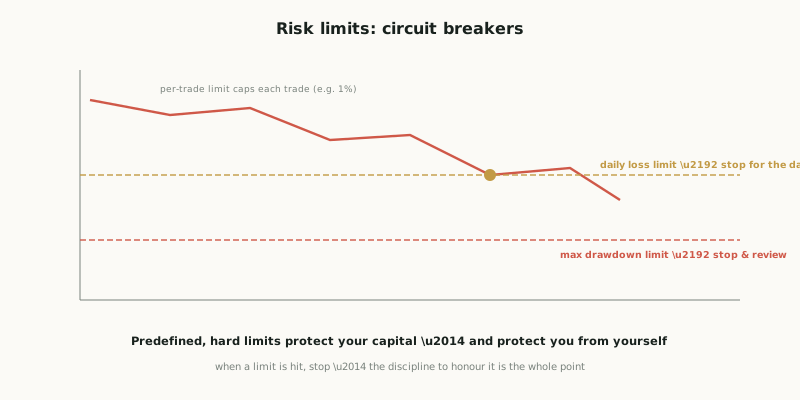
The per-trade risk limit is the foundation — a maximum percentage of your account risked on any single trade (commonly the 1–2% rule, from position sizing) — ensuring no one trade can do serious damage. The daily loss limit caps how much you'll lose in a single day before stopping (e.g. halt if down 3%, or three units of risk, on the day) — the key behavioural circuit breaker, discussed below. Weekly and monthly loss limits are larger circuit breakers over longer spans. The maximum drawdown limit sets a level of total account drawdown at which you stop to reassess (e.g. down 20% from your peak → stop and review) — a backstop that forces a hard pause when things have gone seriously wrong. And maximum open risk (or portfolio heat) caps your total simultaneous risk across all open positions, preventing too many correlated bets adding up to one outsized exposure (the correlation-risk link). Together, these limits cap risk at every level — the trade, the day, the week, the total account, and the aggregate exposure.
Why they matter — protecting capital and yourself
Risk limits serve two distinct, vital purposes. The first is protecting capital from catastrophic loss — the survival imperative. By capping losses at each level, they ensure that no single trade, no bad day, and no bad stretch can take out a fatal portion of your account; they keep you in the game (the essence of avoiding risk of ruin). The second, and often underrated, purpose is protecting you from yourself. This is where the daily loss limit shines: after a few losses in a row, emotions run high — frustration, the urge to recover, "tilt" — and traders frequently spiral into revenge trading, taking impulsive, oversized, rule-breaking trades to win it back, which usually deepens the hole dramatically. A hard, predefined daily loss limit is a circuit breaker that stops this spiral cold: hit the limit, and you're done for the day, walking away before the emotional state that produces the worst decisions can do its damage. The drawdown limit plays a similar role over a longer horizon, forcing a pause to reassess (is this normal variance, or has something genuinely changed?) rather than continuing to bleed. The crucial property is that risk limits are predefined and mechanical, so they work precisely when your emotions would otherwise override your judgement — the rule is set in advance, by your rational self, to bind your in-the-moment self.
Setting and honouring them
To use risk limits well, set them in advance — based on your risk tolerance, your system's normal behaviour, and your account size — with sensible, considered values (for example, a per-trade limit of 1%, a daily loss limit of 3%, a max-drawdown limit of 20%; the exact numbers are personal, but they should be deliberate, not arbitrary). Make them hard rules, not soft intentions — the entire point is that they bind when you're tempted to break them, so "I'll stop after losing 3%, unless I really feel like one more trade" defeats the purpose. And then, the part that matters most: when a limit is hit, stop — walk away, close the platform, do something else — and do not override it. The discipline to honour your limits when every emotional impulse is screaming to keep going is the whole game (this is where the broader skill of trading discipline comes in); a limit you break in the heat of the moment is worse than no limit, because it teaches you that your rules are negotiable.
The honest framing: risk limits are predefined caps on risk and loss — per-trade (%), daily and weekly loss limits, a max-drawdown limit, and a cap on total open risk — that protect your capital from catastrophe and protect you from yourself (the daily loss limit halting the tilt/revenge spiral after a bad run). They force pauses to reassess and, being predefined and mechanical, work when emotions would override judgement. Set them in advance with deliberate values, make them hard, and — above all — honour them: the discipline to stop when a limit is hit is the entire point. They don't make you money; they keep you in the game and prevent small problems from becoming account-ending ones. Risk limits are essential survival infrastructure for any trader — simple to set, hard to honour, and worth every ounce of the discipline they demand.
Beyond loss limits: trade and behavioural rules
Loss limits cap how much you can lose, but a fuller risk framework also includes rules that govern your behaviour — the conditions under which you'll trade at all — because much of trading risk comes not from the market but from when and how you choose to engage with it. Several behavioural limits are worth considering. A maximum number of trades per day caps overtrading — the tendency to keep taking marginal setups out of boredom or eagerness, which racks up costs and exposes you to more variance than your edge warrants. A "stop after N consecutive losses" rule complements the daily loss limit, recognising that a losing streak often coincides with deteriorating focus or being out of sync with the market — stepping back after, say, three losses in a row can break the cycle before it becomes a spiral. Rules around not trading in certain conditions are equally valuable: avoiding trading around major scheduled news releases (where volatility and slippage can be brutal) unless that's your deliberate strategy, or simply not trading when you're tired, stressed, ill or emotional — states in which judgement and discipline reliably degrade.
There are also position and exposure rules beyond raw loss limits: a cap on the number of simultaneous positions (too many at once is hard to manage and often means correlated, overlapping risk), and limits on exposure to a single currency across positions (the correlation-risk point — three "different" trades that are all really bets on the dollar are one big dollar bet). The common thread across all these rules is that they pre-commit you, in a calm moment, to sensible behaviour — so that your in-the-moment self, subject to boredom, frustration, excitement or fatigue, is constrained by the better judgement of your rational self. The most effective approach is to build these rules into a defined trading routine and a checklist: a pre-trade checklist (is this a valid setup? is my risk within limits? am I in a fit state to trade?) and clear session rules (when I trade, when I stop, what conditions I avoid). Written down and honoured, this framework turns good risk practice from a matter of in-the-moment willpower — which is unreliable precisely when you need it most — into a set of standing commitments. Combined with the loss limits and underpinned by genuine discipline, these behavioural rules round out a risk framework that protects you not just from large losses, but from the everyday lapses of judgement that quietly erode accounts.
Risk limits are predefined caps that tell you when to stop: a per-trade limit (max % per trade, e.g. 1–2% — no single trade does major damage), a daily loss limit (stop for the day if down, say, 3% — the key circuit breaker against tilt/revenge trading after a bad run), weekly/monthly limits, a max-drawdown limit (e.g. down 20% → stop and review), and a cap on total open risk (portfolio heat). They do two things: protect your capital from catastrophe (survival, avoiding risk of ruin) and protect you from yourself — working mechanically when emotions would override judgement. Set them in advance with deliberate values, make them hard, and honour them — when a limit is hit, stop and walk away; the discipline to do so is the whole point. They don't make money; they keep you in the game.