
When interest rates have been cut to near zero and the economy still needs support, central banks reach for an unconventional tool: quantitative easing (QE) — creating new money to buy financial assets on a massive scale. QE reshapes the monetary landscape, and for currency traders it is among the most powerful forces of all, because expanding (or contracting) the money supply directly affects a currency's value. This guide explains what QE is, how it works, why it tends to weaken a currency, what its reverse (quantitative tightening) does, and why both matter for forex — building on the central-bank and interest-rate material at the heart of fundamental analysis.
It extends central banks and monetary policy and interest rates, and connects to inflation (which QE can stoke).
Key takeaways
Q: What is quantitative easing?
A: Quantitative easing (QE) is an unconventional monetary policy in which a central bank creates new money to buy financial assets — mainly government bonds — injecting liquidity, lowering long-term interest rates, and stimulating the economy when conventional rate cuts are exhausted (rates near zero).
Q: How does quantitative easing affect a currency?
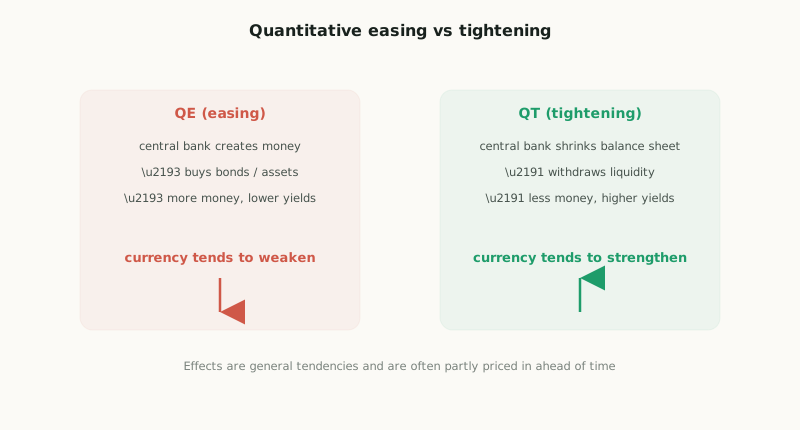
A: QE tends to weaken the currency. It increases the money supply (more of the currency in existence), lowers yields (making the currency less attractive to yield-seeking capital), and signals accommodative policy. These effects generally put downward pressure on the currency, though they are often partly priced in advance.
Q: What is quantitative tightening?
A: Quantitative tightening (QT) is the reverse of QE: the central bank reduces its balance sheet by letting bonds mature without reinvesting, or selling them, withdrawing liquidity from the system. It tends to support or strengthen the currency, raising yields and reducing the money supply.
What QE is and how it works
Quantitative easing is an unconventional monetary policy used when conventional policy — cutting interest rates — has been exhausted, with rates already at or near zero, yet the economy still needs stimulus. In QE, the central bank creates new money (electronically) and uses it to buy financial assets, primarily government bonds (and sometimes other assets), from the market on a large scale. This is the defining mechanism: new money is created and injected into the financial system through these asset purchases. QE is, in effect, a way to provide further monetary stimulus once interest rates can go no lower — the central bank's "next tool" at the zero bound.
The intended effects work through several channels. Buying bonds on a large scale pushes up their prices and pushes down their yields, lowering long-term interest rates across the economy (whereas conventional policy mainly affects short-term rates, QE targets longer-term ones). The new money increases liquidity and the money supply, aiming to encourage lending and spending. And by lowering yields on safe assets, QE pushes investors toward riskier, higher-returning assets, supporting asset prices and (in theory) wealth and confidence. The overall goal is to stimulate economic activity and stave off deflation when conventional tools are spent. QE was deployed massively by major central banks (the US Federal Reserve, Bank of England, European Central Bank, Bank of Japan) following the 2008 financial crisis and again in subsequent crises, making it a central feature of the modern monetary landscape rather than a rare curiosity. For the forex trader, the key is that QE represents a powerful loosening of monetary policy that expands the money supply — and that has direct currency implications.
Why QE tends to weaken a currency
QE generally puts downward pressure on a currency, for reasons that follow directly from how it works. First, QE increases the money supply — it creates more of the currency — and, all else equal, increasing the supply of something tends to lower its value (more units of the currency in existence can mean each is worth relatively less). Second, QE lowers yields: by pushing down interest rates and bond yields, it makes the currency less attractive to yield-seeking international capital (the interest-rate channel from the rates guide works in reverse — lower yields mean less incentive to hold the currency, reducing demand for it). Third, QE signals accommodative, dovish policy: a central bank resorting to QE is clearly in stimulus mode, which markets read as currency-negative, especially relative to economies tightening or with higher yields.
So the logic is consistent across channels: more currency in existence, lower yields reducing its appeal, and a clear signal of loose policy all point toward a weaker currency. This is why QE announcements and programmes are closely watched forex events, and why a central bank launching or expanding QE often sees its currency soften, particularly against currencies whose central banks are tightening (the policy divergence that the interest-rate and carry-trade material identifies as a major driver). That said — and consistent with the site's honest stance — the effect is a tendency, not a certainty, and is subject to important nuance. Markets are forward-looking and often price in expected QE before it happens (so the actual announcement may move the currency less than expected, or even the "wrong" way if the QE is smaller than anticipated — the "buy the rumour, sell the fact" dynamic). The currency's reaction also depends on the relative picture (QE matters most against what other central banks are doing) and on broader risk sentiment. So while QE's fundamental tendency is to weaken the currency — more money, lower yields, dovish signal — the actual market reaction must be read in the context of expectations and the relative policy landscape, as with all fundamental drivers.
Quantitative tightening
The reverse of QE is quantitative tightening (QT), and it has become equally important as central banks have moved to unwind the vast asset holdings accumulated through years of QE. In QT, the central bank reduces its balance sheet — either by letting the bonds it holds mature without reinvesting the proceeds (passive QT, the more common approach) or by actively selling them (active QT) — thereby withdrawing the liquidity that QE injected. Where QE created money and bought assets, QT removes money and sheds assets; it is monetary tightening through the balance sheet, complementing interest-rate rises in a tightening cycle.
QT's currency effects are, predictably, the opposite of QE's: it tends to support or strengthen the currency. By withdrawing liquidity, QT reduces the money supply (fewer units of the currency, supporting its value); by allowing yields to rise (less central-bank buying means higher yields), it makes the currency more attractive to yield-seeking capital; and it signals tighter, more hawkish policy, which markets read as currency-positive. The table below summarises the contrast.
QE versus QT
| Dimension | QE (easing) | QT (tightening) |
|---|---|---|
| Balance sheet | Expands (buys assets) | Shrinks (sheds assets) |
| Money supply | Increases | Decreases |
| Yields | Pushed down | Allowed to rise |
| Policy signal | Dovish / accommodative | Hawkish / restrictive |
| Currency tendency | Weaken | Strengthen |
The same nuances apply to QT as to QE — effects are tendencies, are often anticipated and priced in, and matter most in the relative, cross-central-bank context. But the symmetry is clear and useful: QE loosens and tends to weaken the currency; QT tightens and tends to strengthen it. Together, QE and QT represent the balance-sheet dimension of monetary policy, operating alongside interest-rate decisions, and a complete reading of a central bank's stance considers both — a bank cutting rates and doing QE is doubly dovish (strongly currency-negative), while one raising rates and doing QT is doubly hawkish (strongly currency-positive).
What it means for forex
For the forex trader, QE and QT matter because they are major drivers of a currency's value through the monetary-policy channel, and reading them is part of the fundamental analysis that underlies longer-term currency views (and the position-trading approach). The practical understanding is to treat QE/QT as a key component of a central bank's overall policy stance, alongside interest rates: a central bank's combination of rate direction and balance-sheet policy (QE or QT) together define how loose or tight its policy is, and therefore the fundamental pressure on its currency. When assessing a currency's fundamental backdrop, ask not only "which way are rates going?" but "is the central bank expanding (QE) or shrinking (QT) its balance sheet?" — both shape the currency's prospects.
The most powerful signals come from divergence between central banks, as throughout fundamental forex analysis. A currency whose central bank is easing (cutting rates, doing QE) is fundamentally pressured to weaken against a currency whose central bank is tightening (raising rates, doing QT) — the policy gap drives the pair, and such divergences underlie many of the major, sustained currency trends that position traders seek to ride. Major QE/QT announcements and shifts are also significant events (relevant to news trading), capable of causing sharp moves — though, as noted, much may be priced in by expectations, so the reaction depends on the surprise relative to what markets anticipated. The honest, balanced takeaway: QE and QT are powerful fundamental forces with clear tendencies (QE weakens, QT strengthens the currency, via money supply, yields and policy signalling), best understood as the balance-sheet side of monetary policy and read in the relative, cross-central-bank context, with awareness that markets are forward-looking and price in expectations. Understanding them deepens a trader's grasp of the monetary forces that drive currencies over the medium and long term, complementing the interest-rate, central-bank and inflation analysis that together form the fundamental picture.
QE in practice
It helps to ground these mechanics in how QE has actually played out, since it moved from a rare experiment to a mainstream tool within a generation. QE was deployed on a vast scale by the major central banks — the US Federal Reserve, Bank of England, European Central Bank and Bank of Japan — in response to the 2008 global financial crisis, when conventional rate cuts to near zero proved insufficient and the banks turned to large-scale asset purchases to stabilise the financial system and support recovery. It was used again, even more aggressively and rapidly, during the economic shock of the early 2020s, when central banks unleashed enormous QE programmes alongside emergency rate cuts. The Bank of Japan, notably, has been the most persistent user, maintaining ultra-loose policy and asset purchases for many years as it battled chronic low inflation.
These episodes illustrate the currency dynamics in action. Periods of aggressive QE generally coincided with downward pressure on the currency doing the easing, particularly relative to economies with tighter policy — the policy-divergence effect. And the unwinding of QE, as central banks later shifted to tightening and quantitative tightening, tended to support those currencies, again most clearly where it diverged from other central banks still easing. The episodes also underscored the nuances: markets anticipated and priced QE expectations well in advance, so currencies often moved on the expectation of QE (or its end) rather than only on the announcements themselves, and the relative picture between central banks mattered more than any one bank's actions in isolation. The broad lesson from QE in practice matches the theory: it is a powerful, now-routine policy tool whose currency effects (weakening on easing, strengthening on tightening) play out most clearly through divergence between central banks and are heavily shaped by market expectations — reinforcing why traders watch not just what central banks do with their balance sheets, but what they are expected to do relative to one another.
Quantitative easing (QE) is unconventional policy used at the zero bound: the central bank creates money to buy assets (mainly bonds), injecting liquidity, lowering long-term yields and stimulating the economy. It tends to weaken the currency — more money supply, lower yields (less attractive to capital), and a dovish signal. Quantitative tightening (QT) is the reverse — shrinking the balance sheet, withdrawing liquidity — and tends to strengthen the currency. Both are the balance-sheet dimension of monetary policy, working alongside interest rates; read a bank's full stance (rates + QE/QT) together. Deployed massively since 2008 and again in the early 2020s, QE's effects are tendencies, often priced in by forward-looking markets, and matter most in the relative cross-central-bank context — policy divergence drives major trends.