
When fear grips markets and risk assets tumble, money doesn't vanish — it runs somewhere safer. A handful of currencies are the traditional shelters investors flee to in a storm, strengthening just as riskier assets fall. Understanding which they are, and why they earn that status, gives you a powerful lens on risk sentiment itself — because how the havens are moving often tells you whether the market is fearful or greedy. This guide explains safe-haven currencies: which they are, why each qualifies, how they behave, and why haven status is relative rather than permanent.
They're the flip side of risk-on / risk-off, overlap with the reserve currencies concept, and interact with carry-trade dynamics.
Key takeaways
Q: What are safe-haven currencies?
A: Safe-haven currencies are those investors flock to during times of market stress, fear or crisis (risk-off), and which therefore tend to hold or gain value when risk assets fall. The main ones are the US dollar (USD), Japanese yen (JPY) and Swiss franc (CHF); gold is a classic non-currency safe haven. They tend to move inversely to risk sentiment.
Q: Why are the USD, JPY and CHF safe havens?
A: Each for its own reasons. The USD is the world reserve currency with the deepest, most liquid markets (US Treasuries), so crises spark a flight to dollar liquidity. The JPY benefits from Japan's creditor status and carry-trade unwinds (traders buy back yen they were short). The CHF reflects Switzerland's stability, neutrality, strong institutions and sound finances.
Q: Is safe-haven status permanent?
A: No — it's relative and can change. Haven status rests on perceptions of stability, liquidity and specific dynamics that can shift over time. Central banks can also intervene against an overly strong haven (Switzerland has acted to weaken the franc), and not every crisis behaves identically. Haven behaviour is a strong tendency, not an absolute law, so it should be confirmed with context.
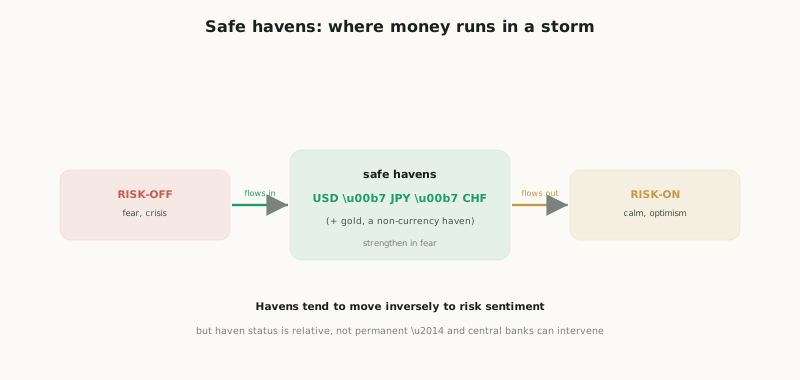
Which currencies, and why
Safe-haven currencies are those investors flock to during times of market stress, fear, uncertainty or crisis (so-called risk-off periods) — and which therefore tend to hold or gain value when risk assets are falling. The main ones, each qualifying for its own reasons, are shown below.
The main safe havens
The US dollar (USD) is the pre-eminent haven because it's the world's reserve currency, backed by the deepest and most liquid financial markets on earth — US Treasuries are the global "safe asset," and the dollar is the currency in which the world borrows, trades and holds reserves. In a crisis, demand for dollars and Treasuries surges in a "flight to safety and liquidity," often lifting the dollar even when the trouble originates in the US. The Japanese yen (JPY) earns haven status through Japan's position as a large net creditor nation (with vast foreign assets) and, crucially, through carry-trade dynamics: because Japan has long had very low interest rates, the yen is a favourite funding currency for carry trades (traders borrow/sell yen to buy higher-yielding currencies). When fear strikes and those carry trades unwind, traders must buy back the yen they were short, mechanically pushing it up — a powerful risk-off driver. The Swiss franc (CHF) reflects Switzerland's long-standing stability, political neutrality, strong institutions, low debt and sound monetary tradition — a classic store of value in uncertain times. And gold, while not a currency, is the archetypal non-currency safe haven, valued for millennia precisely as a store of value when confidence in other assets wavers.
How they behave — and the caveats
The defining behaviour of safe havens is their inverse relationship to risk sentiment. In risk-off conditions — fear, crises, market crashes, geopolitical shocks — capital flows into the havens and they strengthen. In risk-on conditions — calm, optimism, growth — capital flows out of them toward higher-yielding and riskier assets, and the havens tend to weaken. This makes the safe havens a barometer of, and a way to trade, market sentiment: a sharp rally in the yen and franc alongside falling stocks is a hallmark of risk-off, while the reverse signals risk appetite. For forex traders, this is how risk sentiment is often expressed — buying havens (or pairs like USD/JPY, USD/CHF in particular directions) to position for fear, or selling them for calm.
The honest caveats matter, because haven behaviour is a tendency, not a law. First, haven status is relative and not permanent: it rests on perceptions of stability, liquidity and the specific dynamics described above — perceptions and dynamics that can shift over time (the dollar's status depends partly on the global system's continued reliance on it; the yen's on carry dynamics; the franc's on Switzerland's standing). Second, central banks can intervene against their own currency when haven demand pushes it uncomfortably high — Switzerland, for instance, has acted forcefully to weaken an over-strong franc (the dramatic 2015 removal of its EUR/CHF floor being a famous example), and Japan has intervened in the yen (see currency intervention). Third, not every crisis behaves identically — a crisis centred on the US itself, or one with unusual features, may see the havens behave differently than the textbook suggests. So treat the safe-haven framework as a strong and useful tendency for reading and trading risk sentiment, confirmed by the actual context, rather than a guarantee that a given currency will always rise in any given panic. The honest framing: safe-haven currencies (mainly USD, JPY, CHF — plus gold as a non-currency haven) are those investors flock to in fear/crisis (risk-off), tending to hold or gain value when risk assets fall and to weaken in risk-on; each qualifies for its own reasons (USD reserve-currency liquidity, JPY creditor status and carry unwinds, CHF Swiss stability). They move inversely to risk sentiment, and are how traders often express risk-on/off. But haven status is relative and not permanent — it rests on shifting perceptions and dynamics, central banks can intervene against an over-strong haven, and not every crisis behaves identically. A valuable concept for reading risk sentiment — a tendency to confirm with context, not an absolute law.
Trading with safe havens
For traders, the safe-haven framework is primarily a way to read and express risk sentiment. Certain pairs are natural barometers and vehicles. USD/JPY and the yen crosses are especially sensitive: in risk-off, the yen typically strengthens (USD/JPY often falls, and yen crosses like AUD/JPY or NZD/JPY — pairing a risk-sensitive, higher-yielding currency against the haven yen — tend to drop sharply, making them popular "risk barometers"). USD/CHF and EUR/CHF reflect franc-haven demand. And in a broad flight to safety, the dollar itself often strengthens against most currencies as the world reaches for liquidity. A trader expecting or observing risk-off might therefore lean toward the havens (and against risk currencies); one positioning for calm or risk-on might do the reverse — always recognising they're trading sentiment, which can turn quickly.
Crucially, safe-haven signals are best confirmed across markets rather than read in isolation. Genuine risk-off usually shows up everywhere at once: equities falling, volatility gauges (like the VIX) spiking, government bonds rallying (yields falling), gold often rising, and the havens strengthening — a coherent, market-wide picture. When the havens move together with these other risk signals, the sentiment read is robust; when a haven moves alone for currency-specific reasons (a domestic data surprise, an intervention), it may not be a sentiment signal at all. This cross-market confirmation guards against misreading a currency-specific move as a risk event. It's also worth holding the earlier caveats in mind while trading: each haven has its own drivers that can override the sentiment story (the yen is buffeted by Japanese policy and intervention, the franc by the SNB, the dollar by US-specific factors), haven status is a tendency rather than a guarantee, and unusual crises can scramble the usual patterns. So use safe havens as a powerful lens for trading risk sentiment — via the sensitive pairs, confirmed by the broader risk picture, and with awareness of each currency's own dynamics and the possibility of intervention. The honest bottom line is the one running through all of fundamental analysis: this is a strong, useful tendency for reading the market's mood and positioning accordingly, not a mechanical rule — confirm it with context, and manage risk as always.
Havens are not risk-free
A final, important clarification: "safe haven" does not mean "safe" in the sense of guaranteed or risk-free. These currencies are relatively sought-after in stress, but they still move — sometimes violently — and can lose value, sometimes for reasons unrelated to global risk sentiment. The yen can weaken sharply on Japanese monetary policy even amid global calm; the franc can be deliberately driven down by the Swiss National Bank; the dollar can fall when the crisis is American in origin or when the Fed eases aggressively. Holding a haven is not a guarantee of safety, and trading one is not low-risk. The label describes a tendency to attract flows in fear, not an absence of risk. Likewise, the haven framework describes relative behaviour between currencies — it doesn't shield you from the ordinary volatility, leverage and execution risks of trading. So treat safe havens as a valuable way to read and position around risk sentiment, while applying exactly the same risk management, stops and position sizing you would to any trade. The "safe" in safe haven is comparative and conditional, never absolute — a nuance that protects you from the dangerous assumption that a haven position can't hurt you.
Safe-haven currencies are those money flees to in fear/crisis (risk-off), tending to hold or gain value when risk assets fall and to weaken in risk-on — so they move inversely to risk sentiment. The main ones: USD (reserve currency, deep liquid Treasuries, flight to liquidity), JPY (creditor status + carry-trade unwinds buying back yen), CHF (Swiss stability, neutrality, sound finances) — plus gold as the classic non-currency haven. They're how traders often express risk-on/off. But haven status is relative, not permanent — it rests on shifting perceptions and dynamics, central banks can intervene against an over-strong haven (e.g. the 2015 Swiss franc shock), and not every crisis behaves identically. Treat it as a strong tendency for reading risk sentiment, confirmed by context — not an absolute law.