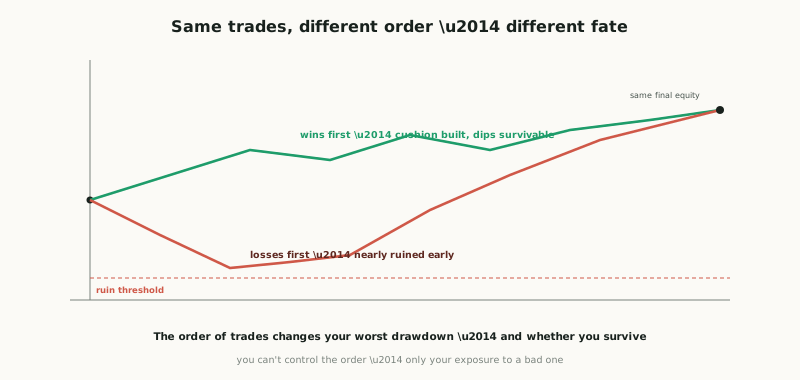
Two traders take the exact same set of trades and end at the exact same equity — yet one nearly blew up along the way while the other barely flinched. The only difference was the order in which the trades arrived. That's sequence risk: the often-overlooked truth that the path matters, not just the destination, and that the path can decide whether you survive at all. This guide explains sequence risk: what it is, why early losses are so dangerous, how it differs from general variance, and how to manage it.
It's the risk that Monte Carlo simulation exists to quantify, a direct driver of risk of ruin, and a deeper cut of the lesson in variance and luck.
Key takeaways
Q: What is sequence risk in trading?
A: Sequence risk (or sequence-of-returns risk) is the risk that the order in which your trades or returns occur affects your outcome — even with the same set of trades and the same overall edge. The same trades in a different order produce a different equity path and, crucially, a different maximum drawdown and risk of ruin. It's about path-dependence, not just the final result.
Q: Why are early losses especially dangerous?
A: Because a cluster of losses early — before your edge has built a cushion — can drive a deep drawdown that hits your risk of ruin and ends the account before the edge has a chance to play out. The same losses occurring later, after wins have built a buffer, might be easily survivable. With fixed-fractional sizing, early losses also shrink the capital base, compounding the damage.
Q: How do you manage sequence risk?
A: You can't control the order your trades arrive in — only your exposure to a bad one. So you size conservatively enough to survive the worst plausible sequence, not just the average. Monte Carlo simulation is the tool to estimate the range of drawdowns different orderings could produce, and keeping risk per trade small means you survive long enough for your edge to manifest over many trades.
Why order matters
Sequence risk (or sequence-of-returns risk) is the risk that the order in which your trades occur affects your outcome — even when the set of trades, and your overall edge, are identical. Take a fixed collection of wins and losses: rearranged into a different order, they produce a different equity path, and — critically — a different maximum drawdown and a different risk of ruin, even though the final tally is the same. The reason this matters so much is that survival is path-dependent. A cluster of losses early — a bad run right at the start, before your edge has built any cushion — can drive a deep drawdown that breaches your risk of ruin and ends the account before the edge ever gets to play out. The very same losses occurring later, after a run of wins had built a buffer, might be shrugged off as a routine dip. So the order alone can be the difference between a strategy that compounds for years and one that's dead in month two — with no change at all to its underlying quality. This path-dependence is amplified by fixed-fractional sizing (where early losses shrink the capital base you trade from, compounding the damage of a bad opening sequence) and sharpened further whenever capital is added or withdrawn at the wrong moment.
How it differs from variance, and how to manage it
Sequence risk is closely related to, but distinct from, the general role of variance and luck. Variance is about noise versus signal — the fact that short-term results are dominated by randomness, so you shouldn't over-read a good or bad patch. Sequence risk is specifically about order and path-dependence — the fact that the same results, simply reordered, change your drawdown and your odds of survival. One says "don't judge your edge by a small, noisy sample"; the other says "even with a real edge, the arrangement of your wins and losses can ruin you before the edge pays off." Both flow from randomness, but sequence risk zeroes in on the survival consequences of ordering.
The management principle follows directly from the nature of the problem: you cannot control the order in which your trades arrive — only your exposure to a bad one. So the defence is to size conservatively enough to survive the worst plausible sequence, not merely the average or the one your backtest happened to show. Monte Carlo simulation is the natural tool here: by reshuffling your trades into thousands of orderings, it reveals the range of drawdowns different sequences could produce — so you can set your risk per trade small enough that even the ugly orderings stay within survivable limits. Keeping risk per trade modest is the practical heart of it: small risk means even a punishing early losing streak only dents the account rather than ending it, buying you the time to let the edge manifest over a large number of trades (the law of large numbers needs you to still be trading to work). And it means never trusting a backtest's single, lucky-ordered drawdown as your worst case — the real one could be considerably deeper. The honest framing: sequence risk is the risk that the order of your trades affects your outcome — the same set of trades, reordered, produces a different equity path and, crucially, a different maximum drawdown and risk of ruin. A cluster of losses early can drive a deep drawdown that ruins you before your edge plays out, while the same losses later (after a cushion) might be survivable; fixed-fractional sizing compounds this, and ill-timed capital additions/withdrawals sharpen it. It's distinct from general variance/luck (noise vs signal) — sequence risk is specifically about order and path-dependence. The remedy: you can't control the order, only your exposure, so size conservatively enough to survive the worst plausible sequence; Monte Carlo estimates the range of drawdowns different orderings could produce, and small risk per trade keeps you alive long enough for the edge to manifest. Don't trust a backtest's single, lucky-ordered drawdown — the real one could be worse.
Sequence risk beyond trading
Sequence risk isn't unique to trading — recognising where else it appears sharpens the intuition for why it matters. Its most famous home is retirement planning, where it's called sequence-of-returns risk. Two retirees can experience the same average market return over their retirement, yet end up in completely different places: the one who hits a bad market early — while drawing down savings — can deplete their capital so far that even a strong subsequent recovery can't rebuild it, because there's less money left to recover, whereas the one who enjoys good early years builds a cushion that easily absorbs later downturns. Same average return, opposite outcomes, decided entirely by order. The parallel to trading is exact: in both cases, withdrawals or losses during an early drawdown do disproportionate, sometimes irreversible damage, because they shrink the base from which everything must subsequently compound. Anywhere returns compound and capital can be drawn down, the sequence — not just the average — governs survival.
That generalisation yields some durable, practical rules. Be most conservative when you're most vulnerable — which, for a trader, means early on, before any cushion exists, and after any drawdown that has reduced your capital: this is precisely when a bad sequence can be fatal, so it's when risk per trade should be at its most restrained. Let the cushion earn you room: as profits accumulate and build a buffer above your starting capital, you can afford slightly more latitude, because a losing sequence now eats into gains rather than threatening ruin (a measured version of scaling risk with success, never recklessly). Don't withdraw during a drawdown: pulling capital out while you're down compounds sequence risk exactly as it does for the unlucky retiree, locking in the damage at the worst time — if you must take income from trading, draw it from profits and ideally not in the depths of a losing run. And above all, respect the early period: the beginning of any trading account, or any strategy, is its most fragile phase, because there's been no time to build the buffer that makes later bad luck survivable. The unifying thread, in trading and in life, is that you survive on the worst sequence, not the average one — so build your sizing, your withdrawals and your expectations around the bad ordering you cannot rule out, rather than the comfortable one you hope for.
The bottom line
Strip sequence risk to its essence and it delivers one of the most important survival rules in trading. You will never get to choose the order in which your wins and losses arrive — that ordering is dealt to you by chance, and somewhere in the range of plausible orderings is a punishing early losing streak you cannot rule out. Since you can't control the sequence, you control the only thing you can: your exposure to a bad one. That makes small, consistent risk per trade the master key — not because it maximises returns (it doesn't), but because it ensures that no plausible ordering of your trades can end the account before your edge has the many trades it needs to work. A trader who internalises sequence risk stops asking "how much could I make if everything goes right?" and starts asking "would I survive if the worst plausible run hit me first?" — and sizes for the answer. Build for the bad order you can't rule out, and the good orders take care of themselves.
Sequence risk is the risk that the order of your trades changes your outcome — the same set of trades, reordered, produces a different equity path and, crucially, a different maximum drawdown and risk of ruin, even with an identical edge. Early losses are the danger: a bad run at the start, before a cushion exists, can drive a deep drawdown that ruins you before the edge plays out — the same losses later might be survivable. Fixed-fractional sizing compounds it; ill-timed deposits/withdrawals sharpen it. It's distinct from general variance (noise vs signal) — it's about order and path-dependence. You can't control the order, only your exposure: size to survive the worst plausible sequence (Monte Carlo estimates the range), keep risk per trade small so you survive long enough for the edge to work, and never trust a backtest's single, lucky-ordered drawdown as your worst case.