Your backtest shows one equity curve, climbing reassuringly with a drawdown you can point to and say "that's the worst it got." But that single curve is just the one path history happened to take — the particular order in which your trades occurred was partly luck. Monte Carlo simulation asks a sharper, more honest question: of all the ways your trades could have unfolded, how bad could it realistically have gotten? This guide explains Monte Carlo simulation in trading: how it works, why it beats relying on a single backtest, what it reveals, and its limitations.
It's the quantitative tool behind understanding risk of ruin, it confronts the sequence risk hidden in any backtest, and it embodies the lesson of variance and luck.
Key takeaways
Q: What is a Monte Carlo simulation in trading?
A: It's a technique that runs thousands of randomised simulations of how a strategy's results could unfold — typically by reshuffling or resampling its historical trades into many different orderings — to reveal the full range of possible outcomes rather than the single path that actually happened. It's especially used to estimate the range of maximum drawdowns and the risk of ruin a strategy could realistically produce.
Q: Why use Monte Carlo instead of a backtest?
A: Because a backtest shows only one realised equity curve, and the order in which those trades occurred was partly luck. A different ordering of the same trades could have produced a much deeper drawdown. Monte Carlo reshuffles the trades thousands of times to expose those worse (and better) sequences, so you discover the deeper drawdowns and ruin scenarios you didn't experience but could plausibly face.
Q: What are the limitations of Monte Carlo simulation?
A: It's garbage-in, garbage-out: results depend entirely on representative inputs, and it assumes the future resembles the past, so a small or unrepresentative trade sample, or a market regime change, makes it misleading. Simple reshuffling also assumes trades are independent, ignoring real-world streaks and regime effects, and it models the randomness of ordering — not fundamental strategy breakdown or true black swans beyond the data.
How it works
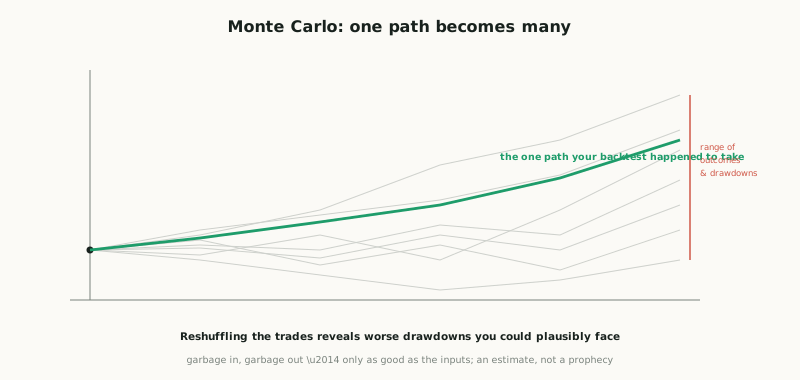
A Monte Carlo simulation runs many (typically thousands of) randomised simulations to map the range of outcomes a strategy might produce. In trading, the usual method is straightforward: take your strategy's trade results (the actual sequence of wins and losses, or its win rate and R-multiple distribution), then randomly reshuffle or resample them thousands of times to generate thousands of alternative equity-curve paths. Each path uses the same underlying trades (or trades drawn from the same distribution) but in a different order — and because order matters for the path (even when the final tally is identical), each produces a different journey, with different peaks, troughs and especially different drawdowns. You then analyse the distribution of all those outcomes.
What a Monte Carlo run reveals
Why it beats a single backtest, and its limits
The value is profound and often sobering. Your backtested equity curve is just one realised path, and the order of trades within it was partly chance — a different ordering of the very same trades could have clustered the losses early into a far deeper drawdown than the one you observed. Monte Carlo exposes exactly this: by reshuffling thousands of times, it reveals the range of drawdowns and the worse sequences you didn't happen to live through but could plausibly face — and the worst-case drawdown across the simulations is typically materially deeper than the single backtest's. This lets you set realistic expectations (the drawdown you should be prepared for, not just the one that happened), estimate your risk of ruin, and — crucially — size your positions conservatively enough to survive the bad sequences, not merely the lucky one your backtest showed. It directly stress-tests a strategy against the sequence and variance risk that a single historical run hides.
But it must be used with clear eyes about its limits. The first and biggest is garbage in, garbage out: the results depend entirely on the quality and representativeness of the inputs. If your trade sample is small, unrepresentative, or drawn from a market regime that won't persist, the simulation — however many thousands of paths it runs — will be confidently misleading; it fundamentally assumes the future resembles the input distribution. Second, simple reshuffling assumes trades are independent (no autocorrelation), whereas real trading often has streaks and regime effects (losses clustering in adverse conditions), which naive shuffling ignores — more sophisticated methods (block resampling, modelling correlations) address this, but the basic version overlooks it. Third, it models the randomness of ordering and sampling, not fundamental strategy breakdown, structural change, or true black swans beyond anything in your data. So Monte Carlo is a powerful tool for understanding the range of risk inherent in a strategy's known behaviour — an estimate, not a prophecy. The honest framing: Monte Carlo simulation runs thousands of randomised simulations (reshuffling/resampling your strategy's trades) to reveal the range of possible outcomes — final equity, and especially maximum drawdowns and risk of ruin — rather than relying on the single historical path that happened to occur. It's valuable because your backtest is just one realised sequence (the order was luck); Monte Carlo exposes the deeper drawdowns and worse sequences you could plausibly face, helping set realistic expectations and conservative position sizing and stress-testing against sequence/variance risk. But it's garbage-in-garbage-out (depends on representative inputs; assumes the future resembles the past), simple reshuffling assumes independence (ignoring real streaks/regime), and it models ordering randomness, not fundamental breakdown or black swans. Use it to prepare for worse-than-backtest outcomes — an estimate, not a crystal ball.
Putting Monte Carlo to work
In practice, running a Monte Carlo analysis on your own trading is more accessible than it sounds. The raw material is your trade log — ideally a meaningful sample of results (from a robust backtest or, better, real trading), recorded as a series of returns or R-multiples. Software (and many trading platforms or simple scripts) will then reshuffle or resample those results thousands of times and produce the distribution of outcomes. The outputs worth studying are less about the average (which roughly matches your backtest) and more about the extremes and percentiles: the distribution of maximum drawdowns (what's the 95th-percentile worst drawdown across all the simulated orderings?), the proportion of paths that hit a ruin threshold (your estimated risk of ruin), and the spread of final equity. The headline lesson is almost always the same and almost always sobering: the worst plausible drawdown is materially deeper than the one your single backtest happened to show.
That insight feeds directly into position sizing, which is the main practical payoff. By seeing the range of drawdowns different orderings could produce, you can choose a risk per trade small enough that even the ugly percentile outcomes stay within limits you could psychologically and financially survive — sizing for the bad sequence rather than the lucky one. You can also compare sizing schemes (running the simulation at 1% versus 2% risk per trade, say, to see how dramatically the drawdown and ruin figures worsen) and stress-test whether your plan survives a realistic run of bad luck. This connects naturally to sequence risk (which Monte Carlo is precisely the tool to quantify) and to risk of ruin (which it estimates empirically). A final discipline: pair Monte Carlo with proper out-of-sample and forward testing, because Monte Carlo can only reshuffle the trades you feed it — it cannot tell you whether your edge will persist, only how the edge you've measured might behave under different orderings. Used together — out-of-sample testing to validate the edge, Monte Carlo to understand its risk profile — they form a far more honest picture than a lone, lucky backtest curve. The honest reminder stands: it's an estimate built on your inputs and assumptions, not a guarantee, so treat its worst cases as a floor to prepare beyond, not a ceiling to trust.
Reading the output honestly
One final discipline guards against a subtle misuse: don't treat the simulation's percentiles as hard limits. When a run reports a 95th-percentile worst drawdown of, say, 28%, that is not a promise that your drawdown will never exceed 28% — it's the worst case among the orderings of the trades you supplied, under the assumptions you made. Reality can, and sometimes does, exceed any figure a backtest-based simulation produces, because the future can deliver conditions, correlations and losing trades that simply weren't in your sample. The 99th percentile is worse than the 95th, and the genuine tail — the true black swan — lies beyond even that, in territory the simulation never modelled. So the right posture is to use Monte Carlo's worst cases as a more realistic floor than your single backtest offered, then add a further margin of conservatism on top, rather than treating the simulated worst case as the worst that can happen. Read humbly and used to increase caution — not to license confidence — Monte Carlo is one of the most clarifying risk tools available; read as a precise forecast, it becomes just another source of false comfort.
Monte Carlo simulation runs thousands of randomised paths — reshuffling or resampling your strategy's trades — to reveal the range of outcomes, especially the distribution of maximum drawdowns and the risk of ruin, rather than trusting the single backtest curve. Its power: your backtest is one realised path and the trade order was partly luck — a different order could have meant a far deeper drawdown, which Monte Carlo exposes, so you set realistic expectations and size to survive the bad sequences, not the lucky one. Its limits: garbage in, garbage out (only as good as representative inputs; assumes the future resembles the past); simple reshuffling assumes trades are independent (ignoring real streaks/regime); and it models ordering randomness, not strategy breakdown or true black swans. A powerful tool for the range of risk — an estimate, not a prophecy.