
Traders obsess over entries — but it's the exit that turns a position into a profit or a loss. A take-profit target, decided in advance, is the other half of a trade plan from the stop-loss: it defines where you'll lock in a gain, replaces greed and fear at the exit with a plan, and lets you know your risk and reward before you ever click buy. Yet exits are where many traders are weakest, improvising under emotional pressure and either cutting winners short or giving profit back. This guide explains setting take-profit targets: why a planned exit matters, the main ways to set one, and the central tension between locking in a defined gain and letting profits run.
It's the counterpart to the stop-loss, defines half of your risk:reward ratio, and connects to scaling out of positions.
Key takeaways
Q: What is a take-profit target?
A: A take-profit is a predetermined price level at which you exit a winning trade to lock in profit — the counterpart to a stop-loss, which limits a loss. Setting it in advance defines where you'll take your gain, lets you calculate the risk:reward before entering, and removes emotion from the exit.
Q: How do you set a take-profit level?
A: Common methods include targeting the next significant support or resistance level, setting it as a multiple of your risk (an R-multiple, for a defined risk:reward), using a measured move or pattern/Fibonacci target, or trailing a stop instead of using a fixed target to let a trend run. The best method depends on the trade and your style.
Q: Should you use a fixed target or let profits run?
A: It's a trade-off. A fixed target locks in a defined risk:reward but caps gains — you may exit before a big move. Letting profits run (e.g., via a trailing stop) can capture large trends but risks giving back profit. Many traders compromise by taking partial profit at a target and letting the rest run.
Why a planned exit matters
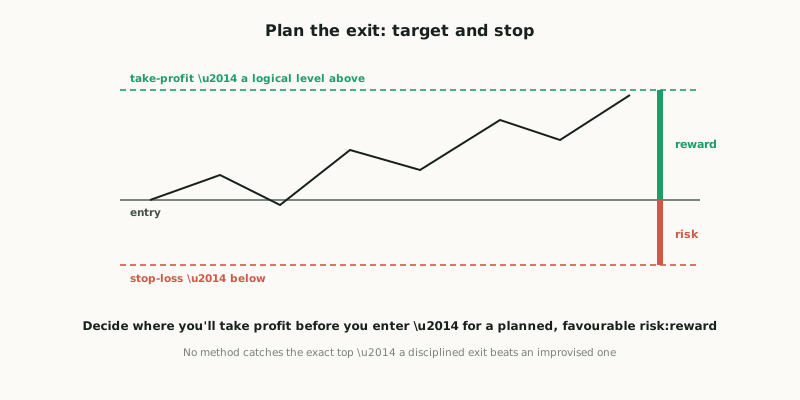
A take-profit is a predetermined level at which you exit a winning trade to lock in profit — the mirror image of a stop-loss (which exits a losing trade to cap the loss). Together, the stop and the target define a trade's complete plan: where you're wrong (the stop) and where you'll take your reward (the target). The reason a planned exit matters so much is that exiting is at least as hard, and as important, as entering — and without a plan, the exit is driven by emotion. Greed tempts you to hold a winner too long, hoping for more, only to watch the profit evaporate when price reverses. Fear tempts you to grab a small profit too early, terrified of giving it back, cutting winners short. Either way, improvised exits tend to be poor exits.
A defined take-profit target counters this in three ways. It imposes discipline: you decide the exit calmly, in advance, rather than in the heat of a live position. It lets you calculate risk:reward before entering: knowing your target (reward) and stop (risk), you can assess whether the trade offers a favourable ratio (e.g., risking 1 to make 2) and decline trades that don't — a cornerstone of sound trading (the risk-reward guide). And it removes emotion from the exit: with a plan in place, you're executing a decision made rationally, not reacting to fear and greed in the moment. This is why having some planned approach to exits — whether a fixed target, a trailing method, or a rule — is far better than improvising: the plan, not the impulse, governs the exit. As with stops, the discipline of deciding the exit in advance is what separates a controlled trade from an emotional one.
Ways to set a target
There are several established ways to set a take-profit target, suited to different trades and styles. The table summarises the main ones.
Common ways to set a target
The most common and intuitive is to target the next significant support or resistance level — a logical place where price may stall or reverse, so a sensible spot to bank profit (targeting just before a major resistance in a long, for instance). The risk:reward / R-multiple approach sets the target at a multiple of the risk (the stop distance): if your stop risks "1R," you might target "2R" or "3R" (twice or three times the risk), ensuring a favourable risk:reward by design — a discipline that keeps you in trades where the reward justifies the risk. Measured moves and pattern targets use chart structure: the projected target of a chart pattern (e.g., a pattern's height added to the breakout), or Fibonacci extension levels, give a technical objective. Volatility-based targets (e.g., a multiple of the ATR) scale the target to the instrument's recent range. And trailing replaces a fixed target altogether — rather than capping the gain at a set level, you trail a stop behind a running trade (the trailing-stops guide) to let winners run with no fixed ceiling.
These aren't mutually exclusive, and the "best" depends on the trade. For a range-bound market or a move into a clear level, a fixed target at support/resistance (or a sensible R-multiple) makes sense — you're capturing a defined move. For a trending market where you want to ride a large move, trailing (no fixed target) is often better — capping a trend at a fixed target would leave most of the move on the table. A common, sensible compromise is partial exits (scaling out): take some profit at a defined target (banking a sure gain) and let the rest run with a trailing stop (capturing more if the trend continues) — combining the certainty of a target with the upside of letting it run. The key is to choose a method that fits the trade and your style, and to set the target as part of the plan, before entering.
Run it or lock it: the tension
Underlying all target-setting is a fundamental tension: lock in a defined gain versus let profits run. A fixed target gives certainty and a planned risk:reward, and avoids the regret of giving profit back — but it caps your gain, so you'll sometimes exit just before a much larger move, leaving money on the table. Letting profits run (via trailing or no fixed cap) can capture those big moves — the trend trader's dream of a huge winner — but risks giving back accumulated profit when the move finally reverses, and means no trade has a guaranteed, defined reward. Neither approach is universally right; they're a genuine trade-off between certainty and defined risk:reward (fixed target) and capturing large moves (let it run).
How to navigate it depends on your strategy and temperament. Range and mean-reversion traders, capturing defined moves between levels, lean toward fixed targets. Trend-followers, aiming to ride large moves, lean toward trailing and letting winners run (often accepting more, smaller losers in exchange for occasional big winners — the trend-following profile). Many traders split the difference with partial exits, as above. The honest framing, consistent with this site's risk-first philosophy, is that the specific exit method matters less than having a planned, disciplined approach to exits at all — and accepting that no method captures the exact top or bottom. You will never consistently exit at the perfect price; chasing that is a recipe for the greed-and-fear improvisation a plan is meant to prevent. The goal is a good enough, planned exit executed with discipline — banking solid gains via a sensible method, accepting that some winners could have been bigger and some targets are reached only partway, and never letting the impossible quest for the perfect exit undermine a sound, rule-based one. A planned take-profit (in whatever form suits your style), set in advance and executed without emotion, is the mark of a disciplined trader; an improvised exit driven by greed or fear is the mark of an undisciplined one. As with everything in risk management, the plan is what protects you — here, from your own emotions at the moment of taking profit.
Common exit mistakes
Knowing the methods is one thing; avoiding the classic exit errors is another, and they're worth naming because they're so common and so costly. The first is moving the target out of greed: price approaches your planned take-profit, the trade is going well, and you're tempted to shift the target further away to capture "just a bit more" — only to watch price reverse and give back the gain you could have banked. Moving a target further mid-trade, on a whim, is usually greed overriding the plan, and it frequently turns a winner into a smaller winner or even a loser. (Trailing a stop is a disciplined way to let profits run; arbitrarily extending a fixed target in the heat of the moment is not.)
The opposite error is taking profit too early out of fear: nervous about giving back any gain, you grab a tiny profit far short of your planned target, cutting winners off at the knees — which, over many trades, starves your strategy of the larger wins it needs to offset losers (and wrecks your intended risk:reward). A third is having no exit plan at all, leaving the exit entirely to in-the-moment emotion — the very problem a planned target solves. A fourth is ignoring your stop while honouring your target (or vice versa) — letting a loser run past the stop hoping it comes back, while diligently cutting winners short, which inverts sound trading (it should be cut losers, let winners run, not the reverse). The common thread is emotion overriding the plan at the exit, in one direction or the other. The remedy is the discipline this guide has stressed throughout: set the stop and target as a plan before entering, then execute the plan — adjusting only by pre-defined rules (like trailing), not by in-the-moment greed or fear. A trader who consistently honours a sensible, pre-planned exit will outperform one who improvises, even with identical entries, because so much of trading success or failure is decided at the exit.
A take-profit target is a planned exit for a winning trade — the counterpart to a stop-loss. Deciding it in advance imposes discipline, lets you assess risk:reward before entering, and removes greed and fear from the exit. Main methods: target the next support/resistance, use an R-multiple (a multiple of your risk, for a defined risk:reward), use a measured move / Fibonacci or volatility (ATR) target, or trail a stop to let it run. Fixed targets suit range/defined moves; trailing suits trends; partial exits (scale out) blend both. The core tension: a fixed target gives certainty and defined risk:reward but caps gains; letting it run captures big moves but can give profit back. No method catches the exact top — aim for a good-enough, planned, disciplined exit, not a perfect one. Having a planned exit at all matters more than which method.