A fixed stop-loss protects you from a loss; a trailing stop protects your profit. By following a winning trade — moving in your favour as price advances, but never backward — it lets you ride a trend while ratcheting your accumulated gains into safety, automatically exiting when the move finally reverses. It's one of the most useful tools for letting winners run without giving everything back, the natural partner to letting profits run. The catch: set it too tight and you'll be shaken out of good trends; too wide and you give back too much. This guide explains trailing stops: how they work, break-even stops, the main trailing methods, and the central tight-versus-wide trade-off.
It builds on the stop-loss, is an alternative to a fixed take-profit target, and is a staple tool of trend-following.
Key takeaways
Q: What is a trailing stop?
A: A trailing stop is a stop-loss that moves in the direction of a profitable trade as price moves in your favour, but never moves backward. In a long position, it rises as price rises, staying a set distance below; if price falls back to it, you exit — locking in profit while letting the trade run as long as the trend continues.
Q: What is a break-even stop?
A: A break-even stop is when you move your stop-loss to your entry price once a trade is sufficiently in profit, so the trade can no longer lose money — effectively a 'free' trade. It's a common first step in protecting a position, sometimes used before or instead of a full trailing stop.
Q: Should a trailing stop be tight or wide?
A: It's a trade-off. A tight trail locks in more profit but is more easily hit by normal price noise, stopping you out early before a trend ends. A wide trail lets the trend breathe and keeps you in longer, but gives back more profit when price reverses. The right distance depends on the trade, timeframe and volatility.
What a trailing stop is
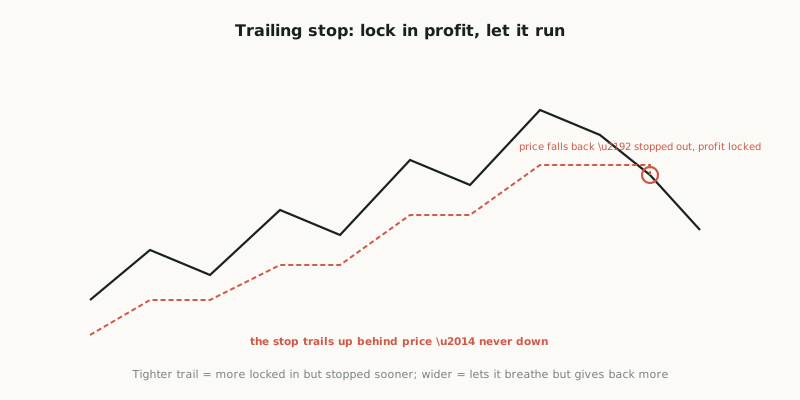
A trailing stop is a stop-loss that moves (trails) in the direction of a profitable trade as price moves in your favour — and, crucially, only in your favour, never backward. In a long position, the trailing stop rises as price rises, staying a set distance below the price; it ratchets up with each new high but never moves down, so if price subsequently falls back to the trailing stop, you're exited — having locked in the profit accumulated up to that point. (In a short, it's the mirror: the stop trails down as price falls.) The effect is that you stay in the trade as long as the trend continues in your favour, while your worst-case exit keeps improving (the locked-in profit keeps rising), and you're automatically taken out when the trend reverses enough to hit the trailing level.
This serves a clear purpose: it lets winners run while protecting profit. Unlike a fixed take-profit target (which caps your gain at a set level), a trailing stop imposes no ceiling — you can ride a large trend for as far as it goes — yet, unlike simply holding with no exit plan, it continuously protects the profit you've built, so a reversal takes you out with a gain rather than letting the profit fully evaporate. It's the tool that resolves the trend trader's dilemma: how to stay in a big move (not cap it with a fixed target) without risking giving the entire profit back. The trailing stop's ratcheting protection captures the trend while it lasts and banks the gains when it ends. A related, simpler technique is the break-even stop: once a trade is sufficiently in profit, you move your stop up to your entry price (break-even), so the trade can no longer lose money — a "free" trade. The break-even stop is often a first step in protecting a position (eliminating the risk of a winner turning into a loser) before or instead of a full trailing stop, and it embodies the same idea: progressively moving the stop in your favour to protect gains.
Methods of trailing
There are several ways to trail a stop, differing in what they follow. A fixed-distance trail keeps the stop a set number of pips (or a set percentage) behind the price — simple, but arbitrary, and blind to volatility. A volatility-based trail (commonly using the ATR) keeps the stop a multiple of the recent range behind price — adapting to the instrument's volatility, so it gives a volatile market more room and a calm one less (the volatility-based-sizing guide explains the ATR logic). A structure-based trail follows the market's own structure — for example, in an uptrend, moving the stop up to just below each successive higher low (swing low), so you're stopped out only if the trend's structure breaks; this is one of the more logical methods, since it ties the stop to the trend's actual behaviour. A moving-average trail keeps the stop below a chosen moving average, exiting if price closes through it. Of these, the structure-based and ATR-based methods are generally more sensible than an arbitrary fixed distance, because they adapt the trail to the market's real volatility and structure rather than an unrelated fixed number. Some platforms also offer automatic trailing-stop orders (trailing by a set distance), though manual trailing to structure is often preferred for its logic.
Whatever the method, the principle is the same: the stop only ever moves in the profitable direction, protecting more profit as the trade advances, and exits you when price retraces to it. The choice of method should suit the trade and timeframe — a structure-based trail on the relevant swing points, or an ATR-based trail scaled to volatility, tends to work better than a one-size-fits-all fixed distance.
The tight-versus-wide trade-off
The central decision with any trailing stop — and the source of most of the difficulty — is how tight or wide to trail, and it's a genuine trade-off.
A tight trail (close behind price) locks in more profit and gives back little when the trend ends — but it's easily hit by normal price noise, so you'll often be stopped out early, before the trend is really over (shaken out by an ordinary pullback, then watching the trend continue without you). A wide trail (further behind price) lets the trend breathe — you stay in through normal pullbacks and capture more of a long move — but you give back more profit when the trend finally does reverse (the stop is hit further from the peak). Tighter = more locked in but stopped sooner; wider = lets it run but gives back more. There's no perfect setting — it's an inherent trade-off between protecting profit and capturing the move.
This trade-off has practical consequences worth respecting. Trailing too tight is a common error: it can mean "death by a thousand cuts," repeatedly stopping you out of good trends prematurely on normal noise, so you never capture the big moves the trailing stop was meant to ride — defeating its purpose. Trailing too wide, conversely, can give back a large chunk of a hard-won profit when a strong trend reverses sharply. The right balance depends on the trade, timeframe and volatility: a longer-term trend trade needs a wider trail (room for big pullbacks within a large trend), while a shorter-term trade may use a tighter one; a volatile instrument needs more room than a calm one (which is exactly why volatility- and structure-based trails, which adapt to this, tend to outperform arbitrary fixed distances). The honest framing: trailing stops are an excellent tool for letting winners run while protecting profit — ideal for trend-following — but the tight-versus-wide trade-off is real and unavoidable, and the most common mistake is trailing too tight and being shaken out of the very trends you wanted to ride. Set the trail to the trade's structure and volatility, give a genuine trend enough room to breathe, accept that you'll give back some profit at the reversal (you can't exit at the exact top), and use the trailing stop to do what it does best: keep you in a winning trend with your gains protected, until the trend truly ends. Like every risk tool, it's about disciplined, sensible application — not a perfect setting that doesn't exist.
When to use a trailing stop
Trailing stops aren't right for every trade, so it helps to know when they shine and when they don't. They're at their best in trending markets and for trend-following approaches, where the whole aim is to ride a sustained move for as far as it goes — here a trailing stop is ideal, keeping you in the trend with protection and exiting only when the trend genuinely reverses, with no fixed cap to leave a big move on the table. If your edge is capturing the occasional large trend (accepting many smaller losers in return), trailing is the natural exit. They're less suited to range-bound markets and defined, mean-reverting moves, where price is expected to travel a known distance to a level and then turn — there, a fixed target at the level usually makes more sense than trailing (trailing in a range tends to give back profit as price oscillates, or stop you out on the normal back-and-forth). So a rough rule: trail in trends, use fixed targets in ranges — match the exit to the kind of move you're trading.
Two practical points on how to deploy a trailing stop. First, when to start trailing: many traders don't trail from the outset but wait until the trade is meaningfully in profit — often first moving the stop to break-even (eliminating loss risk) and only then beginning to trail as the move extends. Trailing too eagerly from entry can stop you out on the normal noise before the trend even develops. Second, combining with partial profits: a common, sensible structure is to take partial profit at a fixed target (banking a sure gain) and trail the remainder (riding any further trend) — marrying the certainty of a target with the open-ended upside of trailing, and easing the psychological pressure of an all-or-nothing exit. Used this way — in trending conditions, activated once a trade is established, often after a move to break-even, and sometimes on a partial position — the trailing stop does its job well: keeping you in winning trends with protected profit. As always, it's about sensible, disciplined application matched to the trade, not a single magic configuration.
A trailing stop is a stop that moves with a profitable trade (and never backward) — rising below a long as price rises — locking in profit while letting the trade run, and exiting you when price falls back to it. It lets winners run without a fixed cap while protecting accumulated gains. A break-even stop (moving the stop to entry once in profit, making the trade "free") is a simpler related step. Trail by: structure (below swing lows), volatility (ATR multiple), a moving average, or a fixed distance — structure- and ATR-based adapt best. The key trade-off: a tight trail locks in more but is stopped early by noise; a wide trail lets the trend breathe but gives back more. The common mistake is trailing too tight and being shaken out of good trends. Set it to the trade's structure and volatility, give trends room, and accept you won't exit at the exact top.