The Ichimoku Cloud looks intimidating at first glance: five lines weaving across the chart, plus a shaded "cloud" projected into the future. Many traders take one look and move on. But the system — properly called Ichimoku Kinko Hyo, roughly "one glance equilibrium chart" — was designed by Japanese journalist Goichi Hosoda precisely so that trend, support, resistance and momentum could all be assessed at a single glance, once you know how to read it. Decoded, it is a remarkably complete, self-contained trading system. This guide demystifies the Ichimoku Cloud: its five components, how the cloud reveals trend and support/resistance, how to read price relative to it, and its real limitations. It is an advanced tool with a steep learning curve, but a rewarding one.
Its lines build on the moving-average logic of moving averages explained, and it sits among the systems in technical indicators explained.
Key takeaways
Q: What is the Ichimoku Cloud?
A: The Ichimoku Cloud (Ichimoku Kinko Hyo) is a comprehensive technical system that shows trend, support and resistance, and momentum at a glance. It comprises five lines, the most distinctive being the 'cloud' (Kumo), a shaded area projected ahead of price that indicates trend and future support or resistance.
Q: How do you read the Ichimoku Cloud?
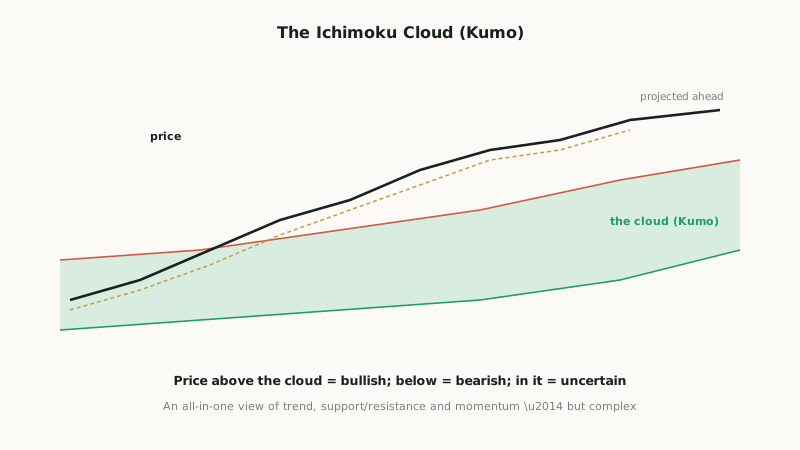
A: The core read is price relative to the cloud: price above the cloud is bullish, below it is bearish, and within it is uncertain or transitional. The cloud's thickness suggests the strength of support or resistance, and crossovers of the Tenkan and Kijun lines provide additional signals.
Q: Is the Ichimoku Cloud good for beginners?
A: It has a steep learning curve. With five components and a forward-projected cloud, it looks cluttered and takes time to understand. Beginners are usually better starting with simpler indicators, but once learned, Ichimoku offers an all-in-one view that some traders find very powerful, especially in trending markets.
The five components
Ichimoku comprises five lines, each with a role, which together form the system. The Tenkan-sen (conversion line) is a short-term average based on the midpoint of the highest high and lowest low over a short period (commonly 9), tracking near-term price — broadly analogous to a fast moving average. The Kijun-sen (base line) does the same over a longer period (commonly 26), tracking the medium-term trend — like a slower moving average. These two function much like the moving-average pair from that guide, with their crossover providing signals.
The two lines that form the cloud (Kumo) are the distinctive heart of the system. Senkou Span A (leading span A) is the average of the Tenkan and Kijun, and Senkou Span B (leading span B) is the midpoint of the high-low range over a longer period (commonly 52) — and crucially, both are plotted ahead of the current price (commonly 26 periods into the future). The area between these two leading spans is the cloud, shaded on the chart and projected forward. Finally, the Chikou Span (lagging span) is the current close plotted behind (commonly 26 periods back), used to confirm signals by comparing current price to past price. The forward-projected cloud and backward-projected lagging span are what give Ichimoku its unusual appearance and its ability to relate past, present and future price in one view. While five components sound complex, each has a clear purpose, and the cloud is the centrepiece that does most of the work.
Reading the cloud
The cloud (Kumo) is the most important element, and the core of reading Ichimoku is price relative to the cloud. The principle is simple and powerful: when price is above the cloud, the trend is bullish; when price is below the cloud, the trend is bearish; and when price is within the cloud, the market is in an uncertain, transitional or rangebound state. This single read — price's position relative to the cloud — gives an immediate sense of the trend, which is the "one glance" the system is named for. The cloud thus acts as a dynamic trend indicator and a zone of support (in an uptrend, with price above) or resistance (in a downtrend, with price below).
The cloud carries more information through its thickness and position. A thick cloud suggests strong support or resistance (a more significant barrier price must overcome), while a thin cloud suggests weaker support/resistance (more easily broken). Because the cloud is projected ahead of price, it also shows future support and resistance — you can see where the cloud lies in front of current price, anticipating zones that may halt or reverse a move. The cloud's "colour" (determined by whether Senkou Span A is above or below Span B) indicates the projected bias — a bullish cloud (A above B) versus a bearish cloud (B above A) — giving a sense of the forward-looking trend tilt. So the cloud alone conveys trend (price above/below), strength of support/resistance (thickness), future levels (its forward projection), and bias (its colour) — a great deal of information in one shaded band, which is why it is the centrepiece of the system.
Signals and confirmation
Beyond the cloud, Ichimoku generates signals from its other components, used in combination for confirmation. The Tenkan/Kijun crossover works like a moving-average crossover: when the faster Tenkan crosses above the slower Kijun, it is a bullish signal; when it crosses below, bearish. As with MA crossovers, these signals are considered stronger when they align with the cloud — a bullish Tenkan/Kijun cross occurring while price is above the cloud is more reliable than one against the cloud's trend, illustrating how the components confirm each other.
The Chikou Span (lagging line) provides further confirmation: when the Chikou (current close plotted back) is above the price of that past period, it confirms bullish momentum; below, bearish. Many Ichimoku traders look for multiple components to align — price above the cloud, a bullish Tenkan/Kijun cross, a bullish cloud ahead, and the Chikou confirming — before considering a strong bullish setup, and the mirror for bearish. This requirement for confluence among the components is a strength of the system, building in confirmation rather than relying on a single signal. It also means Ichimoku is genuinely a system rather than a single indicator: trend (cloud), momentum and signals (crossovers), and confirmation (Chikou) are integrated, which is the source of its appeal as an all-in-one approach. Reading these elements together — with the cloud as the anchor and the other components confirming — is how the system is meant to be used.
Ichimoku's genius is integration: trend (price vs cloud), momentum and signals (Tenkan/Kijun cross), future support/resistance (the projected cloud), and confirmation (Chikou) in one view. Its weakness is the flip side — complexity and lag. The five lines look cluttered, and like all trend tools it works beautifully in trends and poorly in ranges. It's a system to learn, not a magic signal.
Strengths, limits and how to approach it
Ichimoku's great strength is its comprehensiveness: it integrates trend, support/resistance, momentum and signals into a single coherent view, letting a trader assess the situation "at a glance" once fluent. For trending markets especially, it can be a powerful and elegant system, and its forward-projected cloud offers a genuinely useful anticipation of support and resistance that few other tools provide. Many traders who invest the time to learn it find it a complete framework they can rely on.
Its limitations are equally real. The system is complex, with a steep learning curve — five components, unusual projections, and a chart that looks cluttered to the uninitiated — making it poorly suited to beginners, who are better starting with simpler indicators (moving averages, RSI, MACD) before tackling Ichimoku. Like all trend-based tools, it works best in trending markets and struggles in ranging, choppy conditions, where price meanders in and around the cloud and signals become unreliable — the same trend-context caveat that applies across this site's indicator coverage. Its components also lag, as all averaged indicators do, so signals can be late. And, as always, it is not magic: it is a tool (a sophisticated one) that must be understood, applied with awareness of market context (it suits trends), and ideally not treated as an infallible standalone system. The sensible approach is to learn it thoroughly if it appeals — understanding each component and practising reading the integrated picture — use it primarily in trending conditions, respect its lag and complexity, and recognise that, like every indicator, it improves decision-making rather than guaranteeing outcomes. For traders willing to climb its learning curve, Ichimoku offers a uniquely complete, single-glance view of the market; for those unwilling, simpler tools serve perfectly well.
Settings and adapting it
Ichimoku's traditional settings — 9, 26 and 52 for the Tenkan, Kijun and Senkou Span B periods, with the cloud and lagging span shifted 26 periods — have a historical origin: they reflect the rhythms of the Japanese markets Hosoda studied, when trading weeks were longer, so 26 approximated a month and 52 two months. These defaults remain the standard and are what most traders use, preserving the system as designed. While the numbers can be adjusted for different markets or timeframes, the conventional advice is to keep the traditional settings unless you have a clear reason and have tested an alternative, since Ichimoku's components are calibrated to work together and altering them piecemeal can break that balance.
A feature worth knowing is the Kumo twist — the point where the two cloud-forming spans (Senkou A and B) cross, flipping the cloud's colour from bearish to bullish or vice versa. Because the cloud is projected ahead, these twists are visible in advance, offering a forward hint of a potential trend-bias change. Twists are watched as possible early signals of a shifting trend, adding to the cloud's forward-looking value, though like all signals they are confirmation-worthy rather than certain.
For those who find the full five-line system cluttered, a practical simplification is to focus primarily on the cloud — price above or below it for trend, its thickness for support/resistance strength, and its forward projection and colour for bias — while treating the Tenkan/Kijun cross and Chikou as secondary confirmation. The cloud alone captures much of Ichimoku's value, so a trader can begin by reading just price-versus-cloud and add the other components as fluency grows. This staged approach tames the learning curve: start with the cloud's trend read, layer in the crossover and lagging-span confirmation over time, and keep the traditional settings throughout. Approached patiently like this, Ichimoku's intimidating appearance gives way to a coherent, single-glance system — used, as always, in trending conditions and in combination with sound judgement rather than as an infallible oracle.
The Ichimoku Cloud is a complete system of five lines: Tenkan and Kijun (fast/slow midpoint lines, their cross a signal), Senkou Spans A and B (which form the cloud/Kumo, projected ahead), and the Chikou Span (lagging confirmation), with traditional settings 9/26/52. The core read is price vs the cloud: above = bullish, below = bearish, inside = uncertain; thickness shows support/resistance strength, and it projects future levels (watch Kumo twists for bias changes). Best with components aligned, in trending markets. Simplify by focusing on the cloud first. Its strengths are comprehensiveness and the forward-looking cloud; its weaknesses are complexity, lag and a steep learning curve — a system to learn, not a magic signal.