Ichimoku looks like a tangle of lines and a strange floating cloud — until it clicks, and then it becomes something rare: a single glance that tells you the trend, the momentum, and the key support and resistance, all at once. The Ichimoku trading system trades that complete picture, with confluence built right in, which is its great appeal. This guide explains how to trade with Ichimoku: a recap of its components, the signals the system generates, the power of its component agreement, and its honest limitations.
It builds directly on the indicator detailed in the Ichimoku cloud, is fundamentally a trend-following system, and embodies the principle of confluence.
Key takeaways
Q: What is the Ichimoku trading system?
A: It's a complete trend-following system built on the Ichimoku Kinko Hyo indicator, which combines several components — the cloud (Kumo), the Tenkan-sen and Kijun-sen lines, and the Chikou Span — to show trend, momentum and support/resistance in one view. Trading signals come from price's position relative to the cloud, line crosses, and confirmation from the other components.
Q: How do you read Ichimoku signals?
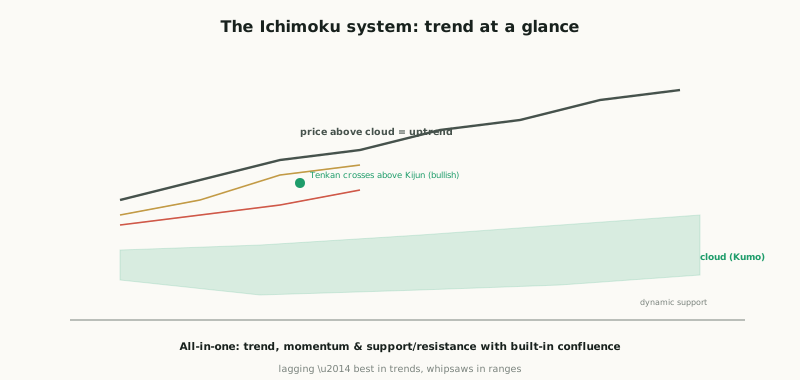
A: Price above the cloud signals an uptrend (below it, a downtrend; inside it, uncertainty). A Tenkan-sen crossing above the Kijun-sen (a 'TK cross') is a bullish signal, stronger when above the cloud. The Kijun acts as a trend line, the Chikou Span confirms direction, and a break through the cloud (Kumo breakout) signals a trend change. The strongest setups occur when several components agree.
Q: What are the limitations of the Ichimoku system?
A: It's a lagging system, built from averages, so its signals arrive late and it whipsaws in ranging or choppy markets. It works best in trending conditions and poorly in ranges, has a steep learning curve given its many components, and — like any system — offers no guarantees. It's best used with its own built-in confluence, respect for the trend, and disciplined risk management.
The components, briefly
The Ichimoku Kinko Hyo (roughly, "one-glance equilibrium chart") combines five elements, each detailed in the Ichimoku cloud: the Tenkan-sen (conversion line, fast), the Kijun-sen (base line, slower, a key equilibrium level), the Senkou Span A and B (which form the Kumo or cloud, projected ahead as dynamic support/resistance), and the Chikou Span (the lagging line, plotting the close shifted back). Together they're designed to convey trend, momentum and support/resistance simultaneously — the "one glance" ideal. Here we focus on how to trade the resulting picture.
The system's signals
The Ichimoku system generates several related signals, summarised below.
Ichimoku signals
The foundational read is price relative to the cloud: price above the Kumo signals an uptrend (be a buyer), below it a downtrend (be a seller), and inside it uncertainty (often a no-trade zone). The cloud also acts as dynamic support/resistance, its thickness reflects the strength of that support/resistance, and a "twist" (where Senkou Span A and B cross, changing the cloud's colour) hints at a potential trend change ahead. The TK cross — the Tenkan-sen crossing above the Kijun-sen — is a bullish momentum signal (and the reverse bearish), much like a fast/slow moving-average cross, and is considered stronger when it occurs above the cloud (in agreement with the trend). The Kijun-sen serves as a key trend/equilibrium line and dynamic level — price holding above it supports a bullish view. The Chikou Span provides confirmation: when the lagging line is above the price/cloud of its time, it confirms bullishness (below, bearishness). And a Kumo breakout — price decisively breaking through the cloud — signals a potential trend change.
The real power of the system is its built-in confluence: the strongest, highest-conviction signals occur when multiple components agree. A textbook bullish setup has price above the cloud, a bullish TK cross, the Chikou above price, and price holding above a rising Kijun — four elements pointing the same way. Because the system bundles trend, momentum and support/resistance into one tool, it effectively enforces confluence and naturally filters out low-quality, counter-trend trades (you simply don't go long below the cloud). This is why many trend-followers love it: it imposes a disciplined, trend-aligned structure.
Strengths and honest limits
The strengths are clear: an all-in-one trend-following system with dynamic levels and built-in confluence, excellent for keeping you on the right side of a trend and out of counter-trend trades. But the limitations are equally real. Ichimoku looks complex and cluttered at first and has a steep learning curve — it takes time before the "one glance" becomes genuinely intuitive. More fundamentally, it's a lagging system, built from averages, so its signals arrive late, and it whipsaws badly in ranging or choppy markets (where the cloud goes flat and thin and signals become unreliable). It works best in clearly trending markets and poorly in ranges — recognising which regime you're in is essential. It was originally developed for Japanese markets decades ago and works perfectly well on forex, but carries no magic: it's a structured way of reading trend and momentum, not a guaranteed edge. So trade with the system's confluence (wait for components to align), respect the trend (don't fight the cloud), avoid it (or stand aside) in choppy ranges, and apply risk management on every trade. Demo it first — it rewards traders willing to learn its components properly. The honest framing: the Ichimoku trading system uses the all-in-one indicator (cloud, Tenkan, Kijun, Chikou) to read trend, momentum and support/resistance and generate signals — price above the cloud = bullish, TK crosses, Kijun as trend line, Chikou confirmation, Kumo breakouts — with the strongest setups when multiple components align (built-in confluence). It's a powerful, complete trend-following system with dynamic levels. But it's lagging (late signals, whipsaws in ranges), works best in trends and poorly in chop, has a steep learning curve, and is no guarantee — use its confluence, respect the trend, and manage risk. Demo it first; it suits trend-followers who take the time to learn it.
A complete Ichimoku trade
To see the system's confluence in action, walk through a textbook long setup. You're watching a pair and the picture aligns: price is above the cloud (uptrend confirmed), the cloud ahead is green and rising (bullish, with support beneath), the Tenkan crosses above the Kijun while above the cloud (a strong TK cross), the Chikou Span is above the price of its time (confirmation, with clear space above it), and price is holding above a rising Kijun-sen. With all five elements pointing up, this is a high-conviction Ichimoku long — the entry might be on the TK cross or a pullback to the Tenkan/Kijun, the stop below the Kijun or below the cloud (a logical invalidation — if price falls back into or below the cloud, the bullish thesis is broken), and the trade managed by trailing behind the rising Kijun or the top of the cloud as the trend develops. The mirror image — price below a red, falling cloud, bearish TK cross, Chikou below price — defines the high-conviction short. The discipline is to wait for the components to agree and to stand aside when they don't (price inside the cloud, or signals conflicting), which is exactly how the system filters out marginal trades.
A few practical notes complete the picture. The classic settings are 9, 26 and 52 (the Tenkan, Kijun and Senkou Span B periods), derived from the trading calendar of Ichimoku's original era; many traders keep these defaults, while others adjust for the 24-hour, five-day forex week — there's no magic in the exact numbers, and consistency matters more than tinkering. Ichimoku also lends itself well to multi-timeframe analysis: establishing the trend and cloud bias on a higher timeframe (say the daily) and then timing entries with the system on a lower one (the 4-hour or 1-hour) is a powerful way to ensure you're trading with the larger trend — a natural extension of the system's trend-first philosophy. Throughout, the honest caveats from earlier hold: wait for genuine alignment rather than forcing a partial signal, stay out during choppy, cloud-bound ranges where the system whipsaws, never treat any signal as a guarantee, and size and stop every trade so a failed setup is survivable. Learned properly and applied patiently — with its confluence respected and its weaknesses (lag, ranges) avoided — the Ichimoku system rewards the trend-follower with a clear, structured, trend-aligned way of reading the market at a glance.
Who the Ichimoku system suits
Ichimoku isn't for everyone, and it's worth being honest about who benefits. It suits trend-followers who trade higher timeframes and are willing to invest the time to learn its components until the "one glance" becomes genuinely intuitive — for them, the built-in confluence and trend discipline are a real asset. It suits less well the scalper or range-trader, the impatient beginner who wants signals today, or anyone trading choppy, non-trending markets where the system whipsaws. If you try Ichimoku and find the cluttered chart and lagging signals more confusing than clarifying, that's a perfectly valid reason to use something simpler — plenty of successful traders never touch it. But if you're drawn to trend-following and prepared to learn it properly on a demo first, Ichimoku offers something genuinely valuable: a single, coherent framework that keeps you on the right side of the trend and filters out the marginal, counter-trend trades that quietly drain accounts. Like every system on this site, it's a structured way of reading the market, not a guarantee — its edge comes from your discipline in applying it well, in the conditions it's built for, with risk management on every trade.
The Ichimoku trading system trades the all-in-one Ichimoku indicator (cloud/Kumo, Tenkan, Kijun, Chikou). Core signals: price above the cloud = uptrend (below = downtrend, inside = unclear), the cloud as dynamic support/resistance; a TK cross (Tenkan over Kijun = bullish, stronger above the cloud); the Kijun as a trend line; the Chikou confirming direction; and Kumo breakouts signalling trend change. Its power is built-in confluence — strongest when components agree (price above cloud + bullish TK cross + Chikou above + rising Kijun). Strengths: a complete trend system that keeps you trend-aligned. Limits: it's lagging (late signals, whipsaws in ranges), best in trends and poor in chop, with a steep learning curve and no guarantees. Use its confluence, respect the trend, manage risk — and demo it first.