The most dangerous thing in markets may be a long stretch of calm. That was the great, counterintuitive insight of economist Hyman Minsky: stability itself breeds the excess that ends in crisis. In the good times, confidence and leverage quietly accumulate, fragility builds beneath a placid surface, and the system creeps toward a tipping point that finally snaps — a "Minsky moment." This guide explains Minsky's financial instability hypothesis: why stability breeds instability, the stages of degrading finance, and how the dynamic shows up in forex.
It's the credit-cycle engine beneath financial bubbles, intimately linked to the carry trade and the business cycle.
Key takeaways
Q: What is a Minsky moment?
A: A Minsky moment is the point at which a long build-up of debt and risk-taking suddenly gives way to a sharp collapse — when overextended borrowers are forced to sell assets to cover their positions, triggering cascading declines. It's named after economist Hyman Minsky, whose financial instability hypothesis argued that long periods of stability encourage ever-greater leverage, sowing the seeds of the eventual crisis.
Q: What is Minsky's financial instability hypothesis?
A: It's the idea that financial markets are inherently prone to boom-and-bust because 'stability breeds instability'. During good times, calm and rising asset prices breed confidence, encouraging investors and lenders to take on progressively more debt and risk. Financing quality degrades from sound (hedge) to fragile (speculative) to reckless (Ponzi), until the system is so overextended that a shock tips it into crisis — the Minsky moment.
Q: How does the Minsky moment apply to forex?
A: The dynamic appears in currency markets through leveraged carry trades, credit booms and currency crises. A long calm can encourage crowded, highly-leveraged carry positions, which then unwind violently when sentiment turns — a Minsky-like cascade. Emerging-market currency crises often follow the same arc: a build-up of foreign-currency debt during stable times, then a sudden, self-reinforcing collapse. It's a lens for understanding fragility, not a timing tool.
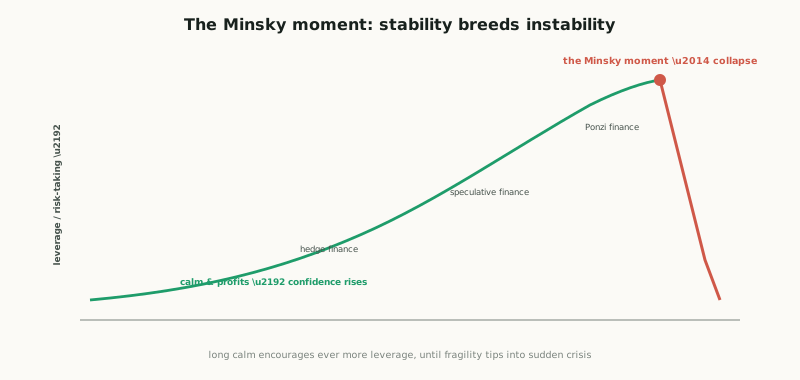
Stability breeds instability
Minsky's financial instability hypothesis argues that financial markets are inherently prone to boom-and-bust — not because of outside shocks, but because of their own internal dynamics. The core idea is the paradox that stability breeds instability. During good times — calm markets, rising asset prices, easy profits — confidence grows: investors, lenders and borrowers come to believe the calm will continue, so they take on progressively more debt and risk, because doing so has been rewarded and feels safe. Lenders relax standards (defaults have been low, so why worry?); borrowers leverage up (asset prices keep rising, so debt feels easily serviced). The very absence of recent trouble encourages the build-up of the leverage that creates future trouble. Over time, the financial system becomes steadily more fragile — more leveraged, more interconnected, more dependent on conditions staying benign — even as it appears most stable. Then some shock, or simply the exhaustion of the credit expansion, tips the overextended system into crisis.
Minsky described the degradation through three stages of financing, which trace the path from soundness to fragility.
| Stage | How debt is serviced | Fragility |
|---|---|---|
| Hedge finance | Income covers interest and principal | Sound |
| Speculative finance | Income covers interest only; must roll debt | Fragile |
| Ponzi finance | Income covers neither; relies on rising asset prices | Reckless |
In hedge finance, borrowers' income comfortably covers both interest and principal — sound and self-sustaining. In speculative finance, income covers only the interest, so debt must be continually rolled over — fragile, dependent on credit staying available. In Ponzi finance (Minsky's term, after Charles Ponzi), income covers neither interest nor principal, and the borrower relies entirely on rising asset prices to refinance or sell at a profit — reckless, and viable only while prices keep climbing. As a boom matures, the mix shifts dangerously from hedge toward speculative and Ponzi finance, so an ever-larger share of the system depends on the music never stopping. When asset prices stall or a shock hits, the Ponzi and speculative borrowers can't service or refinance their debt, are forced to sell assets to raise cash, which pushes prices down, which forces more selling — a self-reinforcing cascade. That sudden flip from boom to collapse is the Minsky moment: the instant the slowly-built fragility gives way and the deleveraging spiral begins.
In forex — and as a lens, not a timer
The Minsky dynamic appears clearly in currency markets. The leveraged carry trade is a textbook example: during long calm, traders pile into crowded, highly-leveraged carry positions (borrowing a low-yield currency to buy a high-yield one), lulled by the steady carry income and low volatility — the picture of stability breeding risk-taking — until sentiment turns and the trade unwinds violently, a Minsky-like cascade as everyone rushes to exit leveraged positions at once. Emerging-market currency crises often follow the same arc: a build-up of foreign-currency debt during stable, optimistic times, then a sudden, self-reinforcing collapse when confidence breaks, the currency falls, and the now-heavier foreign debt forces further selling (Minsky moments writ large across an economy). More broadly, the hypothesis explains why bubbles and credit booms recur, and why the calmest, most confident periods can be the most dangerous.
The essential caveat — consistent with every theory here — is that Minsky's framework is a lens for understanding fragility, not a timing tool. It tells you that long stability builds instability and that highly-leveraged, Ponzi-heavy systems are fragile and vulnerable to a sudden break — but it does not tell you when the Minsky moment will arrive. Fragile conditions can persist far longer than seems possible (the build-up phase can run for years), and "this is unsustainable" has bankrupted many who were ultimately right but early. So the practical value is in recognising the conditions: when you see prolonged calm breeding ever-more leverage, crowded carry trades, relaxed lending and a system increasingly dependent on rising prices, you're seeing Minsky fragility accumulate — a reason for caution, smaller risk, and alertness to a turn, not a precise short signal. Used that way, Minsky offers something rare and valuable: an explanation of why the safest-seeming times sow the next crisis, and a healthy respect for the fragility hidden inside a long calm. The honest framing: a Minsky moment is the sudden collapse that ends a long build-up of debt and risk, when overextended borrowers must sell to cover, triggering a cascade. Minsky's financial instability hypothesis holds that "stability breeds instability" — calm and rising prices breed confidence and leverage, and financing degrades from hedge (income covers interest and principal) to speculative (interest only) to Ponzi (relies on rising prices) — until a shock tips the fragile system into crisis. In forex it shows up in leveraged carry-trade unwinds and emerging-market currency crises. But it's a lens for fragility, not a timer: fragile conditions persist far longer than expected, so use it to recognise risk and stay cautious, not to time tops; manage risk.
Reading the warning signs
Since Minsky's framework identifies fragility rather than timing, its practical use is in reading the warning signs that fragility is accumulating — the conditions that make a system vulnerable to a Minsky moment, even if you can't say when the moment will come. Several are recognisable. Rising leverage and debt across the system — borrowing growing faster than incomes or output, margin debt climbing, ever-easier credit — is the core signal, since it's the build-up of leverage that creates the fragility. Compressed volatility and spreads: paradoxically, unusually calm markets and very tight risk premia (low volatility, narrow credit spreads, cheap insurance against risk) are themselves a warning, because that calm is exactly what breeds the complacency and risk-taking Minsky described — "the stability" that is breeding instability. Crowded, leveraged trades: when a trade like a popular carry position becomes consensus and heavily leveraged, it's fragile to a sudden unwind. Relaxed lending standards and a growing share of speculative and Ponzi financing — borrowing that only works if asset prices keep rising. And the narrative tell: "this time is different" — widespread confidence that the old limits no longer apply, the verbal signature of late-stage complacency.
The practical stance that follows is one of graduated caution, not market-timing heroics. As you observe these fragility signs accumulating, the sensible response is to reduce risk and leverage, tighten your own discipline, hold more buffer, and stay alert to a turn — not to bet the farm on an imminent collapse, because (as stressed) fragile conditions can persist far longer than seems possible, and shorting a still-inflating bubble has ruined many who were ultimately right. Minsky teaches respect for the danger hidden in calm, which translates into defensive behaviour (smaller positions, less leverage, more caution the longer and calmer the boom runs) rather than aggressive top-picking. There's a useful humility here too: the very fact that everything feels safe and stable should, through a Minsky lens, increase rather than decrease your vigilance — a counterintuitive but valuable instinct. For the individual trader, the takeaways are concrete: be most cautious when leverage is high and volatility is low and everyone is relaxed; never be the over-leveraged Ponzi borrower relying on prices only ever rising; keep your own financing firmly in the hedge camp (able to withstand a downturn); and treat prolonged, complacent calm as a reason for more care, not less. The honest reminder: read the fragility signs — rising system-wide leverage, compressed volatility and spreads, crowded leveraged trades, relaxed lending, "this time is different" — and respond with graduated caution (reduce risk and leverage, hold buffers, stay alert), never aggressive top-timing, since fragile calm can persist; let the feeling that everything is safe increase, not decrease, your vigilance.
A Minsky moment is the sudden collapse ending a long build-up of debt and risk — when overextended borrowers must sell to cover, triggering a self-reinforcing cascade. Minsky's financial instability hypothesis: "stability breeds instability" — calm and rising prices breed confidence and ever-more leverage, and financing degrades from hedge (income covers interest and principal), to speculative (interest only, must roll debt), to Ponzi (covers neither, relies on rising prices) — until a shock tips the fragile system into crisis. In forex it appears in leveraged carry-trade unwinds and emerging-market currency crises. Crucially, it's a lens for fragility, not a timer: fragile conditions can persist far longer than seems possible, so use it to recognise accumulating risk and stay cautious — not to time the top — and respect the danger hidden inside a long calm.