
Every generation swears the latest mania is different — a new technology, a new era, a paradigm that old rules of value no longer apply to — and every generation watches it end the same way. Financial bubbles follow a recognisable anatomy, driven by timeless human impulses, yet they remain maddeningly hard to call in real time. Understanding how bubbles inflate and burst is valuable both for recognising the warning signs and — just as importantly — for staying humble about how hard they are to trade. This guide explains financial bubbles and manias: their anatomy, why they form, their forex relevance, and the hard truth about timing them.
It draws on the human impulses of behavioural finance and fear and greed, is closely related to reflexivity, and marks the sentiment extremes that contrary opinion watches for.
Key takeaways
Q: What is a financial bubble?
A: A financial bubble is a self-reinforcing speculative boom in which an asset's price inflates far above its intrinsic value, driven by greed, herd behaviour and leverage, before collapsing. The study of bubbles draws on economists like Hyman Minsky (the financial instability hypothesis) and Charles Kindleberger (Manias, Panics, and Crashes), who mapped their recurring stages.
Q: What are the stages of a bubble?
A: A common model runs: displacement (a new development creates opportunity and excitement), boom (rising prices attract more buyers and credit), euphoria or mania (prices detach from fundamentals amid 'this time is different' thinking and FOMO), distribution (smart money quietly exits), and finally panic or crash (a trigger sparks a rush for the exits and prices collapse).
Q: Can you profit from spotting a bubble?
A: It's far harder than it sounds. Bubbles are obvious in hindsight but very hard to time in real time — knowing you're in one doesn't tell you when it will pop, and it can inflate far longer than seems possible. Shorting a bubble is notoriously dangerous (the timing can ruin you), and riding it risks being caught in the crash. Recognising a bubble is most useful for managing risk and staying rational.
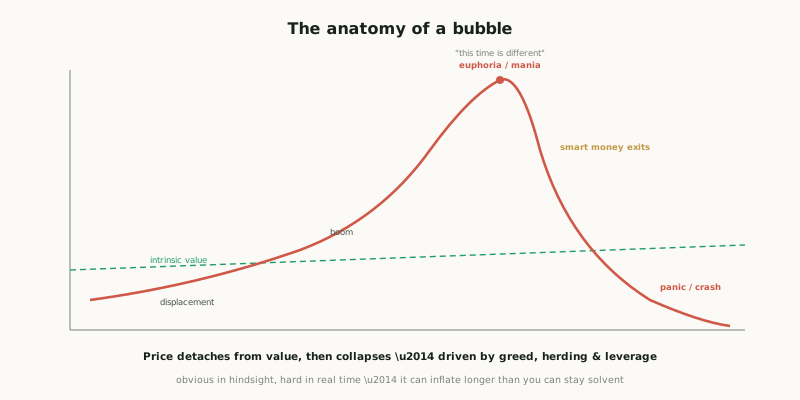
The anatomy of a bubble
The study of bubbles draws on economists Hyman Minsky (whose financial instability hypothesis showed how stability itself breeds the excessive risk-taking that leads to instability) and Charles Kindleberger (whose classic Manias, Panics, and Crashes mapped the recurring pattern across centuries of history). From their work comes a recognisable sequence of stages, summarised below.
The stages of a bubble
It begins with displacement — some new development (a technological breakthrough, a policy shift, a flood of easy money) that creates a genuine profit opportunity and stirs excitement. Then comes the boom: prices rise, drawing in more participants, and credit and leverage expand to fund the buying as optimism grows. This builds into euphoria or mania, the bubble's defining phase: prices detach from fundamentals, the rationalising mantra "this time is different" takes hold, fear of missing out (FOMO) becomes rampant, and greater-fool buying dominates — people buy simply because prices are rising, expecting to sell to someone else at a higher price. At some point comes distribution, where the "smart money" and early insiders quietly exit, selling into the still-euphoric crowd. Finally, a trigger — sometimes major, sometimes trivial — sparks panic: confidence cracks, everyone rushes for the exits at once, leverage forces selling, and prices collapse. Economists call the tipping point, where over-leveraged speculation suddenly unwinds, a "Minsky moment."
Why do bubbles form so reliably? Because they're powered by enduring forces. Human psychology drives them — greed, herd behaviour, FOMO, recency bias, and the cycle of fear and greed. Credit and leverage amplify them, providing the fuel for prices to overshoot. Compelling narratives ("a new era," "the old rules don't apply") give participants permission to abandon valuation discipline. And reflexivity binds it together: rising prices change the perceived (and sometimes actual) fundamentals, which justify still-higher prices in a self-reinforcing loop — until it can't be sustained.
Forex relevance, and the hard truth about timing
In forex, pure bubbles are somewhat rarer than in stocks or crypto, because currencies are relative values (one currency against another) rather than standalone assets that can inflate indefinitely. But closely related phenomena are very real and important: currency crises (such as the 1997 Asian crisis, or pegs breaking under pressure), speculative attacks on overvalued or unsustainably-pegged currencies (Soros versus the pound in 1992), and the boom-and-violent-unwind dynamics of crowded carry trades — where capital piles into high-yielding currencies for years, then exits all at once in a sharp, painful reversal. Emerging-market currencies, in particular, can experience mania-and-collapse cycles. And every trader benefits from recognising bubbles in other assets (dot-com, crypto, housing), both to avoid them and to understand the cross-market risk-off panics they can trigger.
The hard truth, though, is the one that humbles everyone: bubbles are obvious in hindsight but extremely hard to call in real time. Knowing you're in a bubble does not tell you when it will pop — it can inflate far longer, and far more absurdly, than seems possible (the perennial warning that markets "can stay irrational longer than you can stay solvent"). This makes both obvious strategies dangerous: shorting a bubble is notoriously treacherous, because the timing can ruin you long before you're proved right (many a bear has been bankrupted being early); and riding a bubble is dangerous too, because you can never be sure you'll get out before the crash. So the greatest practical value of understanding bubbles is not precise timing but risk awareness and discipline: recognising the signs (detachment from value, "this time is different," mania, rampant leverage, FOMO) helps you stay rational when others lose their heads, size positions sensibly, avoid getting swept up in greater-fool speculation, and manage the risk of the eventual reversal. The honest framing: financial bubbles/manias are self-reinforcing speculative booms where prices detach from value then collapse, following a recognisable anatomy (displacement → boom → euphoria/mania → distribution → panic/crash; per Minsky and Kindleberger), driven by greed, herd behaviour, FOMO, leverage, narratives and reflexive feedback. Understanding them is valuable for recognising mania and managing risk. But they're obvious in hindsight and hard in real time: knowing it's a bubble doesn't tell you when it pops (it can inflate far longer than seems possible), making both shorting and riding bubbles dangerous. In forex, pure bubbles are rarer (relative values), but currency crises, speculative attacks and carry unwinds apply. A valuable framework for recognising mania and managing risk — not a precise timing tool. Respect that bubbles can stay irrational longer than you can stay solvent.
Spotting and surviving manias
History rhymes, and the great bubbles share a family resemblance worth knowing: the Dutch tulip mania of the 1630s, the South Sea Bubble of 1720, the 1920s stock boom before the 1929 crash, the dot-com bubble of 2000, the mid-2000s housing bubble that detonated in 2008, and the various crypto manias all followed the same arc — a genuine displacement, a credit-fuelled boom, a "this time is different" euphoria, and a brutal collapse. Recognising the recurring warning signs is the practical payoff of studying them. The classic red flags: prices clearly detached from any sensible valuation; the "this time is different" narrative explaining why old rules no longer apply; rampant leverage and credit funding the buying; widespread FOMO and the public (the last buyers) piling in; greater-fool reasoning ("I know it's expensive, but someone will pay more"); parabolic price action; and the general sense that an asset has become a one-way bet that "can only go up." When several of these align, caution is warranted — not because you can time the top, but because the risk has become extreme.
The hard part, as ever, is that recognising a bubble doesn't license easy profit. Shorting it is treacherous — bubbles can inflate for months or years past the point of absurdity, and a short entered "early" can be wiped out long before vindication (the graveyard of bearish traders is full of people who were right too soon). Riding it greedily is equally dangerous, since the crash is sudden and you're unlikely to be among the few who exit at the top. So the disciplined response is rarely a heroic bet either way; it's risk management and rationality. If you're exposed to a possibly-bubbly asset, size sensibly, use stops, and take profits along the way rather than betting everything on calling the exact peak. If you're tempted to chase a mania, recognise the FOMO and greater-fool logic for what they are and refuse to abandon your valuation discipline. And across your whole book, respect that bubble collapses trigger cross-market risk-off panics that can hit even unrelated positions (in forex, the carry unwinds and safe-haven flows that accompany crises). The enduring lesson of every mania is the same humbling line: the market can stay irrational longer than you can stay solvent. Understanding bubbles makes you a calmer, more rational, better-risk-managed trader — not a fortune-teller who can pick the top. That clarity, in the heat of a mania when everyone around you is losing their head, is worth far more than any attempt to time the unpredictable.
Financial bubbles/manias are self-reinforcing speculative booms where price detaches from value, then collapses — following a recognisable anatomy (Minsky, Kindleberger): displacement → boom → euphoria/mania ("this time is different," FOMO, greater-fool buying) → distribution (smart money exits) → panic/crash (the "Minsky moment"). They're driven by greed, herd behaviour, FOMO, leverage, seductive narratives and reflexive feedback. Forex relevance: pure bubbles are rarer (currencies are relative values), but currency crises, speculative attacks on pegs, and crowded carry-trade booms/unwinds apply. Hard truth: bubbles are obvious in hindsight, hard in real time — knowing it's a bubble doesn't tell you when it pops (it can inflate far longer than seems possible), so both shorting and riding them are dangerous. Their real value is risk awareness: recognise the signs, stay rational, manage risk — bubbles can stay irrational longer than you can stay solvent.