George Soros built one of history's great trading fortunes on a deceptively simple idea: that what market participants believe doesn't merely reflect reality — it changes it. His theory of reflexivity, set out in The Alchemy of Finance, describes a two-way feedback loop between perception and price that, he argued, drives markets far from the tidy equilibrium that mainstream theory assumes — into self-reinforcing booms and the busts that follow. It's an advanced, philosophical lens, but a genuinely illuminating one. This guide explains reflexivity: the feedback loop at its heart, how it produces booms and busts, its forex relevance, and its honest limits.
It stands as a direct challenge to the efficient market hypothesis, complements behavioural finance, and helps explain financial bubbles.
Key takeaways
Q: What is the theory of reflexivity?
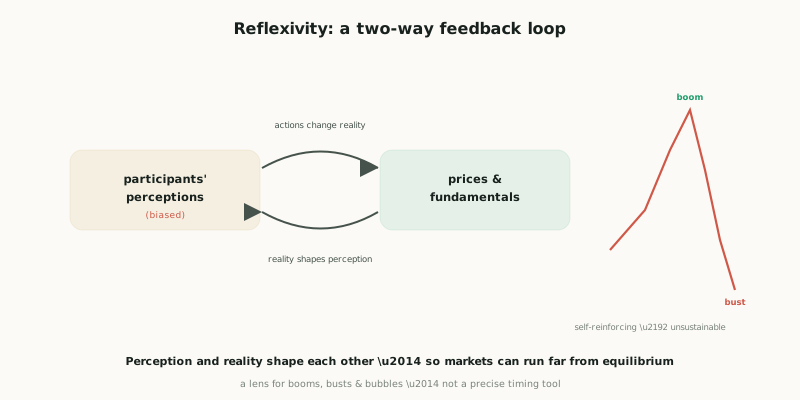
A: Reflexivity, developed by George Soros, is the theory that markets are shaped by a two-way feedback loop between participants' biased perceptions and the underlying reality they're assessing. Traders' beliefs influence prices, and those prices feed back to alter the fundamentals themselves — a circular relationship that can drive markets far from equilibrium into self-reinforcing booms and busts.
Q: How does reflexivity differ from the efficient market hypothesis?
A: The efficient market hypothesis assumes prices rationally reflect all information and tend toward equilibrium. Reflexivity argues the opposite can happen: because perceptions and prices influence each other, markets can become self-reinforcing and run far from any equilibrium, forming bubbles and crashes. Soros held that markets are 'always biased in one direction or another,' not reliably efficient.
Q: Can you trade using reflexivity?
A: Reflexivity is more a conceptual lens than a mechanical system. It powerfully explains why markets trend, overshoot and form booms and busts, but it doesn't tell you precisely when a self-reinforcing loop will start or break — timing remains a matter of judgement. Soros himself relied heavily on intuition and experience, not a fixed reflexivity formula.
The feedback loop at its heart
The core of reflexivity is that, unlike in the natural sciences, the observer affects the observed. In physics, studying a phenomenon doesn't change it — the facts are independent of what anyone thinks. In markets, by contrast, participants' thinking affects the situation they're thinking about, and the situation in turn affects their thinking — a circular, reflexive relationship. Soros described two functions at work simultaneously: the cognitive function (participants try to understand reality — reality shapes their perceptions) and the participating (or manipulative) function (participants act on their understanding, and those actions change reality). Because both operate at once, they interfere with each other: perceptions influence prices, prices feed back to alter the underlying fundamentals, the changed fundamentals reshape perceptions, and so on. A concrete example: a rising share price lets a company raise cheap capital and expand, genuinely improving its fundamentals, which appears to justify the higher price and drives it higher still — a self-reinforcing loop in which perception and reality bootstrap each other upward. The crucial implication is that prices don't merely reflect fundamentals (as efficient-market theory holds); they can influence them, so markets can move away from equilibrium rather than toward it.
Booms, busts, and the challenge to efficiency
This feedback dynamic is what produces Soros's characteristic boom-bust sequences. A self-reinforcing trend builds as perception and reality drive each other in the same direction — optimism lifts prices, higher prices seem to validate the optimism, drawing in more participants and lifting prices further. But such loops contain the seeds of their own destruction: the trend eventually stretches the gap between price and any sustainable reality too far, becomes unsustainable, and reverses — often violently, as the loop runs in reverse (falling prices undermine the fundamentals that had supported them, justifying further falls). Soros summarised the upshot bluntly: markets are "always biased in one direction or another," not the dispassionate, self-correcting mechanisms of theory. This is a frontal challenge to the efficient market hypothesis: where EMH says prices rationally incorporate all information and hover near equilibrium, reflexivity says perception and price can feed on each other to carry markets far from equilibrium, producing the trends, overshoots, bubbles and crashes that efficient-market models struggle to explain. In this sense reflexivity sits alongside behavioural finance and the adaptive market hypothesis as part of the broader case that real markets are messier, more human, and less efficient than the idealised version.
The forex relevance is direct, and Soros demonstrated it spectacularly. Currency trends are often deeply reflexive: a strengthening currency can attract capital flows, shape central-bank and policy responses, and draw in speculative positioning, all feeding back on the exchange rate; carry-trade booms inflate as flows chase yield and then unwind violently when sentiment turns. Soros's most famous trade — betting massively against the British pound in 1992 ("Black Wednesday") — was an exploitation of exactly such dynamics: he recognised that the pound's peg within the European Exchange Rate Mechanism had become unsustainable relative to the underlying reality, and that once the reflexive loop turned, the position would become self-fulfilling as others piled in and the peg broke. Currency crises, speculative attacks on pegs, and trends that overshoot fundamentals are all, in part, reflexive phenomena.
The honest limits matter, though. Reflexivity is fundamentally descriptive and philosophical — a powerful lens for understanding why markets trend, overshoot and form booms and busts, but not a mechanical system or precise predictive tool. It explains why markets can be far from equilibrium without telling you exactly when a self-reinforcing loop will form, how far it will run, or precisely when it will break — and that timing is the hard, money-making (or losing) part. It resists being reduced to rules; Soros himself famously relied on judgement, experience and even physical intuition (his infamous "backache") rather than a reflexivity formula. So treat reflexivity as a way of thinking about markets — a framework for recognising self-reinforcing trends, crowded positioning and unsustainable extremes, and for staying humble about equilibrium — rather than a recipe. The honest framing: reflexivity (Soros) holds that markets are shaped by a two-way feedback loop between participants' biased perceptions and reality — perceptions move prices, prices alter the fundamentals, and the loop becomes self-reinforcing, driving markets far from equilibrium into booms and busts (challenging the efficient market view). It's a valuable conceptual framework for understanding trends, overshoots and bubbles, and it's vividly relevant to currency trends and crises. But it's a descriptive lens, not a predictive system — it explains why loops happen without telling you when they'll start or break, so it informs judgement rather than generating mechanical signals. Use it to think more clearly about market dynamics, not as a crystal ball.
Reflexivity in action
A few concrete episodes show the feedback loop at work. The dot-com boom of the late 1990s was textbook reflexivity: soaring share prices let internet companies raise vast cheap capital and acquire rivals with inflated stock, which genuinely improved their apparent prospects and seemed to justify still-higher valuations — a self-reinforcing loop between perception (internet euphoria) and reality (the funding it enabled) that ran far beyond any sober estimate of fundamentals, until it reversed. The 2008 credit crisis ran the loop in reverse on the way down: falling house prices undermined the mortgage-backed assets on bank balance sheets, forcing sales that pushed prices lower still, eroding confidence and credit, which depressed the economy and housing further — perception and reality dragging each other down. In each case, prices weren't passively reflecting fundamentals; they were actively reshaping them.
In forex, reflexive loops are everywhere once you look. A popular high-yield currency attracts carry-trade flows; those inflows push it higher, which improves carry returns and draws still more capital — a self-reinforcing strengthening that can persist well past fair value, then unwind violently when sentiment cracks and the loop reverses (everyone exits at once, the currency plunges, triggering more exits). Soros's 1992 sterling trade was reflexivity weaponised: he saw that the pound's ERM peg had detached from economic reality, and understood that once he and others bet heavily against it, the selling pressure would itself break the peg — the action changing the reality, a self-fulfilling reflexive move. So how do you use the lens? Not as a formula, but as a way of seeing: watch for self-reinforcing trends where rising prices are themselves generating the "good news" that justifies them; be alert to crowded, one-sided positioning and narratives that have detached from fundamentals; recognise that such trends can run much further than seems rational and reverse much faster; and use that awareness to manage risk and stay humble about equilibrium. Reflexivity won't tell you the turning point, but it sharpens your eye for the conditions under which one becomes likely — and that perspective, applied with judgement, is its real gift to a trader.
A spectrum, not a switch
It helps to see reflexivity and market efficiency as ends of a spectrum rather than a simple either/or. Soros himself acknowledged that markets are often near equilibrium and behaving roughly efficiently — reflexive feedback dominates only in particular conditions, typically when a self-reinforcing narrative takes hold and positioning becomes one-sided. Most of the time, the gentle pull toward fair value the efficient-market view describes is a reasonable approximation; it's at the extremes — the booms, the crises, the crowded trades — that reflexivity takes over and carries prices far from any equilibrium. This is why the lens is most valuable precisely when conventional valuation feels most useless: when an asset or currency is trending relentlessly and "everyone knows" why, reflexivity reminds you that the move may be generating its own justification and could be both bigger and more fragile than it appears. Held this way — as a description of how markets behave in their wilder moods, complementing rather than wholly replacing the efficient-market baseline — reflexivity earns its place in a trader's mental toolkit.
Reflexivity (George Soros, The Alchemy of Finance) holds that markets aren't objective or efficient but shaped by a two-way feedback loop between participants' biased perceptions and reality: perceptions move prices, and prices feed back to alter the fundamentals themselves. Two functions interfere — the cognitive (reality shapes thinking) and the participating (actions change reality) — producing self-reinforcing trends that run far from equilibrium, become unsustainable, and reverse (booms and busts). It challenges the efficient market hypothesis ("markets are always biased in one direction or another"). Forex relevance is direct — reflexive currency trends, carry booms/unwinds, and Soros's 1992 bet against the unsustainable pound peg. But it's a descriptive lens, not a predictive system: it explains why loops form without telling you when they'll start or break (timing needs judgement, as Soros's own intuition-led style showed). Use it to think clearly about market dynamics, not as a crystal ball.