Every country would love three things at once: a stable exchange rate, freely flowing capital, and control over its own interest rates. The trouble — one of the most elegant and important constraints in international economics — is that it can only ever have two of the three. This monetary policy trilemma, or "impossible trinity," quietly shapes the entire architecture of the world's currency regimes and explains why countries make the policy choices they do. This guide explains the trilemma: what the three goals are, why all three can't coexist, and why it matters for forex.
It's the framework underlying exchange rate regimes, the role of capital flows, and the policy choices of central banks.
Key takeaways
Q: What is the monetary policy trilemma?
A: The monetary policy trilemma, also called the impossible trinity, is the principle that a country can have at most two of three desirable goals at the same time: a fixed exchange rate, free movement of capital across its borders, and an independent monetary policy (control of its own interest rates). Pursuing any two forces the country to give up the third.
Q: Why can't a country have all three?
A: Because the three goals conflict. If capital moves freely and you fix the exchange rate, your interest rates must match those needed to maintain the peg — so you lose monetary independence. If you want independent rates and free capital flows, the exchange rate must float. If you want a fixed rate and independent policy, you must restrict capital flows. Free capital movement makes the exchange-rate and interest-rate goals incompatible.
Q: Why does the trilemma matter for forex traders?
A: Because it explains the constraints behind a country's currency regime and policy choices, and where pressure can build. A country trying to defy the trilemma — for example defending a peg with free capital flows while wanting independent rates — sets up tensions that can lead to dramatic currency events, like a peg breaking or capital controls being imposed. It frames why regimes are structured as they are and where vulnerabilities lie.
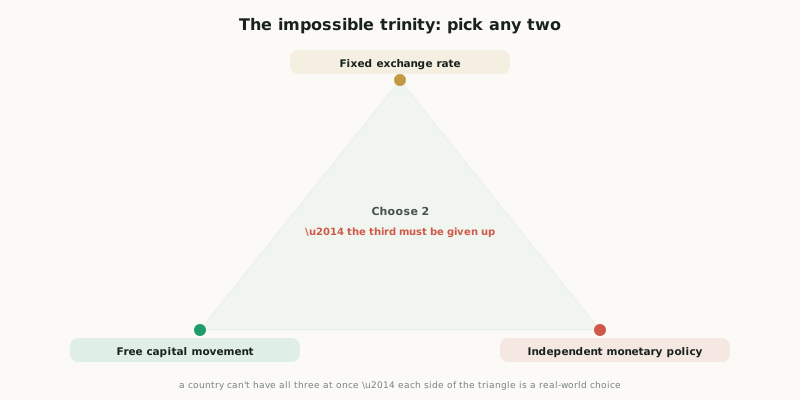
The three goals — pick two
The monetary policy trilemma (the "impossible trinity") states that a country can have at most two of three desirable policy goals simultaneously. The three goals each have obvious appeal.
The three goals (choose two)
A fixed exchange rate offers stability — predictable currency values that ease trade and investment and anchor inflation. Free capital movement lets money flow in and out of the country without restriction, attracting foreign investment and integrating with global markets. Independent monetary policy means the central bank can set its own interest rates to suit the domestic economy — cutting to fight a recession, raising to curb inflation — regardless of what other countries do. Each is genuinely valuable. The trilemma's hard truth is that you cannot have all three at once; pursuing any two forces you to sacrifice the third.
Why all three can't coexist, and why it matters
The reason the three conflict comes down to how free capital movement makes the other two incompatible. Work through the combinations. If you want a fixed exchange rate and free capital flows, then your interest rates are not your own: to hold the peg while capital moves freely, your rates must track whatever is needed to keep money from flooding in or out and breaking the peg — so you lose monetary independence (this is broadly the eurozone-member or currency-peg choice). If you want independent monetary policy and free capital flows, then the exchange rate must float: with rates set for the domestic economy and capital moving freely, the currency's value has to be the release valve that adjusts — so you give up the fixed rate (this is the choice of most major economies, like the US, UK, Japan: floating currencies, independent central banks, open capital). If you want a fixed exchange rate and independent monetary policy, then you must restrict capital flows: capital controls prevent the money movements that would otherwise force your rates to defend the peg — so you sacrifice free capital movement (historically the choice of some managed economies, such as China for long stretches). In every case, it's the free flow of capital that makes simultaneously fixing the exchange rate and controlling interest rates impossible — because open capital markets will arbitrage away any inconsistency between your rate and your peg.
For a forex trader, the trilemma is illuminating in two ways. First, it explains the structure of currency regimes: when you understand that a country has chosen, say, "floating rate + independent policy + open capital," or "peg + open capital + no monetary independence," you understand the constraints it operates under and why it behaves as it does. Second, and more actionably, it shows where pressure and crises build: a country trying to defy the trilemma — attempting to hold a peg with free capital flows while still wanting independent rates for a struggling domestic economy — creates an unsustainable tension that markets can attack. The textbook result is a dramatic currency event: the peg breaks (as speculators bet against an unsustainable fix and the central bank runs out of reserves defending it), or capital controls are suddenly imposed, or rates are forced to punishing levels. Many historic currency crises are, at heart, the trilemma reasserting itself against a country that tried to have all three. So the trilemma is a powerful lens for spotting structural vulnerability — where a regime's goals are in tension and something may eventually have to give (the link to intervention and breaking pegs is direct). It's a framework for understanding constraints and risks, not a timing tool — a tension can persist for a long time before it resolves — so it informs a structural view, combined with the wider picture and risk management. The honest framing: the monetary policy trilemma (impossible trinity) says a country can have at most two of three — a fixed exchange rate, free capital movement, and independent monetary policy — because free capital flows make fixing the rate and controlling interest rates incompatible (open markets arbitrage away the inconsistency). The three combinations: peg + open capital (lose independence), float + independent policy + open capital (lose the peg — most majors), or peg + independent policy (restrict capital). It matters for forex because it explains currency regimes and, crucially, where pressure builds: a country defying it (defending a peg with open capital and wanting independent rates) sets up tensions that can break pegs or force capital controls — the root of many currency crises. A lens on structural constraints and vulnerability, not a timing tool.
The trilemma in the real world
The trilemma stops being abstract the moment you map real regimes onto its three corners. Most major economies — the US, UK, Japan, the eurozone as a bloc — have chosen free capital movement + independent monetary policy, and therefore accept floating exchange rates: their central banks set rates for domestic needs, capital flows freely, and the currency's value is left to adjust, which is exactly why their exchange rates move so much. An individual eurozone member illustrates the opposite sacrifice: by adopting the euro (a fixed rate against neighbours) with free capital flows, members surrendered independent monetary policy to the ECB — a Greece or an Italy cannot set its own rates, the trilemma's price for the single currency. China, for long stretches, took the third path — managing its exchange rate while retaining monetary control by maintaining capital controls that restrict money moving freely across its borders, gradually loosening them only as it navigates the trilemma's constraints. Each is a deliberate choice of which two goals to keep.
The most instructive cases for traders, though, are the crises — moments when a country tried to defy the trilemma and the market forced the issue. The classic template: a country pegs its currency (or holds a tight band) and keeps capital relatively open and wants to run independent rates for a weak domestic economy — an unsustainable trio. Speculators, sensing the contradiction, bet heavily against the peg; the central bank burns through reserves and jacks up rates to defend it, punishing the domestic economy; eventually the defence fails and the peg breaks, often violently. The UK's 1992 ejection from the European Exchange Rate Mechanism and various emerging-market crises follow this shape — the trilemma reasserting itself against a regime trying to have all three. For a forex trader, this is the actionable payoff: the trilemma is a lens for spotting structurally vulnerable regimes — a peg or tight managed rate, combined with open capital and domestic pressure pulling rates the "wrong" way for the peg, is a setup where tension builds and something may eventually give (a devaluation, a break, sudden capital controls, or punishing rate spikes). It doesn't tell you when — such tensions can persist for years, and betting against a peg prematurely has ruined many — but it tells you where the fault lines lie. The honest reminder: the trilemma explains the constraints behind every currency regime and flags where pressure concentrates, making it a powerful structural and risk lens — but it's about vulnerability and constraint, not timing, so combine it with the wider picture and disciplined risk management.
The monetary policy trilemma ("impossible trinity") says a country can have at most two of three: a fixed exchange rate, free capital movement, and independent monetary policy — pursuing any two forces you to give up the third. The reason: free capital flows make fixing the rate and setting your own rates incompatible (open markets arbitrage away the inconsistency). The choices: peg + open capital (lose independence — e.g. a currency peg); float + independent policy + open capital (lose the peg — most major economies); or peg + independent policy (restrict capital). For forex it explains why regimes are structured as they are and, crucially, where crises build: a country defying the trilemma (defending a peg with open capital while wanting independent rates) creates tension that can break the peg or force capital controls — the root of many currency crises. A lens on structural vulnerability, not a timing tool.