
Print enough of anything and each unit is worth less — money included. The size and growth of a nation's money supply sits beneath inflation and, over time, the value of its currency: create money far faster than the economy produces goods, and the currency tends to lose value; show restraint, and it tends to hold. It's one of the oldest truths in economics, and while the real-world relationship is looser and slower than the simple version suggests, it remains a fundamental force every forex trader should understand. This guide explains the money supply and forex: what it is, how it affects currency value, its link to QE and inflation, and the dramatic extreme of hyperinflation.
It's the broader concept behind quantitative easing, the engine of inflation, and a key lever of central-bank policy.
Key takeaways
Q: What is the money supply?
A: The money supply is the total amount of money circulating in an economy. It's measured at different breadths — M0 (base money), M1 (narrow money, like cash and current accounts) and M2/M3 (broader measures including savings). Central banks influence it through interest rates, reserve requirements and tools like quantitative easing.
Q: How does the money supply affect a currency?
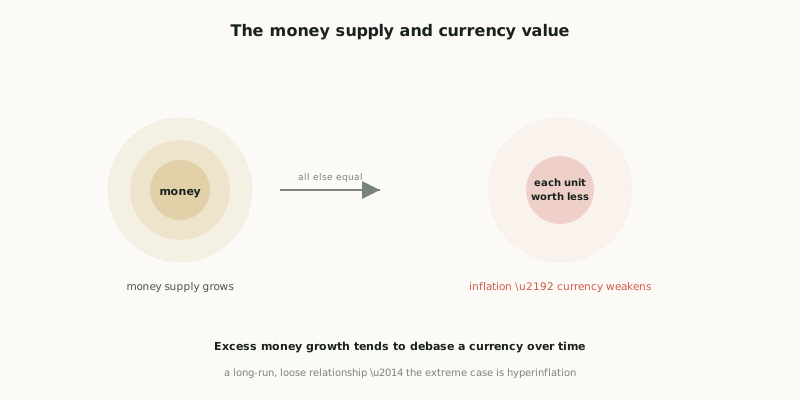
A: All else equal, faster money-supply growth tends to weaken a currency: more units chasing the same goods fuels inflation and erodes each unit's value, including against other currencies. Tighter or slower money growth tends to support a currency. Relative money growth between countries affects their relative currency values over time.
Q: What is the link between the money supply and hyperinflation?
A: Hyperinflation is the extreme case of excessive money creation: when a government prints money far faster than the economy grows, the currency loses value rapidly and can collapse. It's the dramatic illustration of the underlying principle that too much money debases a currency — though in normal conditions the relationship is much looser and slower.
What the money supply is
The money supply is the total amount of money circulating in an economy. It's measured at different levels of breadth, from narrow to broad: M0 (base money — physical currency and central-bank reserves), M1 (narrow money — cash plus easily-spendable deposits like current accounts), and M2 and M3 (broader measures that add savings deposits and other less-liquid forms). These measures capture progressively wider definitions of "money," and economists watch their growth rates as a gauge of how much money is being created. Central banks influence the money supply through several channels: setting interest rates (which affect borrowing and thus money creation through lending), adjusting reserve requirements, and — more directly — tools like quantitative easing (buying assets to inject money into the system). The money supply is therefore both an outcome of economic activity (lending, spending) and a lever of policy.
How it affects currency value
The core principle is intuitive and important: all else equal, faster money-supply growth tends to weaken a currency. If the amount of money grows faster than the economy's output of goods and services, you have more money chasing the same goods — which pushes prices up (inflation) and erodes the value of each unit of the currency, both domestically (it buys less) and against other currencies (it tends to depreciate). Conversely, tighter or slower money growth tends to support a currency's value. This is the "debasement" idea — dilute the supply of money and you dilute its worth — and it echoes the monetarist view that inflation is, at root, a monetary phenomenon (too much money relative to goods). For currencies, what especially matters is relative money growth between countries: a nation expanding its money supply much faster than another tends, over time, to see its currency weaken against that other currency. The extreme, cautionary illustration is hyperinflation: when a government creates money far faster than the economy grows (often to fund deficits it can't otherwise finance), the currency can lose value rapidly and even collapse — history's clearest demonstration of the principle's force.
It's important to place quantitative easing in this context, since the two are related but distinct. QE is one specific way central banks expand the money supply — by creating money to buy assets (bonds) — but the money supply is the broader concept encompassing all money creation, including through ordinary bank lending. So QE is a tool that increases the money supply, and the currency implications of QE (a tendency toward downward pressure, all else equal) flow from this money-supply effect. Understanding the money supply gives the bigger picture into which QE fits.
Using it in forex — honestly
For forex, the money supply matters because its growth — relative to other countries and to the economy's output — drives inflation and currency value over the medium to longer term, with rapid expansion a depreciation risk and restraint a support. It's part of the fundamental backdrop that shapes where a currency is heading structurally, and it's tightly bound up with central-bank policy (which the market watches intensely). But honesty requires emphasising that the relationship is long-run and loose, not precise or immediate. Money can grow substantially without producing immediate inflation or depreciation, depending on the demand for money, its velocity (how fast it circulates), the economy's spare capacity and output, and global factors — a lesson reinforced when large QE programmes did not produce the rapid inflation some predicted, because the conditions (weak demand, low velocity) absorbed the extra money. So the simple "more money = weaker currency" rule is a tendency over time, heavily mediated by other forces, not a mechanical or quick relationship.
Practically, this means the money supply is a medium-to-long-term structural factor, not a short-term trading signal. Day to day, currencies respond far more to interest rates and central-bank policy expectations than to money-supply statistics directly — and indeed, the market's focus on rates and policy is partly because those are the levers and signals that influence money and inflation. The money supply interacts with rates, growth and sentiment, and much of its anticipated effect is bound up in policy expectations the market already prices. The honest framing: the money supply (the total money in an economy, measured M0 to M2/M3) is a fundamental driver — excessive growth tends to cause inflation and debase a currency (more units, less value; the extreme being hyperinflation), while restraint supports it, and relative money growth between countries shapes relative currency values over time. QE is one way to expand it. But the relationship is long-run and loose, not immediate or precise (it depends on money demand, velocity, output and global conditions), and day-to-day currencies track rates and policy expectations more than money-supply data. Use the money supply as a medium-to-long-term structural lens within the bigger fundamental picture and disciplined risk management — not as a short-term signal.
Velocity, demand, and why it isn't mechanical
To understand why "more money" doesn't automatically or immediately mean "weaker currency," it helps to look at the relationship economists use to frame it: the quantity theory of money, often written as MV = PQ — the money supply (M) times its velocity (V, how fast each unit circulates and is spent) equals the price level (P) times real output (Q). The simple "money debases currency" story assumes velocity and output are roughly stable, so that more M flows straight into higher P (inflation). But in reality velocity and money demand are not stable, and that's the crux. If money is created but people and banks hold it rather than spend or lend it — velocity falls, money demand rises — the extra money need not push up prices or weaken the currency much at all, because it isn't chasing goods. The money sits idle instead of bidding up prices.
This is precisely what confounded the widely-predicted inflation surge after the large QE programmes of the post-2008 era: central banks expanded the money base enormously, yet runaway inflation did not immediately follow, because in a weak economy with cautious banks and savers, much of the new money was held rather than circulated — velocity collapsed and demand for money was high, absorbing the expansion. The currency and inflation effects were far milder and slower than a naive reading of the money supply would predict. The lesson is not that the money supply doesn't matter — over the long run, and especially in extreme cases, it very much does (hyperinflations are monetary at root) — but that the link is conditional and loose, mediated by velocity, money demand, the economy's spare capacity and output, and global conditions. The practical implication for a trader: treat the money supply as a long-run structural factor and a tail-risk gauge (rapid, sustained, output-outpacing money growth is a genuine depreciation and inflation risk, and the extreme is catastrophic), but not as a mechanical or short-term predictor — a rising money supply alone doesn't tell you a currency will fall, let alone when. Watch it as part of the slow-moving backdrop, weigh it against velocity and the real economy, and let the faster drivers (rates, policy expectations, sentiment) guide shorter-term views — all within disciplined risk management.
The money supply is the total money circulating in an economy (measured M0 base money, M1 narrow, M2/M3 broad); central banks influence it via rates, reserves and QE (one way to expand it). Core principle: all else equal, faster money growth tends to weaken a currency — more money chasing the same goods fuels inflation and erodes each unit's value (debasement); restraint supports it. Relative money growth between countries shapes relative currency values over time, and the extreme case is hyperinflation (printing far faster than the economy grows can collapse a currency). But the relationship is long-run and loose, not immediate or precise — it depends on money demand, velocity, output and global factors (large QE didn't always bring rapid inflation), and day-to-day currencies track rates and policy expectations more than money data. A medium-to-long-term structural lens, not a short-term signal — use with the bigger picture and risk management.