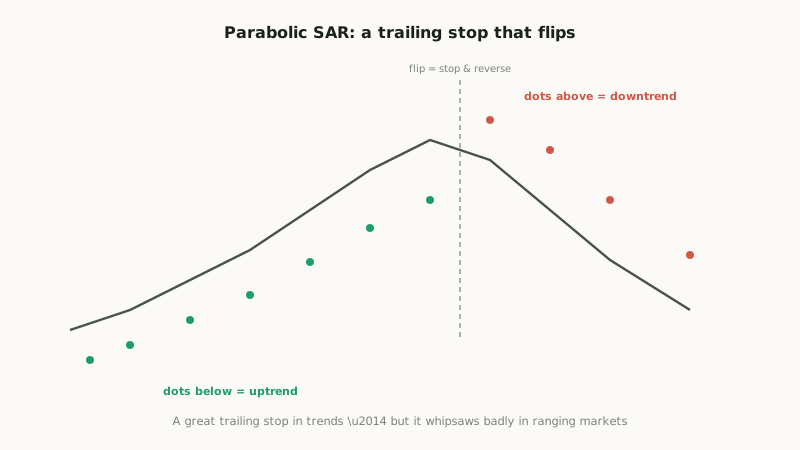
The parabolic SAR plots a distinctive trail of dots that hug the price and flip from one side to the other when the trend turns. "SAR" stands for Stop and Reverse, and that name captures its dual purpose: it provides a trailing stop-loss that follows the trend, and it signals when to potentially reverse position as the trend changes. Developed by J. Welles Wilder, the parabolic SAR is one of the best visual trailing-stop tools available — in a trending market. In a choppy, ranging market, the very same mechanism turns it into a whipsaw machine, flipping back and forth and generating false signals. Understanding both faces — its excellence in trends and its failure in ranges — is the key to using it well. This guide explains how the parabolic SAR works, how to read its flips, and where it shines and struggles.
Its primary use is as the trailing stop introduced in forex order types, applied within trend-following strategies.
Key takeaways
Q: What is the parabolic SAR?
A: The parabolic SAR (Stop and Reverse), developed by J. Welles Wilder, is a trend-following indicator plotted as a series of dots above or below price. Dots below price indicate an uptrend, dots above indicate a downtrend, and they provide trailing stop-loss levels that follow the trend.
Q: How do you use the parabolic SAR as a trailing stop?
A: In an uptrend, the SAR dots sit below price and rise as price rises, serving as a trailing stop that ratchets up to lock in profit. When price falls to touch the dots, the indicator flips to the other side, signalling a 'stop and reverse' — an exit and potential reversal of position.
Q: Why does the parabolic SAR whipsaw?
A: The parabolic SAR is a trend-following tool, so in ranging or choppy markets without a clear trend it flips back and forth frequently, generating many false signals (whipsaws). It performs well in trending markets but poorly in sideways ones, so it is best filtered by a trend indicator like ADX.
How it works
The parabolic SAR appears on the chart as a series of dots positioned above or below the price, and their position encodes the trend. When the dots are below the price, the indicator signals an uptrend; when the dots are above the price, it signals a downtrend. As price moves in the trend's direction, the dots follow along — trailing beneath a rising price in an uptrend, or above a falling price in a downtrend — forming the parabolic curve that gives the indicator its name. The dots thus provide a continuously updating, visual representation of the trend's direction.
The "Stop and Reverse" mechanism is the heart of it. When price moves against the trend far enough to touch the dots, the indicator flips the dots to the other side of price — signalling that the trend has reversed (or at least that the current trend has ended) and prompting a "stop and reverse": exit the current position and potentially open one in the new direction. A distinctive feature is that the dots accelerate toward price over time as a trend extends (governed by an acceleration factor), so the longer and stronger a trend runs, the more tightly the dots close in on price, tightening the trailing stop. This means the SAR gives a trend room early on but progressively locks in more profit as the trend matures, before flipping when price finally turns enough to reach the tightening dots. Understanding this — dots showing trend direction, flipping on a touch, accelerating toward price over time — is the basis for using the indicator.
The parabolic SAR as a trailing stop
The parabolic SAR's best and primary use is as a trailing stop, and it excels at this in a way that connects directly to the trailing-stop concept from the order-types guide. In an uptrend, the dots sit below price and rise as price rises (never falling), exactly mirroring how a trailing stop should ratchet up to lock in accumulating profit while leaving the trade room to continue. You can use the SAR dot as your stop-loss level: as long as price stays above the rising dots, you hold the position; when price falls to touch a dot, you are stopped out — having captured the trend up to that point. The mirror applies in downtrends, with dots above price falling as your trailing stop on a short.
This makes the parabolic SAR a superb visual trailing-stop mechanism: it embodies "let winners run, cut losses short" by following a profitable trend with an ever-tightening stop that protects gains while permitting the trend to extend, then exiting automatically when the trend reverses enough to hit the trailing level. The acceleration feature enhances this — early in a trend the stop is loose (giving room), and as the trend matures the stop tightens (protecting more profit) — which is intelligent trailing-stop behaviour. For trend-following strategies (from that guide), the parabolic SAR offers a clear, rules-based way to trail a stop and ride a trend to its end, taking the guesswork out of when to exit. This trailing-stop application is where the parabolic SAR delivers its greatest value, and it is how most skilled users primarily employ it — as a dynamic, trend-following exit, rather than as a primary entry signal.
The whipsaw problem
The parabolic SAR's great weakness is the flip side of its trend-following design: in ranging or choppy markets, it whipsaws badly. Because the indicator is built to follow trends and flip when price reverses, a sideways market without a clear trend causes it to flip back and forth repeatedly — dots jumping above, then below, then above price as the choppy action triggers flip after flip. Each flip is a "stop and reverse" signal, so in a range the SAR generates a stream of false signals, whipsawing a trader who follows them into a series of small losses as they are repeatedly stopped out and reversed at exactly the wrong moments.
This is the same fundamental limitation that afflicts all trend-following tools (and the mirror of the oscillator trap that afflicts range tools in trends): a trend indicator needs a trend, and applied to a trendless market it fails. The parabolic SAR is particularly prone to this because its flip mechanism is so sensitive to reversals — in choppy conditions, the frequent small reversals trigger constant flips. The practical implication is clear: the parabolic SAR should be used in trending markets, where it shines, and avoided or filtered in ranging ones, where it whipsaws. This is precisely why it pairs so well with a trend-strength filter like the ADX: using the parabolic SAR only when ADX confirms a trending market (high ADX) avoids its whipsaw-prone application in ranges, combining the two tools to use the SAR where it works and stay out where it doesn't. Recognising the SAR's range weakness — and filtering for trending conditions before relying on it — is essential to using it effectively rather than being chopped up by it.
The parabolic SAR is a brilliant trailing stop — in a trend. Its acceleration tightens the stop as the trend matures, embodying "let winners run, cut losses short" automatically. But the same flip mechanism whipsaws relentlessly in ranges. The fix is a trend filter: use the SAR only when ADX confirms a trend, and it goes from liability to asset.
How to approach it
Using the parabolic SAR well comes down to playing to its strengths and guarding against its weakness. Its strength is as a trailing stop and trend-following exit in trending markets — a clear, visual, rules-based way to ride a trend with a protective, tightening stop, ideal for the trend-following strategies covered elsewhere. Lean on it for this: let it trail your stop in a confirmed trend, and let the flip signal your exit when the trend reverses. Many traders use the SAR primarily as an exit/trailing-stop tool rather than for entries, valuing its disciplined trend-riding more than its (less reliable) reversal signals.
Guard against its weakness by not using it in isolation or in ranging markets. The most important pairing is with a trend filter like the ADX: confirm that a trend exists (ADX above its threshold) before relying on the SAR, so you apply it only where it works and avoid the whipsaws of rangebound conditions. More broadly, like every indicator on this site, the parabolic SAR is a tool, not a magic system — it should be understood (the stop-and-reverse dots, the acceleration), used in the right context (trends, not ranges), and combined with other analysis (a trend filter especially) rather than followed blindly. Its flips are not infallible reversal calls, and in the wrong conditions they are noise. Approached correctly — as a trailing-stop and trend-exit tool, applied in trending markets confirmed by a filter — the parabolic SAR is a genuinely valuable addition to a trend trader's toolkit, turning the abstract idea of a trailing stop into a clear, visual, automatic mechanism.
Combining the SAR and its settings
The parabolic SAR is at its best when combined with complementary tools rather than used alone, and a few pairings stand out. The most important, as noted, is a trend filter such as the ADX, which confirms whether a tradeable trend exists before you rely on the SAR's trailing and flip signals — keeping you out of the ranging conditions where it whipsaws. A moving average can serve a similar filtering role: only taking SAR signals in the direction of a longer-term moving average aligns the SAR with the broader trend and screens out counter-trend whipsaws. Combining the SAR (for trailing and exits) with a separate tool for entries and another for trend confirmation plays to each tool's strength.
A practical division of labour many traders adopt is to use the SAR primarily for exits and trailing stops rather than entries. Its reversal flips can be late or false (especially as a trend ends choppily), making them unreliable as standalone entry triggers, whereas its trailing-stop function in an established trend is genuinely excellent. So a common approach is to enter on a separate signal, then hand the trade to the parabolic SAR to trail the stop and dictate the exit as the trend runs and eventually turns — leveraging its strength while avoiding over-reliance on its weaker entry/reversal signals.
On settings, the parabolic SAR is governed mainly by its acceleration factor, which controls how quickly the dots tighten toward price as a trend extends (and a maximum cap on that acceleration). A higher acceleration makes the SAR more sensitive — tighter trailing, quicker flips, more signals (and more whipsaws); a lower acceleration makes it more forgiving — looser trailing, fewer flips, more room for trends to breathe. The standard defaults suit most uses, and as with all indicators, tweaking should be deliberate and tested rather than endless fiddling. Used thoughtfully — filtered for trending conditions, paired with entry and trend tools, employed mainly for trailing and exits, with sensible settings — the parabolic SAR is a clear, disciplined trend-following companion that turns the idea of a trailing stop into an automatic, visual mechanism.
The parabolic SAR (Stop and Reverse) plots dots that signal trend direction — below price = uptrend, above = downtrend — and flip sides when price touches them. Its dots accelerate toward price as a trend matures, making it an excellent visual trailing stop that locks in profit (its best use). Its weakness: it whipsaws badly in ranging markets. Use it in trending markets, filtered by a trend tool like ADX or a moving average, primarily for trailing stops and exits (not standalone entries). The acceleration factor controls its sensitivity — keep sensible defaults. A disciplined trend-following companion, not a magic system.