
Low unemployment should mean rising inflation — or so the Phillips curve has long suggested. It's one of the most influential ideas in macroeconomics, woven deeply into how central banks think about the tradeoff between jobs and prices, and a major reason traders pore over employment data for what it implies about inflation. It is also one of the most famously unreliable relationships in economics. This guide explains the Phillips curve: what it is, why it matters for forex, and its notorious breakdowns.
It's the conceptual bridge between employment data and inflation, central to how central banks set policy.
Key takeaways
Q: What is the Phillips curve?
A: The Phillips curve is an economic concept describing an inverse relationship between unemployment and inflation: when unemployment is low, inflation tends to be higher (a tight labour market pushes wages and prices up), and when unemployment is high, inflation tends to be lower. It implies a short-run tradeoff that policymakers have historically tried to navigate between the two.
Q: Why does the Phillips curve matter for forex?
A: Because it links employment data to inflation and therefore to interest-rate expectations — the key currency driver. If a falling unemployment rate signals building inflation pressure (via the Phillips-curve logic), markets may expect the central bank to raise rates, supporting the currency. It's a major reason traders scrutinise employment and wage data for what it implies about future inflation and policy.
Q: Does the Phillips curve still work?
A: Unreliably — it's famously unstable, which is the key caveat. The 1970s stagflation (high unemployment and high inflation together) appeared to break it, and in recent decades the relationship has often looked 'flat', with low unemployment failing to produce expected inflation. Economists now treat it as a shifting, expectations-dependent relationship rather than a stable law, so it should never be relied on mechanically.
What it is and why it matters
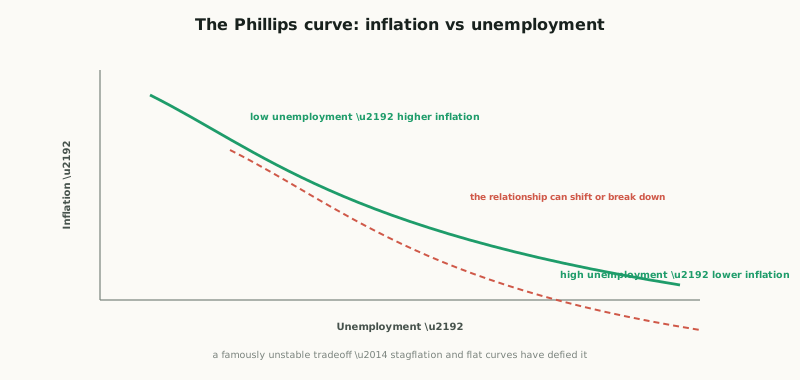
The Phillips curve, named after economist A.W. Phillips, describes an inverse relationship between unemployment and inflation. The intuition is straightforward: when unemployment is low (a tight labour market), employers must compete for scarce workers by raising wages, and those higher costs and higher household incomes push prices up — so inflation tends to be higher. When unemployment is high (a slack labour market), wage and price pressures ease, so inflation tends to be lower. Plotted, this traces a downward-sloping curve — less unemployment, more inflation — implying a short-run tradeoff that policymakers have historically tried to navigate: stimulate to lower unemployment and you may stoke inflation; tighten to curb inflation and you may raise unemployment.
For a forex trader, the Phillips curve matters because it's the conceptual link that turns employment data into an inflation signal, and therefore into an interest-rate signal — and rates are the dominant currency driver. This is precisely why markets scrutinise jobs reports and especially wage growth so intensely: through Phillips-curve logic, a falling unemployment rate or accelerating wages can signal building inflation pressure, leading markets to expect the central bank to raise rates — which tends to support the currency. Conversely, rising unemployment hints at easing inflation and potential rate cuts, a currency negative. So the Phillips curve sits, often implicitly, behind the market's reaction to employment data: traders are really asking "what does this jobs number imply for inflation, and thus for rates?" — and the Phillips curve is the framework supplying the link.
The famous breakdowns
Here is the essential caveat, and it's a big one: the Phillips curve is notoriously unreliable, and treating it as a stable law has burned both economists and traders. The most dramatic failure came in the 1970s, when many economies suffered stagflation — high unemployment and high inflation at the same time — a combination the simple Phillips curve said shouldn't happen, which appeared to shatter the relationship (see stagflation). Economists responded by arguing the curve shifts with inflation expectations: if people expect high inflation, they build it into wages and prices regardless of unemployment, moving the whole curve — so there's no stable, exploitable long-run tradeoff (the "expectations-augmented" Phillips curve). Then, in recent decades, the opposite puzzle appeared: the curve looked "flat," with very low unemployment failing to produce the inflation the relationship predicted, prompting debate about whether the link had weakened or died. The honest upshot is that the Phillips curve is a shifting, expectations-dependent, often weak relationship — a useful idea about labour-market tightness and inflation, but not a reliable mechanical predictor. A trader who assumes "low unemployment must mean rising inflation and rate hikes" can be badly wrong, because the relationship has repeatedly failed to hold.
So how should a trader use it? As a framework for interpretation, held loosely. Understand why the market watches employment and wage data through an inflation lens, and use the Phillips-curve logic to anticipate how the market might react to a jobs surprise — while remembering that the underlying relationship is unstable, that expectations matter as much as the data, and that what truly moves the currency is the central bank's interpretation and the market's reaction, not the textbook curve. In practice, this means watching how central banks themselves talk about labour-market slack and inflation (since their view drives policy), treating the Phillips curve as one input into rate expectations rather than a deterministic forecast, and staying alert to the fact that the relationship can be flat, shifted or temporarily inverted. Like every macro framework on this site, it informs a view without guaranteeing an outcome. The honest framing: the Phillips curve describes an inverse relationship between unemployment and inflation (tight labour market → higher inflation; slack → lower), implying a short-run tradeoff. It matters for forex because it links employment/wage data to inflation and thus to rate expectations — the key currency driver — which is why markets scrutinise jobs reports. But it's famously unstable: 1970s stagflation broke the simple version, it shifts with inflation expectations, and recently it has looked flat (low unemployment not producing inflation). So use it as a loose framework for interpreting how data may affect rate expectations — watching the central bank's own view — not as a reliable mechanical predictor; manage risk.
Expectations and the modern debate
To use the Phillips curve intelligently today, a trader needs to understand why economists no longer treat it as a simple, stable tradeoff — and the answer is expectations. The modern, "expectations-augmented" view holds that inflation depends not just on labour-market slack but heavily on what people expect inflation to be: if workers and firms expect 5% inflation, they build 5% into wage demands and price-setting regardless of unemployment, which becomes self-fulfilling and shifts the whole curve. This is why the 1970s produced stagflation (expectations of high inflation became entrenched even as unemployment rose) and why a related concept, the NAIRU (the "non-accelerating inflation rate of unemployment" — roughly the unemployment level below which inflation starts accelerating), entered the picture: the idea that there's a threshold of labour-market tightness beyond which inflation pressure builds, but that the threshold itself moves and is hard to pin down. The crucial practical implication is that anchored expectations change everything: in recent decades, with central banks having built credibility for hitting low inflation targets, expectations stayed anchored near target even as unemployment fell to multi-decade lows — which is a leading explanation for the "flat" Phillips curve, where the old tradeoff seemed to vanish because nobody expected the low unemployment to produce inflation.
So why do central banks and markets still reference the Phillips curve if it's so unreliable? Because the underlying intuition — that a very tight labour market eventually pressures wages and prices, and a very slack one eases them — retains real explanatory power at the extremes, even if the relationship is weak and shifting in the middle. Central banks haven't abandoned it; they've made it expectations-dependent and treat it as one input into their inflation forecasts rather than a mechanical dial. For a trader, the takeaways are concrete: watch wage growth and inflation expectations measures (not just the headline unemployment rate) as the more telling signals; recognise that a jobs report's market impact depends on whether it shifts the central bank's view of inflation pressure; and stay alert to regime questions — whether expectations remain anchored or are becoming unmoored, since that's precisely when the Phillips relationship can roar back to life (as periods of high, volatile inflation have reminded markets). The Phillips curve is thus best held as a conditional, expectations-aware framework — powerful when expectations move or at labour-market extremes, weak when expectations are anchored — rather than a fixed law. The honest reminder: it's a shifting relationship that depends on inflation expectations, which is why it has broken down and flattened; use it to interpret how labour-market and wage data might shift rate expectations, always filtered through what the central bank believes and whether expectations are anchored — never as a mechanical predictor, and manage risk.
What it means at the desk
Concretely, here's how Phillips-curve logic shows up in a trader's day. A major jobs report lands, and the figure that often moves the currency most isn't the headline payrolls number but wage growth — because, through the Phillips-curve lens, accelerating wages signal building inflation pressure, which signals possible rate hikes, which tends to support the currency. A surprisingly hot wage figure can lift a currency even on an otherwise mediocre report, while soft wages can weigh on it despite strong hiring. But the disciplined trader holds this loosely: the reaction depends on whether the data shifts the market's view of what the central bank will do, and in a "flat curve" regime with anchored expectations, even strong jobs data may provoke little inflation worry and a muted currency response. So the curve is a guide to interpreting the likely reaction, not a guarantee of it — and the trader watches the central bank's commentary to see whether it shares the inflation concern the textbook curve implies. Read this way, the Phillips curve helps you anticipate data reactions without being blindsided when the old relationship doesn't bite.
The Phillips curve describes an inverse relationship between unemployment and inflation: a tight labour market (low unemployment) tends to push wages and prices up (higher inflation); a slack one eases them (lower inflation). It matters for forex because it links employment and wage data to inflation and thus to rate expectations — the key currency driver — which is why markets pore over jobs reports (falling unemployment → possible inflation → possible hikes → currency support). But it's famously unstable: 1970s stagflation broke the simple version, it shifts with inflation expectations, and recently it's looked flat (low unemployment not producing inflation). Use it as a loose interpretive framework for how data may move rate expectations — watching the central bank's own view — never as a reliable mechanical predictor.