Normally, inflation and unemployment pull in opposite directions — a hot economy brings rising prices but low joblessness, a cold one the reverse — and policymakers can lean against whichever is the problem. Stagflation breaks that comforting rule, delivering high inflation and stagnant growth and high unemployment all at once, and it leaves central banks with no painless way out. It's a rare, difficult condition — but an important one to understand, both economically and for its tangled effects on currencies. This guide explains stagflation: what it is, what causes it, why it's a policy nightmare, and its ambiguous forex implications.
It's a pathological state of inflation and the business cycle, and a genuine dilemma for central banks and monetary policy.
Key takeaways
Q: What is stagflation?
A: Stagflation is the rare and painful combination of stagnant economic growth (or recession) and high unemployment occurring together with high inflation. It breaks the usual inverse relationship between inflation and unemployment (the Phillips curve), where one normally falls as the other rises — in stagflation, both problems strike at once.
Q: What causes stagflation?
A: It's typically caused by adverse supply shocks — such as a sharp rise in oil or energy prices, which both raises costs (driving inflation) and depresses output (causing stagnation) — or by policy mistakes, like excessive money-supply growth combined with supply constraints. The classic example is the 1970s, when oil shocks produced high inflation alongside recession.
Q: How does stagflation affect a currency?
A: The effect is ambiguous, because the pressures conflict. High inflation tends to erode a currency's value, but if the central bank raises rates to fight inflation, the higher rates can support it — while the weak economy weighs against it. The net outcome depends on the policy response and on conditions relative to other countries, with risk-off and safe-haven flows often accompanying stagflationary stress.
What stagflation is
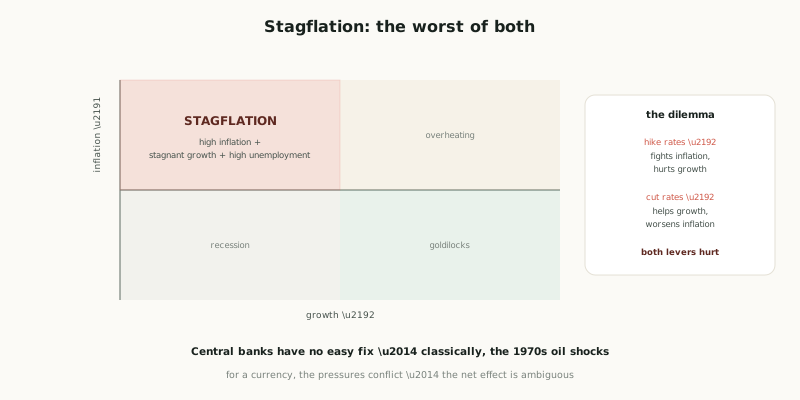
Stagflation is the rare and painful combination of stagnant economic growth (or outright recession) and high unemployment, occurring together with high inflation. The word itself fuses "stagnation" and "inflation." What makes it so troubling is that it breaks the usual trade-off between inflation and unemployment — the relationship economists describe with the Phillips curve, in which inflation and unemployment normally move inversely (a booming economy with low unemployment runs hot and inflationary; a weak economy with high unemployment is disinflationary). In stagflation, that comfortable inverse relationship collapses, and an economy suffers both evils at once: prices rising rapidly even as growth stalls and joblessness climbs. The classic and defining episode is the 1970s, when oil shocks (OPEC embargoes and surging energy prices) produced exactly this toxic mix across many Western economies — an experience that famously challenged the prevailing economic orthodoxy of the time, which had assumed the inflation-unemployment trade-off was reliable.
What causes it? Most often, an adverse supply shock — the textbook case being a sharp rise in oil or energy prices, which simultaneously raises costs across the economy (driving "cost-push" inflation) and depresses output (as expensive energy and inputs throttle production), producing inflation and stagnation together. It can also arise from policy mistakes, such as excessive money-supply growth colliding with supply constraints. The common thread is that something pushes prices up while simultaneously hurting growth — the opposite of the usual demand-driven dynamics.
The policy nightmare, and forex implications
Stagflation is a nightmare for central banks precisely because their standard tools conflict. Normally a central bank fights inflation by raising rates (cooling the economy) and fights weak growth/unemployment by cutting rates (stimulating it) — and normally only one of those is the problem at a time. In stagflation, both are problems at once, so whichever lever the central bank pulls worsens the other: raising rates to tame inflation deepens the recession and pushes unemployment higher, while cutting rates to support growth pours fuel on the inflation fire. There is no easy fix — every option involves accepting more of one pain to relieve the other, which is why stagflation is so feared and so hard to escape (the 1970s required a brutal, recession-inducing tightening to finally break inflation). For traders, the key is to watch which problem the central bank chooses to prioritise, since that choice drives the policy path — and thus the currency.
The forex implications of stagflation are genuinely ambiguous, because the pressures on the currency conflict. On one hand, high inflation tends to erode a currency's value (the purchasing-power and debasement effects covered in inflation and forex). On the other, if the central bank raises rates aggressively to fight that inflation, the higher rates can attract capital and support the currency (the rate-differential effect). Yet at the same time, the weak economy weighs against the currency. The net result depends on which force dominates — chiefly the central bank's policy response and how conditions compare to other countries (currencies trade in pairs, so it's relative stagflation and relative policy that matter). Markets watch closely whether a central bank turns hawkish (prioritising inflation — potentially currency-supportive but recession-risking) or accommodative. Stagflationary stress also tends to bring uncertainty and risk-off sentiment, often boosting safe-haven currencies and pressuring riskier ones. The honest framing: stagflation is the painful combination of stagnant growth, high unemployment and high inflation together (breaking the usual inflation-unemployment trade-off), classically the 1970s oil-shock era, typically caused by supply shocks or policy errors. It's a central-bank nightmare because the standard tools conflict — hiking fights inflation but hurts growth, cutting helps growth but worsens inflation. For forex, a stagflationary currency faces conflicting pressures (inflation erodes it; rate hikes to fight inflation can support it; weak growth weighs on it), so the net effect is ambiguous and depends on the policy response and relative conditions, with risk-off/safe-haven flows common. It's a complex, uncertain environment where outcomes hinge on many interacting factors — understanding stagflation helps you read a difficult macro backdrop and the tensions within it, not predict a currency's direction with confidence.
Navigating a stagflationary environment
Beyond the currency-specific tensions, it helps to understand how a stagflationary backdrop tends to affect markets broadly, since that context shapes currency flows. Historically, stagflation has been kind to real assets and commodities — especially the very things (like oil and gold) whose price rises often cause the inflation — while it tends to punish both bonds (high inflation erodes fixed coupons and pushes yields up) and equities (weak growth hurts earnings while high rates compress valuations), the painful "nowhere to hide" quality that made the 1970s so brutal for conventional portfolios. Gold in particular is often sought as an inflation hedge and store of value when confidence in currencies and policy wavers. For the currency trader, this matters because it shapes the risk environment and the relative appeal of commodity-linked currencies versus others.
The central read in a stagflationary period is relative policy: because currencies trade in pairs, what drives them is how one central bank's response compares to another's. A central bank that turns decisively hawkish — prioritising the inflation fight with aggressive hikes, accepting the growth pain — may see its currency supported by the rising rate differential (even amid a weak economy), while one that stays accommodative to protect growth may see its currency pressured by persistent inflation. So watching which problem each central bank chooses to prioritise, and how that compares across countries, is the key to anticipating relative currency moves. The historical lesson is instructive: the 1970s stagflation was only broken when the US Federal Reserve under Paul Volcker raised rates to punishing levels, inducing a deep recession but ultimately crushing inflation and, in time, strengthening the dollar — a vivid illustration of the hawkish path's currency consequences. The overarching honest point, though, is humility: stagflation is a complex, uncertain environment of conflicting forces, where outcomes depend on many interacting and unpredictable factors. Fundamental analysis helps you understand the tensions and read the relative-policy dynamics — it does not let you forecast a currency's path with confidence. The wise response to such uncertainty is the same as ever: respect the ambiguity, manage risk carefully, and avoid over-confident bets in an environment defined by competing pressures.
A rare and contested diagnosis
It's worth stressing how rare and contested genuine stagflation is. True, sustained stagflation — entrenched high inflation alongside real economic stagnation and rising unemployment — is uncommon; the 1970s remain the textbook case precisely because clean examples are so few. The word gets used loosely whenever inflation and slowing growth coincide even briefly, but a passing bout of "high inflation and softening growth" is not the same as the deep, persistent, hard-to-escape condition the term properly describes. The warning signs to watch are the combination holding together over time: inflation staying stubbornly high while growth weakens and unemployment rises, typically alongside an adverse supply shock (such as a sustained energy-price spike) and a central bank visibly trapped by the conflicting demands on policy. Even then, economists often disagree on whether a given episode truly qualifies. For traders, the lesson is twofold: don't reach for the dramatic "stagflation" label at the first sign of mixed data, and recognise that if a genuine stagflationary regime does take hold, it's an unusually difficult, uncertain environment in which the usual relationships strain and humility is the only sensible posture. Understanding the concept prepares you to recognise the conditions and read the policy tensions — not to declare stagflation prematurely or to trade it with false confidence.
Stagflation = stagnant growth + high unemployment + high inflation together — breaking the usual inflation–unemployment trade-off (the Phillips curve). Classically the 1970s oil shocks; typically caused by supply shocks (e.g. energy prices, which raise costs and depress output) or policy errors. It's a central-bank nightmare because the tools conflict: hiking rates fights inflation but worsens the recession; cutting helps growth but fuels inflation — every lever hurts. For forex, the effect is ambiguous: inflation erodes the currency, but rate hikes to fight it can support it, while weak growth weighs on it — the net depends on the policy response and relative conditions, with risk-off/safe-haven flows common. A complex, uncertain environment — understanding it helps you read the tensions, not predict a precise currency direction.