
In the 1980s, two traders made a bet. Richard Dennis believed trading could be taught; his partner William Eckhardt believed it was an innate gift. To settle it, Dennis recruited a group of complete novices — nicknamed the "Turtles" — and trained them in a fixed, mechanical trading system. The Turtles went on to make fortunes, and the experiment became legendary, settling the argument in Dennis's favour. The system they followed — a systematic, breakout-based trend-following method — remains the textbook illustration of how disciplined, rule-based trend-following works. This guide explains the Turtle system: its origin, its rules, its volatility-based sizing, and the enduring lessons it teaches.
It's a classic application of breakout and trend-following strategies, and a famous early example of volatility-based position sizing.
Key takeaways
Q: What was the Turtle trading experiment?
A: In the 1980s, traders Richard Dennis and William Eckhardt disagreed over whether trading could be taught. To settle it, Dennis recruited and trained a group of novices — nicknamed the 'Turtles' — in a fixed, mechanical trend-following system. The Turtles went on to make large profits, demonstrating that a rule-based edge, followed with discipline, could be taught.
Q: How did the Turtle system work?
A: It was a mechanical trend-following system based on Donchian channel breakouts: buy when price broke above a recent N-day high, sell or short when it broke below an N-day low, and exit on a shorter opposite channel. Position size was set by volatility (using a measure they called 'N', based on ATR), with strict risk limits and pyramiding into winning trends.
Q: Does the Turtle system still work today?
A: The original system worked extremely well in the trending markets of its era. Pure long-term breakout trend-following has had harder, choppier periods since, and the exact original parameters are not a guaranteed edge today. But its principles — mechanical rules, trend-following via breakouts, volatility-based sizing, cutting losses and letting winners run, and disciplined execution — remain hugely influential.
The origin and core idea
The Turtle experiment — born of the Dennis–Eckhardt bet over whether trading could be taught — is one of the most famous stories in trading, precisely because of its result: the trained novices, following a mechanical system with discipline, were highly successful. This proved Dennis's point that a rule-based edge, executed with discipline, could be learned — it wasn't innate genius but a teachable method. That conclusion is itself one of the system's most important legacies, and a hopeful one for any aspiring systematic trader.
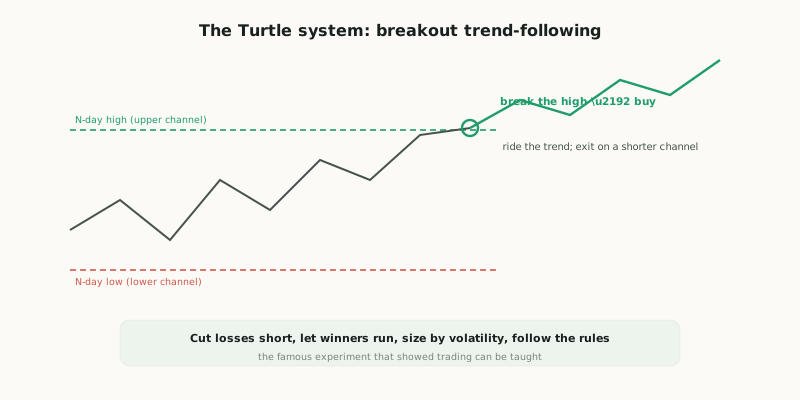
The core idea of the system is trend-following via breakouts. Specifically, it used Donchian channels — a simple indicator marking the highest high and lowest low over the last N periods. The logic: when price breaks above the recent N-day high, it signals a potential new uptrend (a breakout to new highs), so you buy; when price breaks below the recent N-day low, it signals a potential downtrend, so you sell/short. The system then aimed to ride the resulting trend for as long as it lasted, exiting when the trend reversed. This is pure, classic trend-following: enter on a breakout in the trend's direction, hold while the trend runs, exit when it turns — capturing the large, sustained moves that trend-following lives on. The breakout entry is the signal that a trend may be underway; the Donchian channel is simply the mechanical way of defining "a breakout."
The key rules
The original Turtle system was detailed and precise (the Turtles followed exact rules), but its essential components can be summarised. The table captures the key rules.
The Turtle system's key rules
The entry was a breakout of a Donchian channel — for example, buying a 20-day high breakout (with a longer 55-day system as a backup, to catch bigger trends the shorter system might miss). The exit used an opposite, shorter channel — for instance, exiting a long position when price hit a 10-day low — embodying the principle of letting winners run (staying in while the trend continues) while cutting the position when the trend showed clear signs of reversing. The position sizing was a genuine innovation: it was based on volatility, using a measure they called "N" (essentially the ATR, average true range). By sizing positions according to volatility, each trade risked a roughly consistent amount regardless of the instrument's volatility — the foundation of volatility-based position sizing, and a sophisticated approach for its time. The system also used pyramiding (adding to winning positions as the trend extended, in defined units) to maximise gains from big trends, and strict risk management (risking a fixed percentage per trade, with limits on total units/exposure) to control losses. The combination — breakout entries, trend-riding exits, volatility sizing, pyramiding, and tight risk control — made a complete, coherent systematic trend-following machine.
The lessons, and the honest caveats
The Turtle system's enduring value lies less in its exact parameters than in the lessons it crystallises. First, it proved trading can be taught — a mechanical, rules-based edge, followed with discipline, worked for novices, which remains an encouraging and important point. Second, it's a textbook example of systematic trend-following, demonstrating the core principles that still underpin the approach: cut losses short, let winners run, follow the rules mechanically (without second-guessing), size by volatility, and ride the big trends that pay for the many small losing breakouts. Third, and tellingly, the experiment highlighted that the discipline to follow the system was the real key — even when (in later tellings) the rules became widely known, the edge lay in the disciplined execution, since most people can't follow a mechanical system through its inevitable drawdowns and string of small losses. The system worked for those with the discipline to trust it; the rules alone weren't enough.
Honesty requires important caveats, however. The original Turtle system worked brilliantly in the strongly trending markets of its era. Pure, long-term breakout trend-following has had harder periods since — markets have at times been choppier and more range-bound, producing more failed breakouts (whipsaws) and longer drawdowns for such systems — and the exact original parameters are not a guaranteed edge in today's markets. So the Turtle system should not be copied blindly as a turnkey money-maker; like any system, its specific edge is conditional and can decay (the edge-decay point from building a system). But its principles — mechanical rules, trend-following via breakouts, volatility-based position sizing, cutting losses and letting winners run, and above all disciplined execution — remain hugely influential and instructive, informing systematic trend-following to this day. The honest framing: the Turtle trading system is the famous, fully mechanical breakout-based trend-following method from the 1980s Turtle experiment — buy breakouts of Donchian channels, ride trends, exit on shorter opposite channels, size by volatility, pyramid into winners, control risk tightly. It proved trading can be taught and is the classic illustration of disciplined systematic trend-following. While its exact parameters aren't a guaranteed edge today (pure breakout trend-following has had harder periods, and edges decay), its principles endure and are well worth understanding. Study it for the principles and discipline it embodies, not as a formula to copy — and, as always, any system must be tested and traded with risk management.
Applying the principles today
Since the original parameters aren't a turnkey edge anymore, the real value lies in applying the Turtle principles the way modern systematic trend-followers do. Several elements have aged especially well. The dual-system idea — the Turtles used a shorter breakout system (the 20-day) and a longer one (the 55-day) as a backup, so that if a shorter breakout failed, the longer system could still catch a major trend — reflects a durable insight: using multiple breakout lengths helps avoid missing the big trends while filtering some noise. The volatility-based sizing ("N", essentially ATR) is now standard practice in serious systematic trading, because normalising position size by volatility keeps risk consistent across instruments of very different character — a principle far more valuable than any specific channel length. And the discipline of pyramiding into winners (adding to positions as a trend extends, within strict unit limits) embodies the "let winners run" maxim in a controlled, rules-based way.
Perhaps the most transferable Turtle lesson is diversification across many markets. The Turtles traded a broad basket of instruments, not one or two, because trend-following relies on catching the occasional big trend somewhere — and you can't predict which market will trend, so you must be positioned to catch trends wherever they appear. Spreading a trend-following system across many uncorrelated markets smooths the equity curve (some markets trend while others chop) and improves the odds of capturing the large winners that pay for the many small losing breakouts. This is why pure trend-following is typically run across diversified portfolios rather than a single pair. The honest takeaway for a trader today: don't copy the Turtle parameters and expect riches — markets and the specific edge have moved on. Instead, absorb the principles: trend-following via breakouts, multiple system lengths, volatility-based sizing, cutting losses and letting winners run, pyramiding within strict limits, diversification across markets, and — above all — the disciplined, mechanical execution that the experiment showed was the true edge. Build and test your own system on those principles (the building-a-system process), and the Turtle legacy becomes a foundation to learn from rather than a formula to chase. Its enduring message is less "trade these exact rules" than "a tested, disciplined, well-diversified systematic edge, followed faithfully through drawdowns, can work — and can be learned."
The Turtle system came from a 1980s experiment in which traders Dennis and Eckhardt taught novices (the "Turtles") a mechanical system — and they made fortunes, proving trading can be taught. It's a classic systematic trend-following method: enter on a breakout of a Donchian channel (e.g. a 20-day high), exit on a shorter opposite channel (e.g. a 10-day low), size positions by volatility (ATR — their "N"), pyramid into winning trends, and control risk strictly. Lessons: cut losses, let winners run, follow rules mechanically, size by volatility, and — crucially — the discipline to follow the system through drawdowns was the real edge. Honest caveat: the original worked best in its era's trending markets; pure breakout trend-following has had harder periods since, and the exact parameters aren't a guaranteed edge today. Study it for its enduring principles and discipline, not as a formula to copy — test any system and trade it with risk management.