Most candlestick signals rest on one or two candles — a single doji, a two-candle engulfing. Three white soldiers and three black crows rest on three, and that's precisely the point. Three strong candles marching the same way show not a momentary flicker of intent but a sustained, decisive shift in who controls the market — which is why these are among the more reliable reversal patterns. But three big candles also raise a particular risk: that the move is already stretched. This guide explains both patterns: their structure, what they mean, the quality criteria, the overextension caution, and why confirmation still matters.
They belong to the candlestick patterns family, complement other strong reversals like the morning and evening star, and are best read in the context of market structure.
Key takeaways
Q: What are three white soldiers?
A: Three white soldiers is a bullish reversal pattern of three consecutive long green (bullish) candles, each opening within the prior candle's body and closing progressively higher, with small upper wicks. Appearing after a downtrend, it signals a strong, sustained shift to buyers taking control.
Q: What are three black crows?
A: Three black crows is the bearish mirror image: three consecutive long red (bearish) candles, each opening within the prior body and closing progressively lower, with small lower wicks. Appearing after an uptrend, it signals a strong, sustained shift to sellers taking control — a bearish reversal.
Q: Are these patterns reliable?
A: They are considered relatively reliable for candlestick patterns, because three strong candles in a row show sustained momentum rather than a single flicker. But the main caution is overextension: after three big candles, the move may be short-term stretched, so entering on the third can mean chasing. They still need context and confirmation, and can fail.
The two patterns
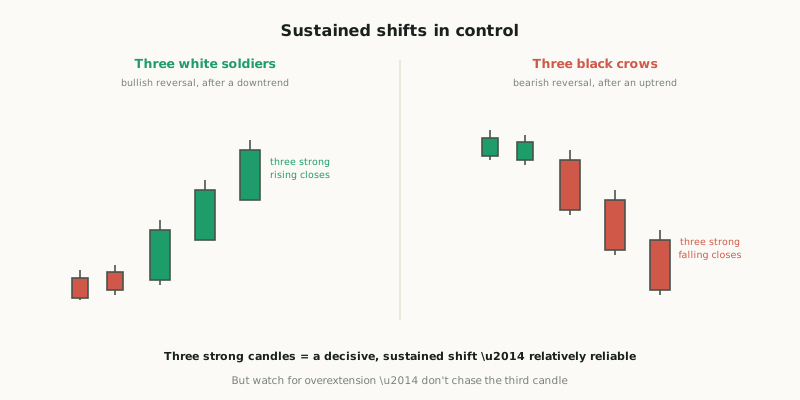
Three white soldiers is a bullish reversal pattern consisting of three consecutive long green (bullish) candles. Each candle opens within the body of the previous one and closes progressively higher (each close above the last), with relatively small upper wicks (showing buyers held control right into the close). Appearing after a downtrend, the three soldiers signal that buyers have decisively taken over, driving price steadily higher over three periods — a strong bullish reversal. Three black crows is the exact mirror image and bearish counterpart: three consecutive long red (bearish) candles, each opening within the prior body and closing progressively lower, with small lower wicks. Appearing after an uptrend, the three crows signal sellers have taken decisive control, pushing price steadily down — a strong bearish reversal. The table lays them side by side.
Three white soldiers vs three black crows
| Feature | Three white soldiers | Three black crows |
|---|---|---|
| Candles | Three long green | Three long red |
| Closes | Progressively higher | Progressively lower |
| Appears after | A downtrend | An uptrend |
| Signals | Bullish reversal | Bearish reversal |
What they mean and the quality criteria
What sets these patterns apart from single- or two-candle signals is that they show sustained momentum over three periods — a decisive, consistent shift in control rather than a single moment of indecision or a one-candle counter-move. Three strong candles in a row, each closing further in the new direction, demonstrate that one side (buyers for soldiers, sellers for crows) has not merely appeared but has taken and held control across multiple periods. This sustained, consistent move is why three white soldiers and three black crows are generally considered relatively strong and reliable reversal signals among candlestick patterns — the three-candle confirmation is, in a sense, built into the pattern itself.
That reliability depends on quality criteria, however, and not every three-candle run qualifies. The candles should be genuinely long and strong (substantial real bodies, reflecting conviction), with small wicks — particularly small wicks against the move (small upper wicks for soldiers, small lower wicks for crows), which show the controlling side held its grip right into each close rather than being pushed back. Each candle should close progressively further in the new direction and ideally open within the prior candle's body (showing steady, orderly advance rather than gaps). When these criteria are met, the pattern is convincing. When they're not — if the candles have long wicks (signalling the controlling side was repeatedly pushed back, i.e. weakening conviction), or if the bodies are shrinking — the pattern is weaker and less trustworthy. So the strength of the signal scales with the strength and cleanliness of the three candles: long, strong, small-wicked, progressively-closing candles make a reliable pattern; ragged, long-wicked ones do not.
The overextension risk and confirmation
The distinctive caution with three white soldiers and three black crows — the one that trips up traders — is overextension. By the time three strong candles have completed, price has already moved a considerable distance in the new direction. This creates a practical problem: entering on the close of the third candle often means buying (or selling) into a move that's already short-term stretched, which can lead to a poor entry right before a pullback. After three big candles in a row, the move may be due a breather — so chasing it at the third candle's close risks getting in at a short-term extreme, then watching price retrace against you. The same enthusiasm that makes the pattern convincing also makes it tempting to chase, and chasing an extended move is a classic error (related to the FOMO and overtrading pitfalls). In extreme cases, a very extended third candle can even signal exhaustion (a climax) rather than healthy continuation.
The practical response is patience: rather than chasing the third candle, wait for a pullback to enter at a better price, or wait for further confirmation that the new direction is holding. This sidesteps the overextension trap and improves the risk:reward of the entry. Beyond overextension, the usual candlestick caveats apply: the pattern needs context (a prior trend to reverse — three green candles within an established uptrend are just continuation, not the reversal pattern), ideally confirmation and confluence (a key level, supportive structure), and it can still fail, so it must be traded with risk management. The honest framing: three white soldiers (bullish, after a downtrend) and three black crows (bearish, after an uptrend) are strong, sustained three-candle reversal patterns — relatively reliable thanks to the three-candle shift in control — provided the candles are long, strong and small-wicked. Their key risk is overextension: don't chase the third candle into a stretched move; wait for a pullback or confirmation. They still need context, benefit from confluence, can fail, and are probabilistic, not magic. Used with that discipline — respecting the quality criteria, not chasing the extension, and managing risk — they're among the more dependable candlestick signals a trader has.
Trading the pattern, and its look-alikes
Trading three white soldiers or three black crows well comes down to managing the overextension problem and respecting context. Because entering on the third candle's close usually means chasing a stretched move, the practical approaches are to wait for a pullback (let price retrace part of the three-candle move, then enter in the pattern's direction at a better price and with a tighter stop) or to wait for confirmation that the new trend is holding before committing. Both sidestep the poor risk:reward of buying at a short-term extreme. For stop placement, a logical level is beyond the start of the pattern — below the low of the first soldier (for a long) or above the high of the first crow (for a short) — though on a deep three-candle move that can be a wide stop, which is itself a reason to wait for a pullback and a tighter entry. As always, size the position by the stop distance and your risk, and never treat the strong-looking pattern as a licence to skip the stop.
It also helps to recognise the pattern's look-alikes and variations, which carry different (often weaker) messages. The classic warning signs are three candles whose bodies are shrinking or whose wicks are growing as the run progresses — traditional candlestick lore calls some of these the "advance block" or "stalled" patterns, and they suggest the move is losing steam rather than confirming a strong reversal, so they shouldn't be traded as clean soldiers/crows. Similarly, three strong candles with little or no body separation can be a related "identical" variant. The key discernment, though, is the most basic one: distinguishing a genuine three-candle reversal from mere continuation. Three strong green candles within an established uptrend are not "three white soldiers" signalling a reversal — they're just the uptrend continuing; the pattern is only a reversal signal when it appears after a downtrend (and the crows after an uptrend). Always check the prior context: the same three candles mean "reversal" after an opposing trend and "continuation" within an aligned one. Get the context right, respect the quality criteria, refuse to chase the extension, and trade with a defined stop — and these become among the more dependable candlestick patterns; ignore those disciplines and even a textbook-looking pattern can lead you into a stretched, failing trade.
Three white soldiers = three consecutive long green candles, each closing progressively higher with small upper wicks, after a downtrend → strong bullish reversal. Three black crows = three consecutive long red candles, closing progressively lower with small lower wicks, after an uptrend → strong bearish reversal. They're relatively reliable because three strong candles show sustained control, not a single flicker. Quality criteria: long, strong bodies with small wicks (against the move), each closing further, opening within the prior body — long wicks or shrinking bodies weaken the signal. Key risk: overextension — after three big candles the move may be stretched, so don't chase the third candle; wait for a pullback or confirmation. Still needs a prior trend (context), benefits from confluence, can fail — probabilistic, not magic. Trade with risk management.