
EUR/CHF looks like one of the calmest pairs on the board — tight, quiet, often barely moving. That very calm is what makes it dangerous, because beneath the placid surface sits the Swiss National Bank (SNB), which actively manages the franc, and a history of sudden, violent shocks — most infamously the 2015 crash that destroyed accounts in minutes. EUR/CHF is the textbook lesson that "low volatility" and "low risk" are not the same thing. This guide explains trading EUR/CHF: what the pair is, why the SNB dominates it, the 2015 event and its lasting lesson, its character, drivers and best sessions.
It's the clearest real-world case of currency intervention and managed-rate tail risk, and it turns on the franc's safe-haven status.
Key takeaways
Q: What is the EUR/CHF pair?
A: EUR/CHF is a cross pair (no US dollar) pitting the euro against the Swiss franc — two closely linked European currencies, since Switzerland trades heavily with the Eurozone. It's typically one of the lower-volatility pairs, trading in tight ranges much of the time, but it's heavily influenced by the Swiss National Bank and carries significant tail risk from SNB policy shifts.
Q: What happened to EUR/CHF in 2015?
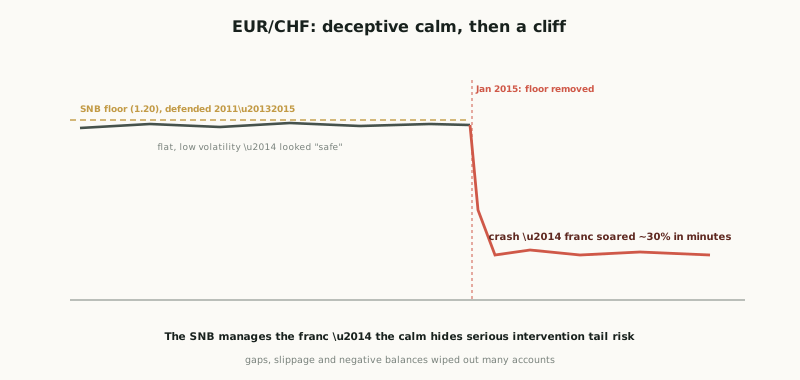
A: From 2011 the Swiss National Bank (SNB) maintained a floor on EUR/CHF (a minimum of 1.20) to stop the franc strengthening too much and hurting Swiss exporters. In January 2015 it suddenly abandoned that floor, and EUR/CHF crashed almost instantly — the franc soared roughly 30% in minutes. The move gapped through stop-losses, caused huge slippage and negative balances, and wiped out many traders and even some brokers.
Q: What drives EUR/CHF?
A: The Swiss National Bank above all — it actively manages the franc (through intervention and negative rates) to limit its strength, because a strong franc hurts Swiss exports. Beyond the SNB, the ECB-vs-SNB rate differential and risk sentiment matter: the franc is a safe haven, so it strengthens in risk-off, pushing EUR/CHF down. The two economies' close links keep the pair relatively stable most of the time.
The SNB and the 2015 lesson
To trade EUR/CHF is to trade the Swiss National Bank. Because a too-strong franc hurts Switzerland's export-heavy economy, the SNB has long acted to limit franc strength — through direct intervention and, at times, deeply negative interest rates. The most dramatic chapter: from 2011 the SNB enforced a floor on EUR/CHF of 1.20 (it would not let the pair fall below that, defending it by creating francs to buy euros), pinning the pair to a tight, artificially calm range for over three years. Then, in January 2015, the SNB abandoned the floor without warning — and EUR/CHF crashed almost instantly, the franc soaring roughly 30% in minutes. The move gapped straight through stop-losses, produced enormous slippage and negative account balances, and wiped out countless traders and even some brokers. It stands as the definitive lesson in intervention tail risk: a pair can look stable, quiet and "safe" for years precisely because a central bank is holding it there — and then move catastrophically when that artificial calm breaks. Never mistake a managed, low-volatility pair for a low-risk one (see exchange rate regimes on why pegs and floors break). Trade EUR/CHF with conservative size, an awareness that stops may not fill where you expect during a shock, and respect for the SNB's outsized influence.
Character, drivers and sessions
In normal conditions, EUR/CHF is one of the lower-volatility pairs, trading in relatively tight ranges with usually tight spreads. The reason is structural: Switzerland and the Eurozone are closely linked economically (the Eurozone is Switzerland's dominant trading partner), so the two currencies tend to move broadly together, dampening the pair's volatility. This calm makes it appealing to range-oriented traders — but always with the tail-risk caveat above firmly in mind. Beyond the dominant SNB influence, the pair's drivers are the ECB-vs-SNB rate differential (the gap between Eurozone and Swiss policy) and risk sentiment: because the franc is a classic safe-haven currency, it tends to strengthen when markets are fearful — pushing EUR/CHF down in risk-off — and weaken in calm, lifting EUR/CHF (though the SNB may lean against excessive franc strength, complicating the clean haven response).
On timing, both the euro and the franc are European currencies, so EUR/CHF is most active during the European/London session, when both legs see their liquidity and movement. On correlations, the franc's haven status means EUR/CHF tends to fall during the same risk-off episodes that lift other havens, and the pair is loosely related to other CHF and EUR crosses. As ever, this describes the pair's typical character and drivers, not a prediction — and with EUR/CHF the honest emphasis falls squarely on risk: the deceptive calm is exactly when caution matters most. The honest framing: EUR/CHF pits the euro against the Swiss-franc safe haven and is defined by the SNB, which actively manages the franc (intervention, negative rates) to limit its strength. It's typically a low-volatility, tight-range pair (the two economies are closely linked) — but it carries serious tail risk from SNB policy shifts, dramatically shown in January 2015 when the SNB abandoned its floor and the pair crashed ~30% in minutes, wiping out many accounts (gaps, slippage, negative balances). The franc's haven status means EUR/CHF tends to fall in risk-off. Drivers: SNB policy/intervention (dominant), the ECB-SNB rate differential, and risk sentiment; it's most active in the European/London session. Treat the deceptive calm with great caution — the tail risk is real, so size conservatively and manage risk.
Trading EUR/CHF with eyes open
So how do you actually trade a pair like this? The honest answer starts with respect for the tail risk, which colours everything else. Many traders are drawn to EUR/CHF precisely for its calm, range-bound behaviour — it can be a reasonable range-trading vehicle, buying near the bottom of an established range and selling near the top, since the close euro–Swiss economic links tend to keep it from trending strongly. But that range-trading must be done with tail-risk-aware sizing: smaller positions than the low volatility would seem to invite, stops that you understand may not fill where you place them during a shock, and no illusion that the quiet will last indefinitely. The 2015 crash is the permanent reminder that selling volatility on a managed pair — collecting small gains from the calm — can work for a long time and then lose far more than was ever made in a single, ungovernable move. If you trade EUR/CHF's range, do so as someone holding a coiled spring, not a sleepy pet.
Watching the SNB is the central ongoing task. Because the bank actively manages the franc, its communications, policy decisions and any hints about intervention or rate settings are the dominant catalysts — far more so than routine data. A trader on this pair should follow SNB statements closely and treat any sign of a policy shift with great seriousness, since this is exactly the channel through which the calm can break. The ECB side and the rate differential matter too, as does risk sentiment via the franc's safe-haven role (risk-off tends to strengthen the franc and pull EUR/CHF down, though the SNB may lean against excessive franc strength, muddying the clean haven response). It's also worth knowing that after 2015 many brokers reduced leverage on CHF pairs and tightened conditions, a structural acknowledgement of the jump risk that traders should factor into their own caution.
The broader lesson EUR/CHF teaches extends well beyond this one pair: a quiet chart is not a safe one when a central bank is holding it quiet. The same logic applies to any heavily managed or pegged currency (see exchange rate regimes) — the suppressed volatility is borrowed, and the bill can come due all at once. For most traders, EUR/CHF is best treated either as a cautious, small-size range play by those who genuinely understand and accept the tail risk, or simply left alone in favour of freely floating pairs whose risks are more transparent. There's no shame in the latter choice; the deceptive calm has cost many traders far more than they expected. The honest framing throughout is the one this pair embodies better than any other: respect what you cannot see, size for the shock you hope never comes, and never confuse a central bank's enforced calm with the absence of danger.
Why Switzerland manages the franc
It helps to understand why the SNB behaves as it does, because that motivation is unlikely to change. Switzerland is a small, open, export-dependent economy, and its franc's deep safe-haven appeal creates a chronic problem: in every bout of global fear, money floods into the franc, driving it up — which makes Swiss exports more expensive abroad and imports cheaper, hurting Swiss industry and risking deflation. Left unchecked, the very thing that makes the franc attractive (its stability and haven status) would strangle the economy through relentless appreciation. So the SNB intervenes — selling francs, running negative rates, at one point enforcing the floor — to lean against this structural upward pressure. For the EUR/CHF trader, the practical implication is durable: the SNB has a standing incentive to resist franc strength (a downward EUR/CHF), and may act, sometimes abruptly, when that strength becomes acute. This isn't a one-off historical quirk but an ongoing feature of the pair, and it's the deeper reason EUR/CHF can never be treated as a simple free-floating market — there is always a powerful, motivated hand near the wheel.
EUR/CHF is a cross (no USD) pitting the euro against the Swiss-franc safe haven, and it's defined by the SNB, which actively manages the franc (intervention, negative rates) to limit its strength. Normally it's a low-volatility, tight-range pair (Switzerland and the Eurozone are closely linked) — but it carries serious tail risk: in January 2015 the SNB abandoned its EUR/CHF floor and the pair crashed ~30% in minutes, gapping through stops and causing negative balances. Low volatility is not low risk. Drivers: SNB policy (dominant), the ECB-SNB rate differential, and risk sentiment (the franc strengthens in risk-off, pushing EUR/CHF down). Most active in the European/London session. Trade it with conservative size, awareness that stops may not fill in a shock, and respect for the SNB.