If a double top is two failed attempts at a level, a triple top is three — and the extra test makes the message clearer: this barrier is holding, and the trend may be done. Triple tops and triple bottoms are reversal patterns, close cousins of the double top and double bottom (already covered), where price tests a level three times and fails, signalling exhaustion and a likely reversal. This guide explains how they form, the logic of three failed tests, how they differ from their double cousins, and how to trade them with confirmation — deepening the chart-patterns material with a stronger variant of a familiar reversal.
It's a deep-dive within chart patterns, a direct extension of the double top and double bottom, and built entirely on support and resistance.
Key takeaways
Q: What is a triple top pattern?
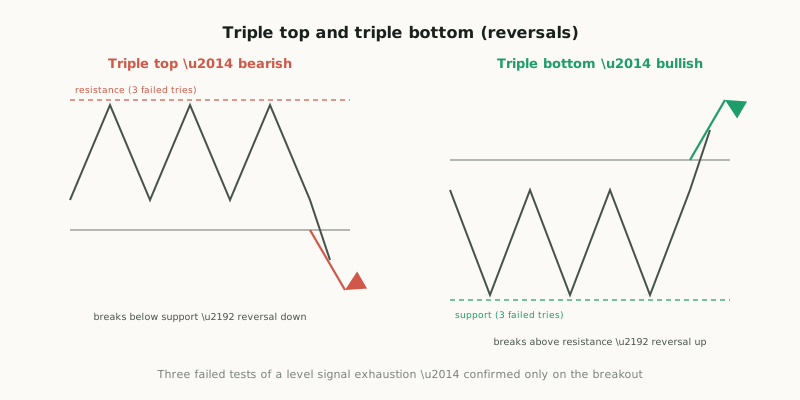
A: A triple top is a bearish reversal pattern formed by three peaks at roughly the same resistance level — three failed attempts to break higher — with troughs between them. It signals a reversal from up to down, confirmed when price breaks below the support level formed by those troughs.
Q: What is a triple bottom pattern?
A: A triple bottom is a bullish reversal pattern formed by three troughs at roughly the same support level — three failed attempts to break lower — with peaks between them. It signals a reversal from down to up, confirmed when price breaks above the resistance formed by those peaks.
Q: How is a triple top different from a double top?
A: A triple top has three tests of the level rather than two. The logic is the same — repeated failure to break a level signalling exhaustion — but the extra test makes the level look stronger and the signal arguably more reliable, though triple tops are rarer and take longer to form than double tops.
How they form
Triple tops and bottoms are reversal patterns built on the simple, powerful logic of repeated failure to break a level. A triple top forms after an uptrend: price rises to a resistance level and is rejected, pulls back, rises again to roughly the same resistance and is rejected again, pulls back, and rises a third time to the same level — only to be rejected once more. The result is three peaks at roughly the same resistance level, with two troughs between them. The pattern signals a bearish reversal (from up to down), and is confirmed when price breaks below the support level formed by the troughs (the "neckline" of the pattern) — the point at which the failure to advance turns into an actual decline.
A triple bottom is the mirror image, forming after a downtrend: price falls to a support level and bounces, falls again to roughly the same support and bounces, and falls a third time to the same level and bounces again — three troughs at roughly the same support level, with two peaks between. It signals a bullish reversal (from down to up), confirmed when price breaks above the resistance formed by the peaks. The underlying meaning is the same in both: three tests of a level that all fail show the level is strong and the prevailing trend is running out of force. In a triple top, three failed attempts to break higher reveal that buyers cannot push through the resistance — the uptrend is exhausting; in a triple bottom, three failed attempts to break lower reveal that sellers cannot push through the support — the downtrend is exhausting. The reversal is signalled when price finally breaks the opposite boundary (support for a top, resistance for a bottom), confirming that the failure has tipped into a turn.
How they differ from doubles
The natural question is how triple tops and bottoms differ from the double versions covered separately — and the answer is simply one more test. The table summarises the relationship.
Triple vs double tops and bottoms
| Aspect | Double top / bottom | Triple top / bottom |
|---|---|---|
| Tests of the level | Two | Three |
| Core logic | Failure to break a level | Same — with more confirmation |
| Reliability (often viewed as) | Strong | Arguably stronger |
| Frequency | More common | Rarer, takes longer to form |
The logic is identical — both are reversal patterns built on repeated failure to break a level, both are confirmed by a breakout through the opposite boundary, and both use the same measured-move target approach. The difference is the number of tests: a double has two, a triple has three. This extra test has a couple of implications. First, a triple is often viewed as a slightly stronger or more reliable signal, because the level has held not twice but three times — more evidence that it's a genuine barrier and that the trend is truly exhausting (each additional failed test reinforces the level's significance). Second, triples are rarer and take longer to form than doubles, since price has to test the level a third time, which doesn't always happen (often a double resolves before a third test occurs). In practice, a triple top/bottom can be thought of as a double that "kept going" — price tested the level a third time instead of reversing after two. Some traders also relate these to the head and shoulders (another multi-peak reversal), though a triple top's three peaks are at roughly the same level, whereas a head and shoulders has a higher middle peak. The key takeaway is that triples and doubles share the same logic and trading approach, with the triple offering one more test's worth of confirmation at the cost of being rarer — so understanding the double (from its guide) gives you the triple almost for free.
Trading triple tops and bottoms
Trading triple tops and bottoms follows the same disciplined, confirmation-first approach as the doubles and all chart patterns. The cardinal rule is to wait for confirmation — the breakout — rather than anticipating the reversal at the third test. The pattern is only confirmed when price breaks the opposite boundary: below the support (troughs' level) for a triple top, or above the resistance (peaks' level) for a triple bottom. Until that breakout, the level could hold for a fourth test or the prior trend could resume, so entering before confirmation is guessing. (Indeed, a common error is to assume the third rejection is the reversal and enter early — but the level might be breached on the next attempt; the breakout is the signal.) Many traders seek further confirmation — a convincing close beyond the boundary, supportive volume, or confluence — to reduce the risk of a false break.
For targets and stops, the conventional measured move projects the height of the pattern (from the peaks/troughs level to the opposite boundary) beyond the breakout point as a rough target, and a stop is placed back beyond the broken boundary (or beyond the pattern) so a failed breakout is cut quickly — defining risk in the disciplined way risk management requires. The honest framing applies as always: triple tops and bottoms are probabilistic patterns, not guarantees — they can fail, breakouts can be false, and the "three equal tests" are rarely textbook-perfect in reality (the levels are roughly, not exactly, equal). They should be traded with confirmation, sensible targets and stops, and awareness of context, never mechanically. Used well — recognising the three failed tests, waiting for the breakout through the opposite boundary with confirmation, projecting a measured target, and managing risk with a protective stop — triple tops and bottoms are reliable, readable reversal patterns, offering a touch more confirmation than their double cousins. But, like every pattern, they are an edge to be traded with discipline, not a certainty: the three tests build the case, but only the breakout confirms it, and only sound risk management makes trading it safe.
The psychology of three tests
It's worth understanding why three failed tests carry weight, because the pattern's reliability comes from the market psychology it reveals rather than from the shape itself. Consider a triple top forming. The first time price reaches the resistance and is rejected, it's just a level holding — buyers were stopped, but the uptrend could easily resume. The second rejection at the same level is more telling: buyers tried again and failed again, suggesting real selling interest is concentrated there. By the third rejection, a clear story has emerged — buyers have repeatedly thrown themselves at the level and been repelled three times, demonstrating that they cannot overcome the supply sitting at that price. Each failed attempt consumes buying power and emboldens sellers; the more times the level holds, the more it looks like a genuine ceiling and the more the prior uptrend appears exhausted. When price then breaks the support below (the troughs' level), it confirms that the buyers, having failed three times to advance, have finally given way — control has shifted to the sellers.
The mirror logic applies to a triple bottom: three failed attempts by sellers to break a support level reveal exhausting selling pressure and concentrated buying interest, until the breakout above confirms the buyers have taken over. This psychological reading explains both the pattern's strength (three confirmations of a level's significance) and its relationship to other multi-test reversals. The head and shoulders, for instance, is another three-peak reversal, but its middle peak is higher (the "head"), whereas a triple top's three peaks are at roughly the same level — a subtle distinction in shape reflecting slightly different paths to the same conclusion (a failed, exhausting uptrend). Understanding the psychology — repeated failure exhausting one side and emboldening the other — is more valuable than memorising the shape, because it tells you what the pattern means: a level that has proven itself a genuine barrier through repeated testing, and a trend that has run out of the force to break it.
Triple tops and bottoms are reversal patterns built on three failed tests of a level. A triple top has three peaks at roughly the same resistance (three failed attempts to break higher) and is bearish, confirmed when price breaks below the troughs' support. A triple bottom has three troughs at the same support, is bullish, and is confirmed by a break above the peaks' resistance. The logic is identical to double tops/bottoms — one more test — making triples arguably more reliable (the level held three times) but rarer. The psychology is the point: each failed test exhausts one side and emboldens the other, so three rejections reveal a genuine barrier and an exhausted trend; the breakout confirms control has shifted. (A head and shoulders is similar but with a higher middle peak.) Trade them on the breakout through the opposite boundary (don't assume the third rejection is the turn), with a measured-move target and a stop beyond the broken level. Probabilistic, not guaranteed — trade with confirmation and risk management.