
Two candles reaching the same high, or the same low, look like the two prongs of a pair of tweezers — and they say something simple but useful: a price level was tested twice, and held. The first candle reaches a level and is rejected; the next returns to the same level and is rejected again. At a meaningful price level, that double rejection can mark a turning point. The tweezer is a minor but intuitive candlestick pattern, and understanding it teaches a broader lesson about how levels are confirmed. This guide explains tweezer tops and bottoms: their structure, what they mean, why the level is everything, and how to confirm them.
It's intimately tied to support and resistance (the level is the point), relates to the larger double top and double bottom patterns, and belongs to the candlestick family.
Key takeaways
Q: What is a tweezer top or bottom?
A: A tweezer pattern is two (or more) candles with nearly equal highs (a tweezer top) or nearly equal lows (a tweezer bottom), resembling the two prongs of a pair of tweezers. A tweezer bottom in a downtrend signals a possible bullish reversal; a tweezer top in an uptrend signals a possible bearish reversal.
Q: What does a tweezer pattern signal?
A: It signals that price reached a level, was rejected, returned to the same level, and was rejected again — confirming that level as support (a tweezer bottom) or resistance (a tweezer top). This double rejection at the same price suggests the trend may reverse there, especially if the level is significant.
Q: Are tweezer patterns reliable?
A: On their own they're a relatively weak, minor signal — two matching extremes can occur by coincidence. They become much more meaningful when the matching high or low forms at a significant support or resistance level, with rejection wicks and a reversing second candle, and with confirmation. Context and confluence make the difference.
Structure and the two versions
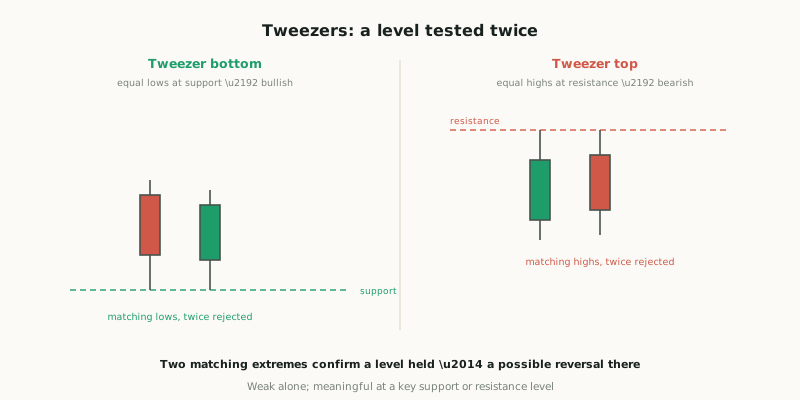
A tweezer pattern consists of two (or sometimes more) candles with nearly equal highs or lows — the matching extremes forming the "prongs" of the tweezers. There are two versions, mirror images of each other. A tweezer bottom forms in a downtrend: two candles with (nearly) equal lows, often the first bearish (red) and the second bullish (green). It signals a potential bullish reversal — the low has been tested twice and held, suggesting support has formed. A tweezer top forms in an uptrend: two candles with (nearly) equal highs, often the first bullish (green) and the second bearish (red). It signals a potential bearish reversal — the high has been tested twice and rejected, suggesting resistance has formed.
The defining feature in both cases is the matching extreme: the two candles reach essentially the same low (bottom) or the same high (top). It's helpful that the second candle typically reverses direction from the first — a bullish (green) candle following a bearish one at a tweezer bottom, or a bearish candle following a bullish one at a tweezer top — since this adds weight, showing that price not only stalled at the level but began to turn. The pattern can involve more than two candles (several touches of the same level), and the matching highs or lows are often marked by wicks rejecting the level (long wicks poking into the level and pulling back), which strengthens the signal by showing the rejection clearly.
What it means: a level tested twice
The tweezer's meaning is entirely about a level being tested twice and holding. Price reaches a level, is rejected, returns to the same level, and is rejected again — which confirms that level as support (at a tweezer bottom) or resistance (at a tweezer top). This is why the pattern is only as meaningful as the level it forms at. Two matching highs or lows at a significant support/resistance level is a meaningful double rejection — evidence the level is holding and the trend may reverse there. The same two candles at a random, unremarkable spot are essentially noise — a coincidence of matching extremes with no significance. The location is everything: at a key level, the tweezer confirms a battle won; in the middle of nowhere, it confirms nothing.
This insight — that the tweezer is fundamentally a double-test of a level — explains both its usefulness and its limitations. Its usefulness: when price approaches an important support or resistance level and forms a tweezer (testing the level twice and being rejected both times), you have candlestick evidence that the level is holding, reinforcing the case for a reversal there. The double rejection is more convincing than a single touch, since it shows the level has repelled price more than once. Its limitation: away from a meaningful level, two matching extremes carry little weight, because price routinely makes similar highs and lows in normal fluctuation — a tweezer in no-man's-land is just a chart pattern that happened to occur, not a signal. This is also why the tweezer connects naturally to the larger double top and double bottom patterns, which are essentially the same idea (a level tested twice and rejected) on a larger scale: a tweezer is, in a sense, a compact, two-candle version of a double top/bottom, carrying the same "level tested twice" message in miniature.
Confirming the tweezer
Given that the tweezer is a relatively minor and weak pattern on its own, confirmation and context are what make it tradeable. The single most important factor, as the key insight stressed, is the level: only treat a tweezer seriously when it forms at a significant support or resistance level (ideally one identified independently on the chart). A tweezer at a major level is a meaningful double-test; one elsewhere is best ignored. This is the essence of confluence — the tweezer plus a key level together make a far stronger case than either alone, and adding further confirming factors (the broader trend context, supportive indicators, a clear rejection) strengthens it further.
Beyond location, the usual confirmations apply. A reversing second candle (and ideally rejection wicks at the level) adds weight, showing price turning rather than merely pausing. Waiting for follow-through confirmation — the next candle or two continuing in the reversal direction after the tweezer — helps verify the reversal is real rather than a brief pause before the trend resumes. And, as always, the tweezer can fail (a level tested twice can still break on the third attempt), so it must be traded with risk management (a defined stop, sensible sizing) — never on the assumption the level will hold. The honest framing: tweezer tops (equal highs at resistance, bearish) and bottoms (equal lows at support, bullish) signal a level tested twice and rejected — a possible reversal at that level. The pattern is weak in isolation but meaningful at a key support/resistance level, especially with rejection wicks, a reversing second candle, and follow-through confirmation. Its whole value lies in confirming a level, so location is everything — a tweezer away from a significant level is noise. Like all candlestick patterns, it's probabilistic, not magic, and best used as one confluence factor among several, traded with risk management.
Trading tweezers
Because the tweezer is fundamentally a confirmation that a level held, trading it well is really about trading the level with the tweezer as supporting evidence. Start by identifying a significant support or resistance level independently on the chart — then treat a tweezer forming at that level as a useful confirmation that the level is being respected. A tweezer bottom at established support (after a downtrend) supports a long; a tweezer top at established resistance (after an uptrend) supports a short. The tweezer adds candlestick weight to the level; the level gives the tweezer meaning. Without a meaningful level, skip it.
For the entry, the reversing second candle and follow-through provide the trigger: rather than acting on the matching extremes alone, wait for the reversal to begin (the second candle turning, and ideally the next candle continuing the new direction) before committing. For the stop, the natural level is just beyond the matching extreme — below the matching lows of a tweezer bottom, or above the matching highs of a tweezer top — since a break beyond the twice-tested level would invalidate the idea that it's holding. That stop placement is logical and usually fairly tight (the matching extremes are close together), which can give a favourable risk:reward when the reversal runs. As with all patterns, size by the stop distance and your risk. It's also worth remembering the tweezer's kinship with the larger double top and double bottom patterns: a tweezer is a compact, two-candle expression of the same "level tested twice and rejected" logic, so the two reinforce each other — a tweezer forming as part of, or near, a developing double top/bottom at a key level is a particularly coherent setup. The honest practical summary: trade the level, use the tweezer as confirmation, enter on the reversal/follow-through, stop just beyond the matching extreme, and size to your risk. The tweezer is a minor signal that becomes useful only in the right place — at a meaningful level, with confirmation, and managed with disciplined risk.
A tweezer is two (or more) candles with matching highs (a tweezer top, in an uptrend → bearish) or matching lows (a tweezer bottom, in a downtrend → bullish) — like the prongs of a pair of tweezers. It signals a level tested twice and rejected: price reached a level, was rejected, returned, and was rejected again — confirming support (bottom) or resistance (top). The key insight: it's only as meaningful as the level — at a significant support/resistance level it's a meaningful double rejection; at a random spot it's noise. Weak alone, it's strengthened by rejection wicks, a reversing second candle, follow-through confirmation, and above all by forming at a key level (confluence). It's essentially a compact double top/bottom. Probabilistic, not magic — trade it with risk management, and only when the level matters.