VWAP is the line institutions judge their own trades against — the volume-weighted average price of the session, a benchmark of where an asset has genuinely traded. Because so much institutional activity references it, it acts as a powerful magnet and fair-value level that traders borrow as a dynamic mean to lean on. It's a staple of stock and futures trading — but in forex there's an important catch, rooted in how forex volume works, that every trader should understand before relying on it. This guide explains VWAP trading: what VWAP is, how it's used for bias and entries, and the crucial forex caveat.
It's intimately tied to volume in forex (and its limits), is often used as a mean-reversion tool, and works alongside other reference levels like pivot points.
Key takeaways
Q: What is VWAP?
A: VWAP (Volume Weighted Average Price) is the average price of an asset over a period (usually the trading day), weighted by the volume traded at each price. It represents the average price at which the asset has actually changed hands, and serves as a benchmark of session 'fair value' that institutions use to judge the quality of their executions.
Q: How do traders use VWAP?
A: As a dynamic mean and fair-value benchmark. Price tends to revert toward VWAP, so traders fade extremes far from it and buy pullbacks to it in uptrends (or sell rallies to it in downtrends). VWAP also serves as a trend-bias filter — price above it suggests buyers are in control on the session, below it sellers. Anchored VWAP, tied to a specific event, is a popular variant.
Q: Does VWAP work in forex?
A: With a major caveat. VWAP requires volume, but spot forex is decentralised and has no true traded volume — platforms show only tick volume (a proxy). So VWAP is less reliable in forex than in centralised markets like stocks and futures with real volume. Forex traders use tick-volume VWAP cautiously, lean on session levels, or reference currency-futures VWAP instead.
What VWAP is, and how traders use it
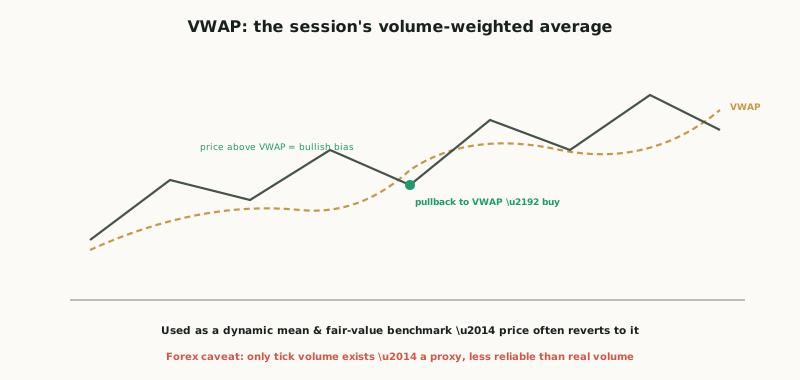
VWAP (Volume Weighted Average Price) is the average price of an asset over a period — usually a single trading day — with each price weighted by the volume traded at it. In plain terms, it's the average price at which the asset has actually changed hands over the session, giving more weight to the prices where most trading occurred. This makes it a benchmark of session "fair value," and crucially it's the yardstick institutions use to assess their own execution quality: a fund buying below VWAP has executed well (better than the day's average), selling above it likewise. Because large players actively reference and trade around VWAP, it becomes a self-fulfilling level of significance.
Traders use VWAP in a few related ways. As a dynamic mean, since price tends to revert toward VWAP, it's used for mean-reversion — fading moves that stretch far from VWAP (expecting a pull back toward it) and treating VWAP itself as dynamic support or resistance. As a trend-bias filter: price trading above VWAP suggests buyers are in control on the session (a bullish bias), below it suggests sellers (bearish). Combining the two gives a common entry approach: in an uptrend (price above VWAP), buy pullbacks to VWAP as it acts as support and the trend resumes; in a downtrend, sell rallies to VWAP. A popular modern variant is the anchored VWAP — calculating VWAP from a specific significant point (a major high, low, or news event) rather than the session start, to measure the average price since that event. VWAP is primarily an intraday tool, resetting each session, so it suits day traders more than longer-term traders.
The crucial forex caveat
Here's the catch every forex trader must understand: VWAP needs volume to compute, but spot forex has no true, centralised volume. Because forex is decentralised (traded over-the-counter across many venues rather than on one exchange), there's no authoritative record of how much actually traded — so the "volume" your platform feeds into VWAP is almost always tick volume (the number of price changes), only a rough proxy for real traded volume (the same limitation that affects OBV and all volume tools — see volume in forex). This means spot-forex VWAP is built on an imperfect substitute and is meaningfully less reliable than VWAP in centralised markets like stocks and futures, where real volume makes it rest on solid ground. Tick volume does correlate with activity, so forex VWAP isn't useless — but treat its signals with extra caution. Practically, forex traders either use tick-volume VWAP as a secondary, suggestive level (not a primary signal), lean more on session-based reference levels (session highs/lows, pivots), or reference the VWAP of the corresponding currency futures (which have real volume) as a cleaner gauge. VWAP is a genuinely powerful tool — where real volume exists.
Beyond the forex caveat, the usual honest points apply: VWAP is a tool, not a system — price reverting to it is a tendency, not a rule (in strong trends, price can ride one side of VWAP for the whole session without reverting), so VWAP signals need confirmation from price action and context, and risk management on every trade. It works best intraday and in conditions where the mean-reversion or institutional-benchmark logic holds. The honest framing: VWAP is the volume-weighted average price over a period (usually the day) — a benchmark of session "fair value" used heavily by institutions to judge execution. Traders use it as a dynamic mean/support-resistance (price reverts to VWAP; buy pullbacks to it in uptrends, fade extremes), as a trend-bias filter (above = bullish, below = bearish), and via anchored VWAP. But the crucial forex caveat is that spot forex has no true volume (only tick volume), so VWAP is less reliable in forex than in centralised stocks/futures — use tick-volume VWAP cautiously, lean on session levels, or use futures VWAP. It's primarily an intraday tool that resets each session. A valuable mean and benchmark where real volume exists; in forex, an imperfect proxy — combine it with price action and risk management.
Using VWAP in practice
In practice, VWAP is rarely used as a bare line; most platforms plot standard-deviation bands around it (one, two, sometimes three deviations), turning VWAP into a channel. These bands give the mean-reversion logic structure: price stretching to the upper band is statistically extended above fair value (a candidate to fade back toward VWAP), while the lower band marks an extended discount — much like Bollinger Bands, but anchored to a volume-weighted mean rather than a simple moving average. A common intraday workflow combines bias and reversion: establish the session bias from price's position relative to VWAP (above = lean long, below = lean short), then enter on pullbacks to VWAP in the direction of that bias (buying a dip to VWAP in an above-VWAP session), or fade stretches to the outer bands back toward the mean — always with a stop and a sense of context, since a trending session can hug one side of VWAP without ever reverting.
The anchored VWAP deserves emphasis because it's where VWAP becomes most flexible. Instead of resetting at the session start, you anchor the calculation to a significant point — a major swing high or low, a big news event, the start of a rally — to see the average price paid by everyone since that moment. Anchored VWAP from a key low often acts as support on the way up (the average buyer since the low is in profit above it); from a key high it often caps rallies. This makes anchored VWAP a powerful, event-aware level that many traders prefer to the standard daily reset. For forex specifically, the workarounds for the volume caveat shape how you apply all this: lean on VWAP more for the liquid, active sessions where tick volume best approximates real activity, treat its signals as confirmation alongside price structure and session levels rather than as standalone triggers, and consider cross-referencing the VWAP of the relevant currency futures (which carry genuine exchange volume) for a cleaner read. Used this way — as a volume-weighted mean and bias tool, with bands for structure and anchoring for flexibility, weighted appropriately for forex's imperfect volume — VWAP adds a genuinely useful institutional lens to intraday trading, provided it's paired with confirmation and disciplined risk management rather than trusted blindly.
Is VWAP worth it in forex?
Given the volume caveat, a fair question is whether forex traders should bother with VWAP at all. The balanced answer: it's a secondary tool in forex rather than a primary one. In stocks and futures, where real volume makes VWAP authoritative, it deserves a central place in an intraday trader's toolkit. In spot forex, its tick-volume foundation means it's best treated as one supporting reference among several — useful as a rough fair-value mean and bias gauge, particularly in liquid sessions, but not something to trade off in isolation, and arguably no more reliable than well-chosen session levels or pivot points that don't depend on volume at all. Traders who love VWAP from equities can still use it in forex with realistic expectations; those who don't lose little by relying on price structure and session levels instead. As with every tool on this site, the honest verdict is the same: VWAP is a genuinely useful lens where its assumptions hold, a weaker proxy where they don't, and never a substitute for sound analysis, confirmation and risk management.
VWAP (Volume Weighted Average Price) is the session's average price weighted by volume — a fair-value benchmark institutions use to judge execution, and a level price tends to revert to. Traders use it as a dynamic mean (fade extremes far from it; buy pullbacks to it in uptrends, sell rallies to it in downtrends), a trend-bias filter (above = bullish, below = bearish), and via anchored VWAP (from a key event). It's mainly an intraday tool (resets each session). Crucial forex caveat: spot forex has no true volume (only tick volume, a proxy), so VWAP is less reliable in forex than in stocks/futures — use it cautiously, lean on session levels, or reference futures VWAP. Reversion to VWAP is a tendency, not a rule (price can ride one side in strong trends) — so confirm with price action and manage risk.