On-Balance Volume (OBV) takes something traders often glance at separately — volume — and turns it into a single running line that rises on buying pressure and falls on selling. It's a neat, intuitive way to see whether volume confirms a price move or quietly disagrees with it. In stocks and futures, where real traded volume exists, it's a genuinely useful tool. In forex, though, one big caveat changes everything, and we'll give it the prominence it deserves. This guide explains OBV: how it works, how to read confirmation and divergence, and the all-important forex limitation.
It's deeply tied to the realities of volume in forex, shares the volume-confirmation logic of volume spread analysis, and is most used for divergence.
Key takeaways
Q: What is On-Balance Volume (OBV)?
A: OBV, developed by Joe Granville, is a cumulative volume-based momentum indicator. It adds the period's volume to a running total on up days and subtracts it on down days, producing a single OBV line. The premise is that volume precedes price, so a rising OBV reflects accumulating buying pressure and a falling OBV selling pressure.
Q: How do you use OBV?
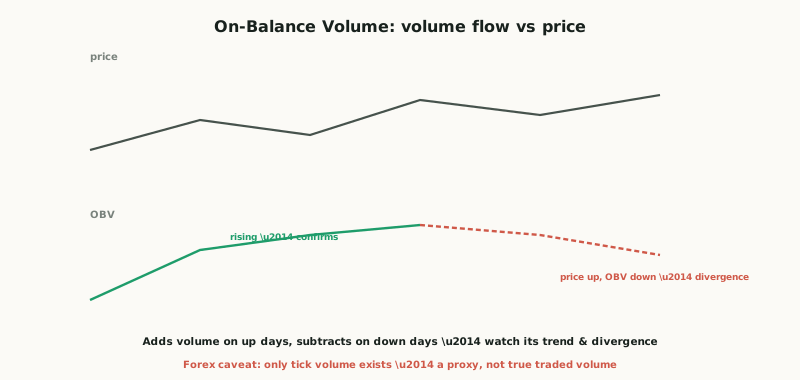
A: Watch its trend and its relationship to price. A rising OBV confirms an uptrend; a falling OBV confirms a downtrend. The most valued signal is divergence: if price rises while OBV falls or flattens, buying pressure isn't supporting the move, warning of a possible reversal. OBV breaking a level before price can also act as an early signal.
Q: Does OBV work in forex?
A: With a major caveat. OBV relies on volume, but spot forex is decentralised and has no true traded volume — platforms show only tick volume (the number of price changes), a rough proxy. So OBV is less reliable in forex than in centralised markets like stocks and futures that have real volume. Use it in forex with that limitation firmly in mind.
How OBV works
OBV was developed by Joe Granville and is a cumulative, volume-based momentum indicator. The calculation is simple: if today's close is higher than yesterday's, you add the day's volume to a running total; if it's lower, you subtract the volume; the result is a single, ever-running OBV line. Crucially, the absolute value of OBV is meaningless — what matters is its direction and trend. The idea rests on the long-held premise that volume precedes price ("volume is the fuel for price moves"): when volume flows in on up days faster than it flows out on down days, OBV rises, reflecting accumulating buying pressure; when the reverse happens, OBV falls, reflecting selling pressure. So OBV attempts to reveal the pressure behind price by tracking where the volume is going.
Reading OBV — confirmation and divergence
OBV is read mainly through its relationship with price. In its simplest use, OBV confirms the price trend: if both price and OBV are rising, the uptrend is "healthy" — backed by volume; if both are falling, the downtrend is confirmed. The most prized signal, though, is divergence. If price is making new highs but OBV is flat or falling, it suggests the rally isn't supported by volume/buying pressure — a warning that the move is weak and may reverse (a bearish divergence). Conversely, if price is falling but OBV is rising, it suggests quiet accumulation beneath a declining price — a potential bullish divergence. Some traders also watch for OBV breaking a level or trendline before price does, treating it as a leading hint. In all cases, the logic is the same: OBV tries to tell you whether the volume story agrees with the price story, with disagreement (divergence) being the most actionable signal.
The crucial forex caveat
Here is the caveat that every forex trader must understand before relying on OBV: spot forex has no true, centralised volume. Because the forex market is decentralised (traded over-the-counter across many banks and venues rather than on a single central exchange), there is no single, authoritative record of how much was actually traded. What your platform shows as "volume" is almost always tick volume — the number of price changes (ticks) in a period — which is only a rough proxy for real traded volume, not the genuine article. OBV is built on volume, so in forex it's built on this imperfect substitute. Tick volume does correlate reasonably with activity, so OBV isn't useless in forex — but it is meaningfully less reliable than in centralised markets like stocks and futures, where real traded volume is recorded and OBV rests on solid ground. The practical upshot: OBV is a stronger tool where true volume exists; in forex, treat its signals with extra caution, lean on tick-volume-based readings as suggestive rather than definitive, and always combine them with price-based analysis. (For the full picture, see volume in forex.)
Beyond the forex caveat, the usual honest points apply. OBV is derived (from price direction and volume) and so confirms more than it predicts; divergence is a warning, not a certainty (OBV can diverge for a while before price obliges, or not at all); and no single indicator works alone. So use OBV — where volume is meaningful — as a confirmation and divergence tool alongside price structure and other analysis, with risk management on every trade. The honest framing: OBV (On-Balance Volume) is a cumulative volume indicator — adding volume on up days, subtracting on down days — that gauges buying/selling pressure on the premise that volume precedes price; a rising OBV confirms buying pressure, falling confirms selling, and its main use is divergence (OBV disagreeing with price warns of weakening or reversal), plus confirming trends and breakouts. But the crucial forex caveat is that spot forex has no true volume (only tick volume, a proxy), so OBV is less reliable in forex than in centralised stocks and futures with real volume — use it in forex with that limitation in mind. It's a useful volume tool where real volume exists; in forex, an imperfect proxy — always combined with price analysis, confirmation and risk management.
Using OBV in practice
Because OBV's absolute value is meaningless, you use it by watching its line the way you'd watch a price chart — its trend, the levels it makes, and how it compares to price. Three practical uses stand out. The first is trend confirmation: check that OBV is moving in the same direction as price (rising OBV under a rising price confirms the uptrend has volume behind it). The second, and most prized, is divergence: a price advance unaccompanied by rising OBV (or a decline unaccompanied by falling OBV) suggests the move lacks volume support and may be vulnerable — a warning to watch for, then confirm with price before acting. The third is treating OBV like a chart in its own right: drawing trendlines on the OBV line and noting when OBV breaks a level or trend, sometimes ahead of price, as a leading hint. Some traders also apply a moving average to OBV and use crossovers of OBV through its own average as a smoothed signal.
In forex, every one of these uses must be tempered by the tick-volume caveat: since the "volume" feeding OBV is only a proxy, treat its forex signals as suggestive rather than authoritative, and always defer to price-based analysis when they conflict. Practically, that means using OBV in forex as a secondary confirmation — a tick-volume-based hint that supports a decision you'd make on price grounds anyway — rather than as a primary signal generator. (On instruments with real volume, such as currency futures, OBV stands on firmer ground, which is one reason some forex traders watch the corresponding futures volume.) Across all markets, the honest discipline is the same as for any indicator: OBV confirms more than it predicts, divergence is a warning rather than a certainty, and it works best in confluence with price structure, support and resistance, and other tools, with risk management on every trade. Used this way — as a volume-pressure lens that confirms or quietly questions the price story, weighted appropriately for the quality of the volume data you actually have — OBV adds a genuinely useful dimension. Used as a standalone forex signal built on a volume proxy, it promises more than it can deliver.
The bottom line on OBV
OBV's value scales directly with the quality of the volume data behind it. In markets with real, centralised traded volume — stocks, futures, including currency futures — it's a genuinely useful gauge of whether buying or selling pressure supports a price move, with divergence its standout signal. In spot forex, built on tick volume, it's a weaker, more suggestive tool that should support price-based decisions rather than drive them. Either way, it confirms more than it predicts and works best in confluence with price structure and other analysis. Know what kind of volume you're really looking at, weight OBV accordingly, and treat it as one informative lens — stronger where real volume exists, softer in spot forex — within a complete, risk-managed approach.
OBV (On-Balance Volume), from Joe Granville, is a cumulative volume indicator — add volume on up days, subtract on down days — gauging buying/selling pressure on the premise that volume precedes price. Its absolute value is meaningless; its trend and divergence matter. A rising OBV confirms an uptrend; the key signal is divergence (price up but OBV flat/falling = unsupported rally, a reversal warning; price down but OBV rising = accumulation). Crucial forex caveat: spot forex is decentralised with no true volume — platforms show only tick volume (a proxy), so OBV is less reliable in forex than in stocks/futures with real volume; treat its forex signals with extra caution. Divergence is a warning, not a certainty, and no indicator works alone — use OBV with price analysis, confirmation and risk management.