
It's one of the simplest indicators there is — the momentum indicator measures nothing more than the speed at which price is changing. Yet that simplicity hides something important: momentum captures the foundational idea behind nearly every oscillator you'll meet, including the RSI, Stochastic and CCI. And because momentum often slows before price actually turns, it can offer an early hint of what's coming. This guide explains the momentum indicator and its close cousin Rate of Change: what they measure, how to read them, and the deeper concept of momentum they embody.
It's the simple root of many technical indicators like the RSI, the engine behind momentum strategies, and a natural tool for spotting divergence.
Key takeaways
Q: What is the momentum indicator?
A: The momentum indicator is one of the simplest technical tools — it measures the speed or rate of price change by comparing the current price to the price a set number of periods ago. Its close cousin, Rate of Change (ROC), measures the same thing as a percentage. Both show how fast price is moving and in which direction.
Q: How do you read the momentum indicator?
A: It oscillates around a baseline (zero for the difference version, 100 for the ratio version). Readings above the baseline indicate upward momentum; below it, downward momentum. Rising momentum means an accelerating move; falling momentum means it's decelerating. Divergence between price and momentum warns that a trend is weakening.
Q: Why does momentum matter in trading?
A: Momentum is the foundational idea behind many oscillators (RSI, Stochastic, CCI and others are all momentum measures). Because momentum often peaks and slows before price actually reverses, it can give an early warning of a turn. It also underpins momentum trading strategies, which aim to ride strong, accelerating moves.
What it measures
The momentum indicator measures the rate of price change — how fast price is moving — by comparing the current price to the price a set number of periods ago. In its simplest form it's just a subtraction: momentum = current price minus the price N periods ago. Its very close cousin, Rate of Change (ROC), measures the same thing as a percentage: the change from N periods ago expressed relative to that earlier price. (Some versions use a ratio, current divided by past, times 100.) The distinction between "momentum" and "ROC" is minor — both answer the same question: how quickly, and in which direction, is price moving compared to recently?
The indicator oscillates around a baseline — zero for the subtraction version, or 100 for the ratio version. The readings are intuitive, as the table shows.
Reading momentum
Reading it, and the concept of momentum
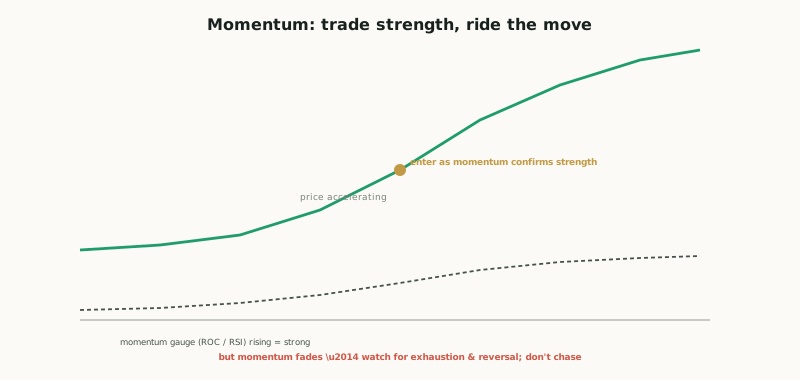
The signals follow directly. A baseline (zero-line) cross marks a shift in momentum direction: crossing above = building upward momentum (bullish), below = downward (bearish). The slope matters too: rising momentum means the move is accelerating, while falling momentum means it's decelerating — and this is subtle but useful, because momentum can fall even while price is still rising, revealing that an up-move is running out of steam before price actually turns. That brings us to the most valuable signal: divergence. When price makes a new high but momentum makes a lower high (or price makes a new low but momentum a higher low), it signals the trend is weakening — an early warning of a possible reversal (the divergence link). Some traders also read relative extremes as overbought/oversold, though momentum has no fixed, standardised levels for this the way the RSI does.
The deeper point is the concept of momentum itself, which is foundational to technical analysis. Many of the oscillators traders rely on — RSI, Stochastic, CCI, and others — are, at heart, momentum measures: refinements of this same basic idea of how fast and in which direction price is moving. And momentum has a useful tendency to peak before price: a move typically decelerates (momentum rolls over) before it actually reverses, so momentum can act as a leading hint where price alone is coincident. This is also the basis of momentum strategies, which aim to identify and ride strong, accelerating moves.
The honest caveats keep it in perspective. The momentum indicator is simple and can be noisy, especially on shorter periods or in choppy markets, producing false baseline crosses. It's derived from price (it lags and confirms, even if its deceleration can hint early), and it gives no fixed overbought/oversold levels. Crucially, momentum slowing does not guarantee a reversal — a move can decelerate and then re-accelerate, so divergence is a warning, not a certainty. So use momentum for momentum and divergence context, with confirmation from price and other tools and an awareness of the trend, never as a standalone trigger. The honest framing: the momentum indicator (and its cousin Rate of Change) is one of the simplest tools, measuring the speed of price change by comparing now to N periods ago — above its baseline is upward momentum, below is downward; rising means accelerating, falling decelerating; and divergence warns of a weakening trend. It captures the foundational idea behind many oscillators (momentum often slows before price reverses, giving early warning) and underpins momentum strategies. But it's simple and noisy, derived from price, gives no fixed overbought/oversold levels, and decelerating momentum doesn't guarantee a reversal. Use it for momentum and divergence context, with confirmation and trend awareness — a simple, foundational momentum lens, not a standalone signal.
Using momentum in practice
The momentum indicator's period (the "N periods ago" it compares against) governs its character: a shorter lookback makes it twitchy and responsive to recent swings, a longer one smoother and more reflective of the bigger move. Common settings sit around 10–14, but as with every indicator the right choice follows your timeframe, and the responsiveness-versus-noise trade-off can't be escaped. Because raw momentum is one of the noisier oscillators, many traders smooth it (with a moving average of the momentum line) or simply use it for context rather than precise triggers.
There are three practical uses. The first is the baseline (zero-line) cross as a momentum-direction signal — useful, but prone to whipsaws in choppy markets, so best confirmed rather than traded blindly. The second, and arguably most valuable, is divergence: when price makes a new extreme but momentum doesn't, the move is losing steam, giving an early warning of a possible reversal — though, crucially, divergence is a warning, not a trigger (momentum can diverge for a long time before price obliges, or simply re-accelerate), so wait for price confirmation before acting on it. The third is using momentum to gauge trend strength and support a momentum strategy — strong, rising momentum confirms a powerful, accelerating trend worth riding, while flagging momentum suggests caution. This connects to a broader strategic choice: momentum tools suit trend-following (ride the strong moves) far more than picking tops and bottoms. The key is to combine momentum with trend context and confirmation: read the prevailing direction from market structure, use momentum to confirm strength or warn of weakening within that context, and require price confirmation for any signal. Avoid the classic errors — trading every zero-line cross, treating divergence as certain, or reading momentum extremes as guaranteed reversals — and remember that momentum, being the simplest of oscillators, is best as a contextual lens on the speed and health of a move rather than a precise entry system. For precise overbought/oversold work, the RSI (a refined momentum measure with fixed levels) is often more practical; raw momentum shines as a clear, foundational read on whether a move is accelerating or fading.
Momentum in a real setup
Two short scenarios show momentum doing its two best jobs. Confirming a trend: suppose a pair breaks out of a range to the upside and begins trending. As price makes higher highs, the momentum indicator pushes well above its baseline and keeps rising — confirming the move is accelerating and the trend has genuine force behind it. A trend-follower reads this as a healthy move worth riding (with the trend, managing risk), rather than fading it. Warning of a turn: later, price grinds out one more marginal new high, but momentum makes a clearly lower high — a divergence. This doesn't mean "sell now"; it means the up-move is losing steam, a yellow flag to tighten stops, take partial profit, or watch closely for price-based confirmation of a reversal. If price then breaks a short-term support or prints a bearish reversal pattern, the divergence is confirmed and a trader might act; if instead momentum re-accelerates and price pushes on, the warning simply passes — which is exactly why divergence is a warning, not a trigger. Across both scenarios, momentum never acts alone: it confirms the strength of a move you'd identified from price structure, and warns of fading strength that you then confirm with price. That supporting, contextual role — reading the health and speed of a move — is where this simple indicator is at its most valuable.
The momentum indicator (and its cousin Rate of Change) is one of the simplest tools — it measures the speed of price change by comparing the current price to the price N periods ago. It oscillates around a baseline: above = upward momentum, below = downward; rising = accelerating, falling = decelerating (momentum can fall while price still rises — a sign of waning strength). Its best signal is divergence (price higher high, momentum lower high → weakening trend). It embodies the foundational idea behind many oscillators (RSI, Stochastic, CCI), and momentum often slows before price reverses, giving early warning. But it's simple and noisy, derived from price, has no fixed overbought/oversold levels, and slowing momentum doesn't guarantee a reversal. Use it for momentum and divergence context — with confirmation, trend awareness and risk management — not as a standalone trigger.