Despite its name, the Commodity Channel Index (CCI) works on any market — forex very much included. It's a momentum oscillator that measures how far price has strayed from its statistical average, flagging when a market is relatively stretched (overbought or oversold) and when momentum is shifting. It's a useful addition to the oscillator toolkit alongside the RSI and Stochastic, but like every indicator, it's a lens for interpreting price, not a crystal ball. This guide explains the CCI: what it measures, how to read its levels and signals, and how to use it sensibly.
It sits in the family of technical indicators, behaves much like the Stochastic and RSI, and is best deployed within confluence.
Key takeaways
Q: What is the CCI indicator?
A: The CCI (Commodity Channel Index), developed by Donald Lambert in 1980, is a momentum oscillator that measures how far the current price has deviated from its statistical average over a period. Despite the name, it's used on any market, not just commodities. It typically oscillates around zero, with most values falling between +100 and -100.
Q: How do you read the CCI?
A: Readings above +100 suggest price is relatively high (overbought); below -100, relatively low (oversold). Crossing above the zero line signals building upward momentum, and below it downward momentum. Divergence between price and the CCI can warn of a weakening trend. It's used for momentum, overbought/oversold and pullback signals.
Q: Is the CCI a reliable signal on its own?
A: No indicator is. The CCI is derived from price and lags it, its overbought/oversold readings can persist for a long time in strong trends (so they aren't automatic reversal signals), and being unbounded it can whipsaw. It's best used with trend context, confirmation from price and other tools, and sound risk management — as one input among several.
What the CCI measures
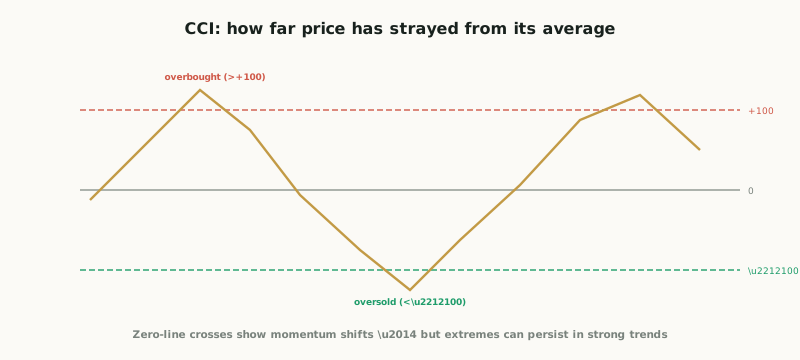
The CCI was developed by Donald Lambert in 1980 and, despite being designed originally for commodities, is applied across all markets. It's a momentum-based oscillator that measures the current price level relative to its average over a chosen period — in other words, how far price has deviated from its statistical mean. Conceptually, it's built from the "typical price" (the average of the high, low and close), its moving average, and the mean deviation, scaled by a constant (0.015) chosen so that roughly 70–80% of readings fall between +100 and -100. The default period is commonly 20. You don't need the formula to use it; the key idea is simply that the CCI rises when price stretches above its recent average and falls when it stretches below — a measure of how far, and in which direction, price has departed from "normal."
The CCI oscillates around a zero line and is technically unbounded — it can spike well beyond ±100 in powerful moves — though most of the time it stays within a ±100 to ±200 range. That unbounded nature is worth remembering: unlike the RSI (which is capped at 0–100), the CCI has no ceiling or floor, so "extreme" is relative.
Reading its levels and signals
The CCI offers a few standard readings, summarised below.
Key CCI readings
The most familiar use is overbought/oversold: readings above +100 indicate price is relatively high (overbought), and below -100 relatively low (oversold) — potential zones for a pullback or reversal. The zero-line cross tracks momentum direction: crossing above zero signals building bullish momentum, below signals bearish. Divergence — price making a new high while the CCI makes a lower high (or vice versa) — warns that the move is losing momentum and may reverse (the divergence link). And because strong trends push the CCI to extremes, some traders use it to gauge trend strength and to time pullback entries (for example, buying when the CCI returns from oversold within an established uptrend). Across all of these, the CCI is most powerful not in isolation but as confirmation — lining up with price structure, support and resistance, or other tools.
The honest caveats are the same as for any oscillator, and they matter. The CCI is derived from price, so it lags and confirms rather than predicts. Its overbought/oversold readings can persist for long stretches in strong trends — a market can stay "overbought" (CCI above +100) for a sustained rally, so treating an extreme reading as an automatic reversal signal is a classic and costly mistake. Being unbounded, it can also produce frequent whipsaws in choppy conditions. And no oscillator works alone or always. So use the CCI with trend context (respect the prevailing direction — favour oversold signals in uptrends, overbought signals in downtrends, rather than blindly fading), with confirmation from price action and other tools, and with risk management on every trade. The honest framing: the CCI is a momentum oscillator measuring how far price has deviated from its average — readings above +100/below -100 flag overbought/oversold, zero-line crosses show momentum direction, and divergence warns of reversals. It's useful for momentum, overbought/oversold and pullback signals, but it's derived from price, its extremes can persist in trends (not automatic reversals), it's unbounded and can whipsaw, and no oscillator works alone. Use it with trend context, confirmation and risk management, as one input among several — a useful momentum lens, not a standalone signal.
Using the CCI in practice
Putting the CCI to work starts with the period. The default of 20 is a sensible middle ground; a shorter period (say 14 or fewer) makes the CCI more responsive but noisier, reaching extremes more often, while a longer period (30 or more) smooths it and produces fewer, more significant signals. Shorter-term traders tend to favour faster settings, longer-term traders slower ones — but the trade-off (responsiveness versus noise) is unavoidable, and there's no "correct" number; test what suits your timeframe and style rather than chasing an optimal value that won't generalise.
Three main approaches dominate, and they map to different market conditions. The first is mean-reversion / overbought-oversold: fading extreme readings (looking for a pullback when the CCI pushes above +100 or below -100) — but this works best in ranging, non-trending markets and is dangerous in strong trends (where extremes persist), so it should be filtered by market context. The second is zero-line / momentum trend trades: treating crosses above zero as bullish and below as bearish, or using the CCI to confirm and time entries in the direction of an established trend (e.g. buying when the CCI recovers from a dip in an uptrend) — generally the safer use, since it works with the trend rather than against it. The third is divergence: watching for the CCI to disagree with price (price higher high, CCI lower high) as an early reversal warning, ideally confirmed by price action before acting. The most common mistakes are exactly the ones the honest caveats flag: blindly fading every overbought/oversold reading (ignoring trend), acting on a raw zero-line cross in choppy conditions (whipsaws), and treating divergence as a certainty rather than a warning. The remedy in every case is context and confirmation — establish the broader trend first (with market structure or a moving average), use the CCI in harmony with that trend, seek confluence with support and resistance or price patterns, and confirm CCI signals with price before committing. Treated this way — as a momentum and stretch gauge that supports a trend-aware, confirmed approach — the CCI earns its place; treated as a standalone buy/sell machine, it will disappoint like any oscillator used in isolation.
Where the CCI fits
It's worth being clear-eyed about where the CCI sits among the many oscillators available. The CCI, RSI, Stochastic, Williams %R and others all measure broadly similar things — momentum and how stretched price is — just with different formulas and scales. This means there's little value in stacking several of them on one chart; they'll mostly agree, giving an illusion of confirmation while really saying the same thing in different colours. Pick one or two oscillators that you understand well and that suit your style, rather than cluttering your analysis with redundant indicators. The CCI's particular flavour — measuring deviation from an average, unbounded, sensitive to how far price has stretched — makes some traders prefer it for spotting strong thrusts and pullbacks within trends; others find the RSI's fixed 0–100 scale or the Stochastic's smoothing more to their taste. None is objectively superior. The honest bottom line is that the CCI is a perfectly good momentum oscillator that earns its keep when used thoughtfully — with trend context, in confluence with price, confirmed before acting, and traded with risk management — and disappoints only when asked to be something it isn't: a standalone, set-and-forget signal that magically calls tops and bottoms. Choose it because its behaviour suits how you read markets, learn its quirks (especially that extremes persist in trends), and let it play a supporting role in a complete approach rather than a starring one.
The CCI (Commodity Channel Index), from Donald Lambert (1980), is a momentum oscillator measuring how far price has deviated from its average — it oscillates around zero and is unbounded, though mostly within ±100. Read it as: above +100 = overbought, below −100 = oversold, zero-line crosses = momentum shifts, and divergence vs price = a weakening trend. Useful for momentum, overbought/oversold and pullback entries within a trend. But it's derived from price (lags), its extremes can persist in strong trends (not automatic reversals — don't blindly fade), and being unbounded it can whipsaw. No oscillator works alone: use the CCI with trend context, confirmation from price and other tools, and risk management — one input among several, not a crystal ball.