
Williams %R — developed by the well-known trader Larry Williams — is a close cousin of the Stochastic Oscillator: a momentum tool that shows where the current price sits within its recent trading range, flagging overbought and oversold conditions. Its one quirk, an upside-down scale running from 0 to -100, trips up newcomers, but the concept is simple and the tool genuinely useful for timing. Read correctly, it helps you spot stretched conditions and time entries; read carelessly — by blindly fading every "overbought" reading — it becomes a trap. This guide explains Williams %R: how it works, how to read its scale, and how to use it well.
It's one of the technical indicators, nearly a twin of the Stochastic, and works best inside confluence with the trend.
Key takeaways
Q: What is Williams %R?
A: Williams %R (Percent R), developed by Larry Williams, is a momentum oscillator very similar to the Stochastic. It measures where the current close sits relative to the high-low range over a lookback period (default 14), expressed on a scale from 0 to -100. It's used to identify overbought and oversold conditions and time entries.
Q: How do you read the Williams %R scale?
A: It runs from 0 (top) to -100 (bottom). Readings between 0 and -20 indicate overbought (the close is near the top of the recent range); readings between -80 and -100 indicate oversold (the close is near the bottom). The negative, inverted scale is what confuses newcomers, but it measures the same thing as the Stochastic.
Q: How is Williams %R different from the Stochastic Oscillator?
A: They're very similar — both measure where the close sits within the recent high-low range. The main differences are cosmetic: Williams %R uses a 0 to -100 scale, while the Stochastic uses 0 to 100 and adds a smoothed %D signal line. In practice they convey much the same momentum information.
What it is and how to read it
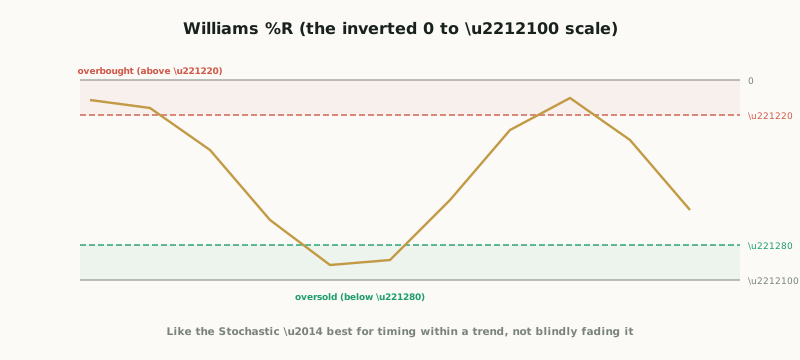
Williams %R is a momentum oscillator that measures where the current close sits relative to the high-low range over a lookback period (default 14) — essentially the same thing the Stochastic measures. Its distinctive feature is the scale: it runs from 0 to -100 (note the negative values, and that it's effectively inverted compared to the Stochastic). Read it like this: 0 to -20 = overbought (the close is near the top of the recent range — price has pushed high); -80 to -100 = oversold (the close is near the bottom of the range — price has pushed low). So a reading near 0 means price is at the top of its range (overbought), and near -100 means the bottom (oversold) — which feels backwards until you internalise it. The negative, inverted scale is purely cosmetic; mathematically %R is essentially an upside-down Stochastic, conveying the same information about where the close lies within recent price action. Don't let the unusual scale put you off — once you remember "near zero = overbought, near -100 = oversold," it reads as naturally as any other oscillator.
The signals follow from the scale. An overbought reading (above -20) suggests price is stretched to the upside and may pull back; an oversold reading (below -80) suggests it's stretched to the downside and may bounce. As with the Stochastic, traders also watch for %R crossing out of the overbought or oversold zones as a trigger (e.g. rising back up through -80 from oversold), and use it to confirm momentum. Its sweet spot is timing entries within a trend: in an established uptrend, waiting for %R to dip into oversold and then turn up can offer a well-timed pullback entry in the direction of the trend — a far better use than trying to call tops and bottoms outright.
Relationship to the Stochastic, and the key caveat
Because Williams %R and the Stochastic Oscillator measure the same underlying thing (the close's position within the recent range), they're very similar in practice; the differences are largely cosmetic — %R uses the 0 to -100 scale, while the Stochastic uses 0 to 100 and adds a smoothed %D signal line for crossovers. If you already use the Stochastic, %R will feel familiar; many traders simply prefer one or the other. There's little point running both, since they'll tell you much the same story.
The most important caveat — and the most common mistake — is the one shared by all overbought/oversold oscillators: extreme readings can persist in strong trends, so don't blindly fade them. In a powerful uptrend, %R can sit in "overbought" (near zero) for a long time as price keeps climbing; a trader who mechanically shorts every overbought reading will be repeatedly run over by the trend. The same applies to oversold readings in downtrends. "Overbought" does not mean "about to fall" — it means "stretched high," which in a strong trend can simply continue. This is exactly why %R works best with the trend (timing pullback entries in the trend's direction) rather than against it (fighting the trend on every extreme). Beyond that, the usual honest points apply: %R is derived from price (it lags and confirms, not predicts), and it works best with confirmation from price structure and other tools, plus risk management on every trade. The honest framing: Williams %R is a momentum oscillator (close kin to the Stochastic) showing where the close sits within the recent high-low range, on a 0 to -100 scale — above -20 is overbought, below -80 oversold. It's useful for spotting overbought/oversold and timing entries, especially within a trend. But its extremes can persist in strong trends (so don't blindly fade them — the classic error is shorting "overbought" in a strong uptrend), it's derived from price, and it works best with trend context, confirmation and risk management, not alone. It's similar enough to the Stochastic that you needn't use both — treat it as one momentum input within your confluence, and let the trend, not the oscillator alone, guide your direction.
Using Williams %R well
The default period for Williams %R is 14, mirroring the Stochastic and RSI conventions. As ever, a shorter lookback makes it faster and noisier (more frequent overbought/oversold readings), a longer one slower and smoother; 14 is a reasonable starting point, and the choice should follow your timeframe rather than a search for a magic setting. Because %R is unsmoothed, it can be quite jumpy, which is part of why pairing it with the trend (below) matters so much.
The single most productive way to use %R is the pullback-in-trend approach, which sidesteps its biggest weakness. First establish the trend — using market structure or a moving average — then use %R only to time entries in the trend's direction. In a confirmed uptrend, wait for %R to dip into oversold (below -80) on a pullback and then turn back up, signalling the pullback may be ending and the uptrend resuming — a well-timed long in the direction of the trend. In a downtrend, do the mirror image: wait for %R to push into overbought (above -20) on a bounce, then turn down, to time a short with the trend. This uses %R for what it's good at (timing) while respecting the trend, rather than fighting it. The contrasting mistake — and the most common one — is the opposite: mechanically fading every extreme regardless of trend (shorting each overbought reading in a strong uptrend, buying each oversold reading in a downtrend), which gets you repeatedly run over, because extremes persist in trends. Other useful refinements: treat the crossing out of a zone (e.g. %R rising back above -80) as the actual trigger rather than the reading itself, and seek confluence — a %R pullback signal that coincides with a support level or a bullish candlestick in an uptrend is far stronger than %R alone. Since %R and the Stochastic measure essentially the same thing, pick one and don't clutter your chart with both. Used as a trend-aligned timing tool with confirmation and risk management, %R is genuinely handy; used as a blind reversal signal, it's a reliable way to lose money fighting trends.
A quick example
To make the trend-aligned approach concrete, picture a pair in a clear uptrend — a series of higher highs and higher lows, with price holding above a rising moving average. Price pulls back modestly, and as it does, Williams %R slides down into oversold below -80. A trader fading extremes blindly might see "overbought turned oversold" as noise or, worse, try to short the pullback; the trend-aware trader instead reads the oversold reading as a potential pullback-buying opportunity in the direction of the established uptrend. They wait for confirmation — %R turning back up and crossing above -80, ideally as price holds a support level or prints a bullish candlestick — and only then consider a long, with a stop below the recent swing low and a sensible position size. If instead the pair were in a downtrend, the mirror logic applies: a push into overbought (above -20) on a bounce, then %R turning down with price rejecting resistance, times a short with the trend. The point of the example isn't a mechanical recipe — it's to show how the same oversold reading means opposite things depending on context, and how combining %R's timing with trend direction, confirmation and risk management turns a noisy oscillator into a useful tool. The reading alone tells you price is stretched; the trend tells you which way that stretch is likely to resolve.
Williams %R (Larry Williams) is a momentum oscillator — essentially an inverted Stochastic — showing where the close sits within the recent high-low range (default 14), on a 0 to -100 scale: 0 to -20 = overbought (close near the top), -80 to -100 = oversold (close near the bottom). Use it to spot stretched conditions and, best of all, to time pullback entries within a trend (e.g. buy when %R turns up from oversold in an uptrend). Key caveat: like all overbought/oversold tools, extremes persist in strong trends — don't blindly fade them (shorting "overbought" in a strong uptrend is the classic error). It's so similar to the Stochastic that you needn't run both. It's derived from price (lags), so use it with trend context, confirmation and risk management — one momentum input within confluence, with the trend guiding direction.