
Wedge patterns play a trick on the eye. A wedge that slopes up tends to break down; a wedge that slopes down tends to break up — the breakout direction is the opposite of the slope, which catches many traders out. The key to reading wedges is understanding why: a narrowing price range means fading momentum, so a rising wedge (rising but with shrinking range) signals buyers running out of steam, and a falling wedge signals sellers running out of steam. This guide explains how rising and falling wedges form, why they carry their counterintuitive bias, and how to trade them with confirmation — deepening the chart-patterns material with one of its more deceptive members.
It's a deep-dive within chart patterns, a close relative of triangles (also converging-line patterns), and built on support and resistance trendlines.
Key takeaways
Q: What is a wedge pattern?
A: A wedge is a chart pattern formed by two converging trendlines that both slope in the same direction — either both up (a rising wedge) or both down (a falling wedge). The narrowing range reflects decelerating momentum, and the pattern signals a likely breakout, usually against the direction of the slope.
Q: Is a rising wedge bullish or bearish?
A: A rising wedge is typically bearish. Despite price making higher highs, the narrowing range shows buying momentum fading, and the pattern usually resolves with a downward breakout — a reversal at the top of an uptrend, or a bearish continuation within a downtrend.
Q: Is a falling wedge bullish or bearish?
A: A falling wedge is typically bullish. Despite price making lower lows, the narrowing range shows selling momentum fading, and the pattern usually resolves with an upward breakout — a reversal at the bottom of a downtrend, or a bullish continuation within an uptrend.
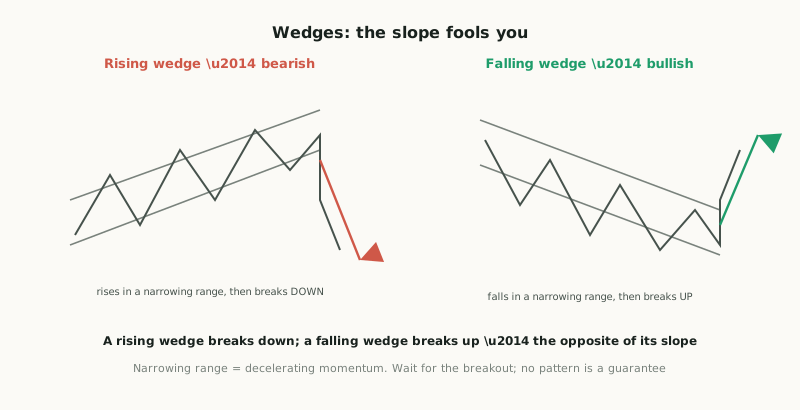
What a wedge is
A wedge is a chart pattern formed by two converging trendlines that both slope in the same direction — this is what distinguishes it from a triangle (where the lines may converge symmetrically, or one may be horizontal). In a wedge, both the upper and lower trendlines tilt the same way (both up, or both down), but they converge because one slopes more steeply than the other, narrowing the price range as the pattern progresses. The narrowing range is the essential feature, and it carries the pattern's meaning: a contracting range reflects decelerating momentum in the direction of the slope. Price may still be making higher highs (in a rising wedge) or lower lows (in a falling wedge), but the shrinking range shows the move is losing force — each push is smaller, the trend is tiring.
This is the conceptual key to wedges, and the source of their counterintuitive bias. Because the narrowing range signals fading momentum in the slope's direction, the wedge tends to resolve with a breakout against the slope: a rising wedge (fading upward momentum) tends to break down, and a falling wedge (fading downward momentum) tends to break up. The slope shows the direction that is weakening, not the direction of the eventual breakout — which is why a rising wedge is bearish and a falling wedge bullish, the opposite of what the slope superficially suggests. Like all chart patterns (as the chart-patterns pillar stresses), wedges are probabilistic tendencies, not certainties — they can and do fail — and they reflect the psychology of a tiring trend rather than any magic. But the converging-lines-equal-fading-momentum logic gives wedges a clear, readable meaning once the counterintuitive direction is understood.
Rising and falling wedges
The two wedges are mirror images, summarised below.
Rising vs falling wedge
| Aspect | Rising wedge | Falling wedge |
|---|---|---|
| Shape | Both lines slope up, converging | Both lines slope down, converging |
| What's fading | Upward (buying) momentum | Downward (selling) momentum |
| Bias | Bearish | Bullish |
| Usual breakout | Downward | Upward |
A rising wedge has both trendlines sloping up and converging (the lower line rising faster than the upper, so the range narrows). Despite the upward slope, it's typically bearish: the narrowing range shows buying momentum fading even as price grinds higher, and the pattern usually breaks downward. A rising wedge appearing at the top of an uptrend is a reversal signal (the uptrend exhausting); appearing within a downtrend (as a corrective bounce), it's a bearish continuation signal (the bounce fading before the downtrend resumes) — either way, the bias is down. A falling wedge is the inverse: both trendlines slope down and converge, and despite the downward slope it's typically bullish, with selling momentum fading and a usual upward breakout. A falling wedge at the bottom of a downtrend is a reversal signal (the downtrend exhausting); within an uptrend (as a corrective dip), it's a bullish continuation signal. So both wedges can act as reversal or continuation patterns depending on the prior trend's context, but their bias is fixed by their type: rising wedge bearish (breaks down), falling wedge bullish (breaks up). Volume often declines through a wedge as it forms (consistent with fading momentum) and may pick up on the breakout — a supporting clue.
Trading wedges
Trading wedges follows the same disciplined, confirmation-first approach as all chart patterns. The cardinal rule is to wait for the breakout rather than anticipating it: a wedge is only a wedge once it resolves, and price can stay within the converging lines longer than expected, so the signal comes when price breaks decisively through the relevant trendline — below the lower line for a rising wedge (bearish), above the upper line for a falling wedge (bullish). Trading before the breakout is guessing; waiting for it is the confirmation the pattern requires. Many traders seek further confirmation — a convincing close beyond the line, a pickup in volume on the breakout, or confluence with other factors (the confluence guide) — to reduce the risk of acting on a false break, since wedges, like all patterns, produce failed breakouts.
For targets and stops, the conventional approach uses a measured move: the height of the wedge (its widest part, at the start) projected from the breakout point gives a rough target, and a stop is placed on the other side of the breakout (back inside the wedge, beyond the line that was broken) so that a failed breakout is cut quickly. This defines the risk and reward in the disciplined way the risk-management section demands. The honest framing, consistent throughout this site, is essential: wedges are probabilistic patterns, not guarantees — they can fail, breakouts can be false, and no pattern should be traded mechanically without confirmation, risk management and awareness of context. Used well — understanding the counterintuitive bias (rising wedge bearish, falling wedge bullish), waiting for the breakout, seeking confirmation, and managing risk with measured targets and protective stops — wedges are a useful addition to the chart-pattern toolkit, capturing the moment a trend's momentum fades and reverses or resumes against the slope. But they are a tool of probability, like every pattern: an edge to be traded with discipline, not a crystal ball. Master the logic (narrowing range equals fading momentum, breakout against the slope), respect the need for confirmation, and the deceptive wedge becomes one of the more readable patterns once its trick is understood.
Telling wedges apart, and false breakouts
A common difficulty is distinguishing a wedge from similar-looking patterns, which matters because they carry different biases. The closest relatives are triangles and channels. A triangle also has converging lines, but typically one line is roughly horizontal (ascending or descending triangle) or the two converge symmetrically toward a flat apex — whereas a wedge's two lines both slope the same way (both up or both down). A channel has two roughly parallel lines (the range stays constant), while a wedge's lines converge (the range narrows). The narrowing-range-with-same-direction-slope is the wedge's signature; getting this identification right is what tells you to expect the counterintuitive against-the-slope breakout rather than a triangle's or channel's behaviour. When in doubt, the defining checks are: do both lines slope the same direction (wedge) or not (triangle/channel)? And does the range narrow (wedge/triangle) or stay constant (channel)?
The other essential caution is false breakouts. Like all patterns, wedges produce failed breaks — price pokes through a trendline and then reverses back inside, trapping traders who acted too early. This is why confirmation matters so much: rather than entering the instant price touches or barely crosses a line, many traders wait for a decisive move — a convincing close beyond the trendline, ideally on increased volume, or supported by confluence with other factors (the confluence guide). The volume clue is genuinely useful here: volume typically declines as the wedge forms (consistent with the fading momentum the narrowing range represents) and often expands on a genuine breakout — so a breakout on rising volume is more trustworthy than one on thin volume. None of this makes the pattern certain (nothing does), but distinguishing the wedge correctly, waiting for a confirmed breakout, and watching volume substantially improves the odds of trading the real signal rather than a fakeout — the disciplined way to use any pattern.
A wedge is two converging trendlines both sloping the same way — the narrowing range signals decelerating momentum, so wedges break against their slope. A rising wedge (both lines up) is bearish and usually breaks down; a falling wedge (both lines down) is bullish and usually breaks up — the opposite of the slope. Both can be reversal patterns (at a trend's end) or continuation patterns (in a corrective move). Distinguish wedges from triangles (one line flat / symmetrical convergence) and channels (parallel lines): the wedge's signature is same-direction sloping lines that converge. Trade them by waiting for a decisive breakout (don't anticipate), seeking confirmation (a convincing close, expanding volume — volume usually fades through the wedge and picks up on a real breakout, helping filter false breaks), with a measured-move target (the wedge's height) and a stop on the other side. Probabilistic, not guaranteed — trade with confirmation and risk management.