Currencies don't move in isolation. Some pairs march in near-lockstep; others mirror each other; and they do so because they share underlying drivers — commodities, risk sentiment, and above all the dollar. Understanding these currency correlations sharpens your analysis (helping you read the whole market's mood) and protects you from a dangerous trap: hidden, doubled-up risk. This guide explains currency correlations: why pairs move together or apart, the main groupings, how to use them, and why they shift.
It's the fundamental "why" behind correlation risk, woven from commodity links, risk sentiment and the safe-haven dynamic.
Key takeaways
Q: What are currency correlations?
A: Currency correlations describe how the prices of different currency pairs tend to move in relation to one another — positively (moving in the same direction), negatively (moving in opposite directions), or with little relationship. They arise because pairs share underlying drivers: a common currency, exposure to commodities, sensitivity to risk sentiment, or the influence of the US dollar. Correlation is usually measured between −1 (perfectly opposite) and +1 (perfectly together).
Q: Why do some currencies move together?
A: Because they respond to the same fundamental forces. Commodity currencies (like AUD, CAD, NZD) tend to move together because they're tied to commodity prices and global growth. Safe-haven currencies (USD, JPY, CHF) tend to strengthen together in risk-off periods. Pairs that share a currency (especially the US dollar) move partly in tandem because the common leg drives both. Shared drivers create the correlations.
Q: Why is it dangerous to ignore correlations?
A: Because trading several correlated pairs can secretly multiply your risk. If you go long three positively-correlated pairs, you don't have three independent trades — you effectively have one big bet that moves together, so a single adverse move hits all three at once. Ignoring this can leave your true exposure far higher than intended. Understanding correlations lets you avoid this hidden concentration and manage real, aggregate risk.
What they are and why they arise
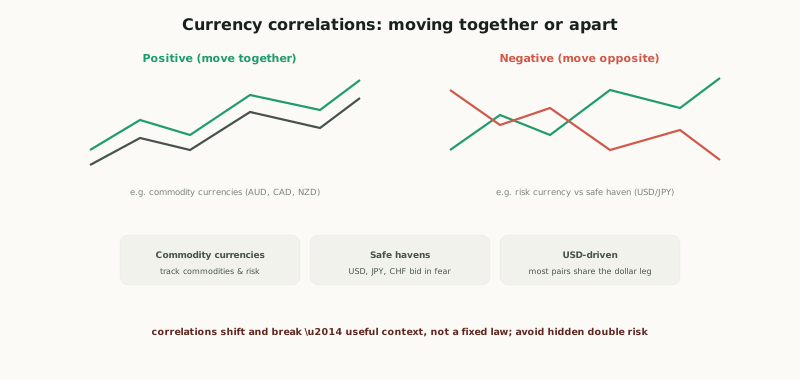
Currency correlations describe how different pairs tend to move in relation to one another — positively (same direction), negatively (opposite directions), or with little relationship — usually measured on a scale from −1 (perfectly opposite) through 0 (unrelated) to +1 (perfectly together). They arise for one fundamental reason: pairs share underlying drivers. The main groupings:
The main correlation groupings
Commodity currencies — the Australian, Canadian and New Zealand dollars (AUD, CAD, NZD) — tend to move together because they're tied to commodity prices and global growth (their economies are commodity-exporters), so they often rise and fall as a group with the commodity and risk cycle. Safe-haven currencies — the US dollar, Japanese yen and Swiss franc (USD, JPY, CHF) — tend to strengthen together in risk-off periods, as capital flees to safety. And because most pairs share the US dollar as one leg, the dollar's broad direction creates correlations across the whole board (a strong-dollar move pushes many USD pairs the same way). These shared drivers also create negative correlations: a risk-on currency and a safe haven tend to move opposite (e.g. as risk appetite rises, the risk currency gains while the haven softens). Recognising these groupings lets you read the market holistically — seeing that "the commodity currencies are all selling off" or "the havens are all bid" tells you about the prevailing risk regime, not just one pair.
Using correlations — and the hidden-risk trap
Correlations are useful in several ways. For analysis and confirmation: if related pairs agree (the whole commodity bloc is rising, all the havens falling), it confirms a broad theme and adds conviction; if they disagree (one commodity currency rallies while the others fall), it flags something idiosyncratic worth investigating. For relative-value ideas: correlations underpin pairs trading, where you trade the spread between two correlated instruments expecting it to revert. And for reading the regime: the pattern of correlations reveals whether the market is in a risk-on or risk-off mood, dollar-driven or commodity-driven.
But the most important practical reason to understand correlations is to avoid a dangerous, hidden trap: trading several correlated pairs can secretly multiply your risk. If you go long three positively-correlated pairs, you do not have three independent trades — you effectively have one big bet that moves together, so a single adverse move hits all three at once, and your true exposure is roughly triple what you intended on a single position. A trader who thinks they've diversified across "three different trades" may actually be concentrated in one giant correlated position, and a bad day can deliver a tripled loss that blows past their risk plan (this is the heart of correlation risk, and a portfolio-heat consideration). Conversely, holding negatively-correlated positions can partly cancel your exposure (a crude hedge). So managing aggregate risk — not just per-trade risk — requires accounting for correlations: limiting how many correlated positions you hold in the same direction, and recognising when "several trades" are really "one trade in disguise."
The essential caveat is that correlations shift and break. They are statistical tendencies driven by fundamentals, not fixed laws — they strengthen, weaken, and even reverse as the underlying drivers change (a commodity currency can decouple from the bloc on its own central-bank story; safe-haven relationships can shift). So correlations are useful context, not a guarantee: never assume a historical correlation will hold indefinitely, monitor whether it's still intact, and don't build a strategy (or a risk assumption) on a relationship that may quietly dissolve. Used as a regime-reading and risk-management lens — with awareness that the relationships evolve — currency correlations meaningfully sharpen analysis and, crucially, keep you from accidentally taking far more risk than you think. The honest framing: currency correlations describe how pairs move together (positive, +1), opposite (negative, −1), or unrelated, arising from shared drivers — commodity currencies (AUD/CAD/NZD) tracking commodities, safe havens (USD/JPY/CHF) bid together in risk-off, and the shared dollar leg across most pairs. Use them to confirm themes, read the risk regime, and inform relative-value trades — but above all to avoid hidden risk: trading several correlated pairs multiplies your true exposure (three correlated longs ≈ one triple-sized bet). And correlations shift and break, so treat them as useful context, not a fixed law; manage aggregate risk and monitor the relationships.
Measuring and managing correlations
To use correlations rigorously, you need to measure them, and a few practicalities matter. The standard measure is the correlation coefficient (from −1 to +1), often shown in a correlation table/matrix that grids pairs against each other — many platforms provide these, letting you see at a glance which pairs are strongly positively correlated (near +1), strongly negatively (near −1), or relatively independent (near 0). Crucially, correlations vary by timeframe: two pairs might be tightly correlated on a daily/weekly basis but much less so intraday, or vice versa, so always measure over the timeframe relevant to your trading — a correlation that holds over months may be irrelevant to a day trader, and vice versa. They also vary over time: a coefficient is a snapshot of a past window, so check it over recent, relevant data rather than relying on a "known" historical relationship.
Managing correlations then comes down to controlling aggregate exposure. The core discipline: don't unknowingly stack correlated risk. Before adding a position, ask how it correlates with what you already hold — going long a third strongly positively-correlated pair means tripling a single underlying bet, so either treat the combined position as one trade for sizing purposes (scaling each down so the aggregate risk stays within your limit) or simply avoid the pile-up. Conversely, you can use negative correlations deliberately as a partial hedge (holding offsetting positions to reduce net exposure), though that also dampens potential gains. A vital regime point: correlations tend to spike toward extremes in risk-off events — in a panic, "everything correlates," as risk currencies all sell off together and havens all rally, so the diversification you thought you had can vanish exactly when you need it (correlated positions all hit at once). This is why crisis losses are so often worse than models predict. So the practical stance: measure correlations over your timeframe and recent data, monitor them for change, size by aggregate (correlation-adjusted) risk rather than per-trade, use negative correlations as a deliberate hedge if wanted, and never assume correlations are stable — especially expecting them to tighten against you in a crisis. The honest reminder: measure correlations with the coefficient/table over your relevant timeframe and recent data; manage aggregate exposure by not stacking correlated positions (treat correlated trades as one bet for sizing) or using negative correlations as a hedge; and remember correlations spike toward 1 in risk-off events, so the diversification can vanish exactly when it matters.
Seen whole, currency correlations are really a reminder that the FX market is an interconnected system, not a set of independent pairs. The dollar's direction, the global risk mood, and the commodity cycle ripple through everything at once, which is why so many pairs move in concert. Reading those connections turns a confusing wall of individual charts into a coherent picture of what's driving the whole market right now — and keeps you honest about how much risk you're really carrying when several of your positions are quietly the same bet.
Currency correlations describe how pairs move together (positive, up to +1), opposite (negative, down to −1), or unrelated — arising from shared drivers: commodity currencies (AUD/CAD/NZD) tracking commodities & growth, safe havens (USD/JPY/CHF) bid together in risk-off, and the shared dollar leg across most pairs. Use them to confirm themes, read the risk regime, and inform relative-value trades — but above all to avoid hidden risk: trading several correlated pairs multiplies your true exposure (three correlated longs ≈ one triple-sized bet, the heart of correlation risk). And correlations shift and break — they're tendencies, not laws — so treat them as useful context, monitor whether they hold, and manage aggregate risk, not just per-trade risk.