Most trading bets on direction — will this go up or down? Pairs trading bets on something subtler: the relationship between two correlated instruments. You go long one and short the other, profiting when their temporarily-stretched spread snaps back to normal — ideally regardless of whether the overall market rises or falls. It's a market-neutral, statistically-minded approach that will appeal to analytically-inclined traders — with one big assumption that must be watched closely. This guide explains pairs trading: the mechanics, the mean-reversion logic, and the crucial risk that correlations break.
It's built on correlation, applies mean reversion to a spread, and shares DNA with hedging.
Key takeaways
Q: What is pairs trading?
A: Pairs trading is a market-neutral, relative-value strategy that trades the relationship between two historically correlated instruments rather than the direction of either. When their prices diverge unusually (the spread between them widens), the trader goes long the underperformer and short the outperformer, expecting the spread to revert to its normal relationship — profiting from the convergence regardless of whether the overall market rises or falls.
Q: How does pairs trading work in forex?
A: In forex, pairs trading can be applied to correlated currency pairs (for example two pairs that tend to move together because they share a currency or respond to similar drivers). When their usual relationship stretches abnormally, a trader can long the relatively weak one and short the relatively strong one, betting the spread reverts. It's a way to trade relative strength while reducing exposure to the overall market direction.
Q: What is the main risk of pairs trading?
A: That the correlation breaks down. Pairs trading assumes the two instruments' historical relationship will hold and the spread will revert — but correlations are not fixed; they can weaken or break entirely due to changing fundamentals, so a 'temporarily' stretched spread can keep widening indefinitely. It is not riskless arbitrage. Managing this requires monitoring the relationship, using stops, and accepting that the mean-reversion assumption can fail.
How it works
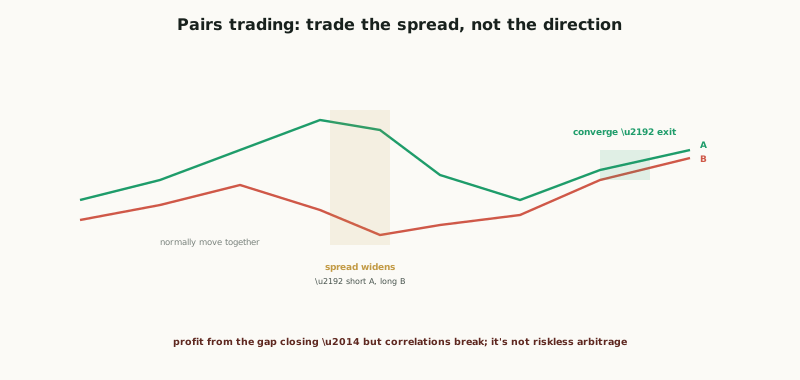
Pairs trading is a market-neutral, relative-value strategy: it trades the relationship between two historically correlated instruments rather than the direction of either one. The setup runs as follows. You identify two instruments that normally move together (a strong historical correlation). You then watch the spread — the difference (or ratio) between their prices. Most of the time they track each other and the spread stays within a normal band. Occasionally they diverge unusually: one races ahead while the other lags, and the spread widens abnormally. That is the signal: assuming the relationship will reassert, you go long the underperformer (the relatively cheap one) and short the outperformer (the relatively expensive one). If the spread then reverts to normal — they converge — both legs tend to profit: the long rises relative to the short, the short falls relative to the long, and you close for a gain on the convergence. Crucially, because you're long one and short the other, your exposure to the overall market direction is largely cancelled out — if both rise together, you lose on the short but gain on the long, and vice versa, so what you're really betting on is the spread, not the market. That's the "market-neutral" appeal: you're trading relative performance, insulated (in theory) from where the broad market goes.
In forex, pairs trading can be applied to correlated currency pairs — two pairs that tend to move together because they share a currency or respond to similar macro drivers (for example, pairs that both strengthen on a risk-on mood, or both track commodity prices). When their usual relationship stretches abnormally, you long the relatively weak one and short the relatively strong one, betting the spread reverts — a way to express a view on relative strength between two currencies or pairs while dampening exposure to the overall market or dollar direction. It's a more statistical, relationship-focused way to trade than simple directional bets, and it naturally suits a systematic, data-driven mindset (measuring the historical spread, its normal range, and how far it has stretched in standard-deviation terms).
The crucial risk: correlations break
Here is the assumption that can sink the whole strategy, and it must be stated plainly: pairs trading relies on the historical correlation holding — and correlations are not fixed. The entire thesis is that the two instruments' relationship will persist and the stretched spread will revert. But correlations can weaken, break, or even invert — because the relationship was always driven by underlying fundamentals, and those can change. If something fundamental shifts (a divergence in the two economies, a central-bank policy split, a structural change in what drives one of them), the two instruments may stop moving together, and a spread you judged "temporarily" stretched can keep widening indefinitely — your "mean-reverting" trade bleeding worse and worse as the relationship you bet on quietly dissolves. This is the cardinal danger: pairs trading is emphatically not riskless arbitrage, despite sometimes being described in those terms. True arbitrage exploits a guaranteed mispricing; pairs trading exploits a statistical tendency that can fail. The spread can also stay stretched far longer than your account (or patience) can withstand, even if it would eventually revert. Managing this requires monitoring the relationship (is the correlation still intact, or has something fundamental changed?), using stops (a maximum loss if the spread keeps widening, accepting the thesis was wrong), sizing conservatively, and never treating the historical correlation as a law of nature. The strategy's market-neutrality reduces directional risk but introduces relationship risk — a different exposure, not the absence of risk.
Used with that clear-eyed respect for its core assumption, pairs trading is an elegant, intellectually-satisfying approach with a genuine edge in the right hands: it trades relative value and mean reversion of a spread, dampens market-direction risk, and rewards careful statistical work on which relationships are robust. But it demands more sophistication than a directional trade, not less — you must select genuinely related pairs (ideally with a fundamental reason for the correlation, not just a coincidental historical one), define the spread and its normal range rigorously, monitor for regime change in the relationship, and apply disciplined risk management including stops for when the mean-reversion assumption fails. Treat it as a relationship bet that can be wrong — not a money machine — and it earns its place in a sophisticated toolkit. The honest framing: pairs trading is a market-neutral, relative-value strategy that trades the spread between two correlated instruments — when they diverge abnormally, long the underperformer and short the outperformer, profiting as the spread reverts, largely independent of overall market direction. In forex it's applied to correlated pairs to trade relative strength. The crucial risk is that correlations break: the relationship rests on fundamentals that can change, so a stretched spread can keep widening — it is not riskless arbitrage. Manage it by choosing fundamentally-grounded correlations, monitoring for regime change, using stops, and sizing conservatively; it's a relationship bet that can fail, demanding more sophistication, not less.
Putting it into practice
Pairs trading done well is a fairly systematic endeavour, and a few practicalities define it. Selecting the pair is the foundation: you want two instruments with a robust relationship, ideally one grounded in fundamentals (a shared currency, similar economic drivers, a structural link) rather than a merely coincidental historical correlation — statisticians distinguish simple correlation (they tend to move together) from cointegration (their spread is stable and mean-reverting over time), and cointegration is the stronger basis, since it's specifically the spread's tendency to revert that the strategy monetises. Measuring the spread: define the spread (a difference or ratio) and its normal range, often standardised as a z-score (how many standard deviations the spread is from its mean) — a common framework enters when the spread stretches to, say, ±2 standard deviations and exits as it reverts toward zero (the mean). Sizing the two legs: to be genuinely market-neutral, the long and short legs should be balanced by their relative volatility or ratio (a "beta-weighted" or ratio-adjusted size), not just equal notional amounts, so a move in the overall market truly cancels out.
The rules then follow naturally: enter when the spread is abnormally stretched (long the laggard, short the leader), exit when it reverts to its mean (taking the convergence profit), and — critically — cut the trade if the spread keeps widening past a defined threshold (your stop, acknowledging the relationship may have broken). Monitoring is ongoing and essential: you must keep checking that the correlation/cointegration is still intact, watching for the regime change (a fundamental shift) that would invalidate the mean-reversion thesis — the moment the relationship structurally changes, the strategy's premise is gone and you should be out. This monitoring-and-stops discipline is what protects against the cardinal risk that correlations break. Because of all this — spread measurement, z-scores, beta-weighting, regime monitoring — pairs trading naturally suits a quantitative, rules-based approach and rewards careful backtesting of the relationship's stability over time. It's more involved than a directional trade, but for the analytically-minded it offers a genuinely different, market-neutral way to extract edge — provided the relationship is sound and the risk of its breaking is respected with stops and vigilance. The honest reminder: select pairs with a fundamentally-grounded, ideally cointegrated (not just correlated) relationship; measure the spread as a z-score and enter when stretched, exit on reversion, and stop out if it keeps widening; beta-weight the two legs for true neutrality; and monitor constantly for regime change — it's a systematic strategy that rewards rigour and respects the correlation-break risk.
Pairs trading is a market-neutral, relative-value strategy: trade the spread between two historically correlated instruments, not their direction. When they diverge abnormally (spread widens), go long the underperformer, short the outperformer, profiting as the spread reverts — largely independent of overall market direction (the long and short cancel directional risk). In forex it's applied to correlated pairs to trade relative strength. The crucial risk: correlations break — the relationship rests on fundamentals that can change, so a "temporarily" stretched spread can keep widening indefinitely; it is not riskless arbitrage. Manage it by choosing fundamentally-grounded correlations, monitoring for regime change, using stops for when mean-reversion fails, and sizing conservatively. It trades relationship risk for directional risk — a different exposure, not no risk — and demands more sophistication, not less.