W.D. Gann claimed markets move according to hidden laws — that price and time obey angles, squares, and natural rhythms, and that a trader who understood this geometry could forecast not just where markets would turn but when. His theory is among the most famous, most elaborate, and most disputed in all of trading. It commands a devoted following and a deeply skeptical opposition in roughly equal measure. This guide explains Gann theory honestly: what it claims, its core tools (angles, squares, cycles), and — importantly — a clear-eyed look at why it's so controversial and unproven. As with the site's treatment of whether technical analysis works, the aim is balanced understanding, not endorsement.
It sits among the classic market theories, raises the same reliability questions as does technical analysis work, and connects to ideas of geometric patterns like harmonic patterns.
Key takeaways
Q: What is Gann theory?
A: Gann theory is a body of techniques developed by trader W.D. Gann (1878–1955), based on geometry, angles, time and price relationships, and cycles. It claims markets move according to predictable geometric and cyclical 'laws' of price and time, and that both price levels and the timing of turns can be forecast using tools like Gann angles, squares and time counts.
Q: What are Gann angles?
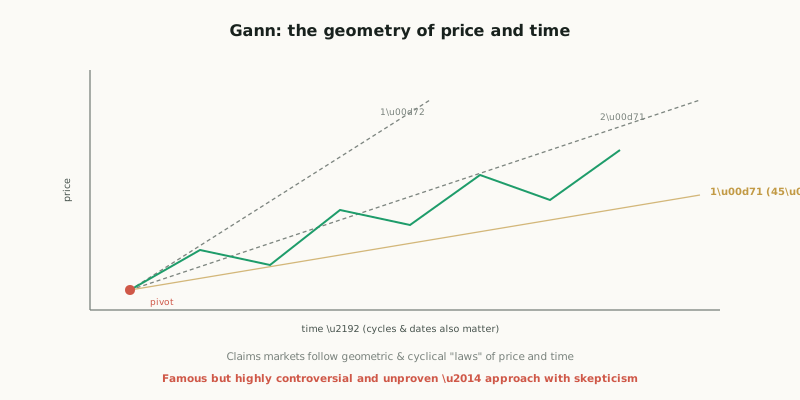
A: Gann angles (or a Gann fan) are diagonal lines drawn from a pivot at specific price-to-time ratios. The most important is the 1×1 angle (45 degrees), representing one unit of price per one unit of time — a balance of price and time. Price above the 1×1 is considered bullish, below it bearish, and the angles are used as dynamic support and resistance.
Q: Is Gann theory reliable?
A: It's highly controversial and lacks rigorous evidence. The techniques are complex, subjective and rooted in esoteric ideas, different analysts get different results, and there's no robust proof the methods reliably predict markets — many regard it as pseudoscience or, at best, a subjective tool whose apparent successes reflect hindsight fitting, self-fulfilling watched levels, or confirmation bias.
Gann and the core idea
William Delbert Gann (1878–1955) was a trader whose name became legendary — and heavily mythologised — in trading lore. He developed an elaborate body of techniques based on geometry, angles, the relationship between time and price, and cycles, and claimed that markets move in predictable geometric and cyclical patterns governed by natural "laws of vibration." The central, distinctive idea of Gann's work is that time matters as much as price: where most analysis focuses on price levels, Gann insisted that when a move would occur — its timing, governed by cycles and time counts — was equally forecastable. His grand claim was that, by understanding the geometry and cycles underlying markets, one could predict both the price levels and the timing of future moves with precision.
This is a far bolder claim than most trading frameworks make, and it's wrapped in ideas that range from the mathematical to the mystical. Gann drew on geometry, ancient mathematics, and — notably — numerology and astrology, reflecting an esoteric worldview in which markets were one expression of universal natural order. It's this combination — an ambitious predictive claim resting partly on mystical foundations — that makes Gann theory simultaneously fascinating to its adherents and a red flag to its critics. To assess it fairly, it helps to look at the actual tools.
The main tools
Gann theory comprises several intricate tools, of which a few are best known. Gann angles (drawn as a "Gann fan") are diagonal lines projected from a significant pivot point at specific price-to-time ratios. The most important is the 1×1 angle — a 45-degree line representing one unit of price per one unit of time, which Gann considered the key balance of price and time. Price trading above the 1×1 angle is read as bullish (price rising faster than the balanced rate), and below it as bearish. Other angles (2×1, 1×2, and so on) represent steeper or shallower price/time rates, and the fan of angles is used as a set of dynamic support and resistance lines. Gann squares (such as the Square of 9 and Square of 144) are geometric and numerical constructions relating price and time through mathematical relationships (square roots and the like), used to identify potential support, resistance and turning points. And time cycles / time analysis form the distinctive heart of the method: Gann emphasised forecasting when turns would occur using cycles, anniversary dates, and specific time counts — with the idea of price and time "squaring" (coming into balance) at significant turning points. Some of his work also incorporated astronomical and astrological cycles.
Taken together, these tools aim to map the market onto a geometric and cyclical grid, from which (the theory claims) future price and timing can be read. The techniques are genuinely intricate, and applying them "correctly" requires considerable study and judgement — which, as we'll see, is part of both their appeal and their problem.
An honest assessment
Gann theory is highly controversial and lacks rigorous evidence, and intellectual honesty requires saying so plainly. Several problems stand out. Its origins are esoteric and mystical (geometry, ancient mathematics, numerology, astrology) rather than grounded in standard financial reasoning. The techniques are highly complex and subjective — which pivot, which angle, which square, which cycle to use are interpretive choices, so different analysts reach different conclusions, and the methods are notoriously prone to hindsight fitting (finding an angle or cycle that "worked" after the fact). There is no robust, peer-reviewed evidence that Gann methods reliably predict markets; supportive "proof" tends to be anecdotal, cherry-picked or retrospective. Even Gann's own legendary trading record is disputed and unverified. Consequently, many traders and academics regard Gann theory as pseudoscience, or at best a subjective tool whose apparent successes are better explained by confirmation bias, hindsight, or self-fulfilling watched levels than by any genuine predictive law.
In fairness, a balanced view notes a few points on the other side. Some elements of Gann's work are used by mainstream-ish traders in modest ways: Gann angles can function as a form of dynamic support/resistance — partly, critics would argue, because they're watched (a self-fulfilling effect, the same dynamic that lends any popular level some validity). And Gann's emphasis on time (not just price) — the idea that when a move happens matters, and that markets may exhibit cyclical timing — is a genuinely interesting contribution that resonates with cycle analysis more broadly. So Gann theory isn't nothing; it contains some usable ideas (geometry as S/R, attention to cycles and time) buried in a great deal of unproven, esoteric complexity. But these usable fragments don't validate the grand predictive claims.
The honest framing, consistent with this site's commitment to evidence over hype: Gann theory is a famous, elaborate body of techniques (angles, squares, time cycles) claiming markets follow predictable geometric and cyclical laws of price and time — a bold predictive claim resting partly on esoteric and mystical foundations. It is highly controversial, deeply subjective, and lacks rigorous evidence; it's widely regarded skeptically (even as pseudoscience), and its apparent successes are often better explained by hindsight fitting, self-fulfilling watched levels, and confirmation bias than by any real law. Approach it critically. If you choose to explore it, treat Gann angles as nothing more than another (popularly watched) support/resistance tool to be tested and used within strict risk management — not as a predictive system, and certainly not as a substitute for sound, evidence-based trading. The interesting kernel — the focus on time and cycles — can be appreciated without swallowing the mystical, unproven whole. As always: be skeptical of any method that promises to forecast both price and timing, demand evidence, and never let an elaborate, confident-sounding theory override disciplined risk management.
Engaging with Gann critically
Suppose you're curious enough to explore Gann's ideas despite the skepticism — how should you do so responsibly? The guiding principle is to extract the usable kernel while refusing the unproven whole, and to test rather than take anything on faith. The defensible kernel is small but real. Gann angles can be treated as one more form of dynamic support and resistance — lines that price may react to, partly because enough people watch them (a self-fulfilling effect that lends any popular level some practical relevance). Used this way — as a watched reference, no different in kind from a trendline or moving average — the 1×1 and its relatives can occasionally be informative, provided you don't imbue them with mystical predictive power. And Gann's emphasis on time and cycles — the reminder that when a move happens may matter, and that markets can show cyclical rhythms — is a legitimate prompt to think about timing, which mainstream cycle analysis also explores.
The discipline, though, is everything. Backtest any Gann technique you're tempted by, honestly and out-of-sample, rather than admiring how well it fits a chart in hindsight — the method's great vulnerability is that its flexibility lets you find an angle, square or cycle that "worked" after the fact, which proves nothing about the future. Be ruthlessly alert to confirmation bias: it's easy to remember the Gann level that held and forget the dozens that didn't. Avoid the deep esoterica (numerology, astrology, the more elaborate squares) unless you have genuine, tested reason to believe in it — complexity and mystique are not evidence. And never let a confident-sounding Gann forecast override your risk management: whatever you read from the angles, position size sensibly, use stops, and treat the analysis as a fallible opinion, not a prophecy. The honest bottom line for the curious: you can appreciate Gann's interesting contributions — geometry as watched support/resistance, and the focus on time and cycles — and even experiment with them, if you do so critically, test everything, guard against bias, and keep them firmly subordinate to evidence-based, risk-managed trading. What you should not do is adopt Gann theory as a predictive system on faith, abandon skepticism, or let its elaborate confidence substitute for the disciplined, tested approach that actually keeps traders solvent. Curiosity is fine; credulity is not.
Gann theory (from trader W.D. Gann, 1878–1955) is an elaborate set of techniques — Gann angles (a fan of price/time lines, the 1×1/45° being key, used as dynamic support/resistance), Gann squares (geometric/numerical constructions for levels and turns), and time cycles (forecasting when turns occur, price and time "squaring") — claiming markets follow geometric and cyclical laws of price and time. Its distinctive idea is that time matters as much as price. But it's highly controversial and unproven: esoteric/mystical in origin (geometry, numerology, astrology), highly complex and subjective (prone to hindsight fitting), with no rigorous evidence and a disputed track record — widely regarded as pseudoscience or, at best, a subjective tool whose successes reflect confirmation bias and self-fulfilling levels. Approach with skepticism; if used at all, treat angles as just another watched S/R tool within strict risk management — not a predictive system.