
Named from the Japanese word for "pregnant," the harami is a small candle cradled inside the body of a larger one — the larger candle the "mother," the small one the "baby." It's the visual signature of momentum suddenly stalling: a strong move, then an abrupt contraction into a small, indecisive candle, hinting that a trend may be running out of steam. The harami is one of the classic candlestick reversal patterns, and the mirror image of the engulfing pattern. This guide explains the harami: its structure, the bullish and bearish versions, what it means, the harami cross variant, and why — as always — confirmation matters.
It's part of the broader candlestick patterns family, the structural opposite of the engulfing pattern, and strongest when it forms at support or resistance.
Key takeaways
Q: What is a harami candlestick pattern?
A: A harami is a two-candle reversal pattern where a large candle is followed by a small candle whose body sits entirely inside the body of the first. Named from the Japanese for 'pregnant', it signals that the prior trend's momentum has suddenly stalled, hinting at a possible reversal.
Q: What is the difference between a bullish and bearish harami?
A: A bullish harami appears in a downtrend — a large red candle followed by a small green candle inside its body — hinting at a bullish reversal. A bearish harami appears in an uptrend — a large green candle followed by a small red candle inside it — hinting at a bearish reversal. Both show momentum stalling.
Q: Is the harami a reliable signal?
A: On its own it's a relatively weak signal, since the small inside candle shows indecision rather than a confirmed reversal. It's far more reliable with confirmation (the next candle continuing in the reversal direction), at a key support or resistance level, and combined with other evidence. The harami cross (where the small candle is a doji) is considered stronger.
Structure and the two versions
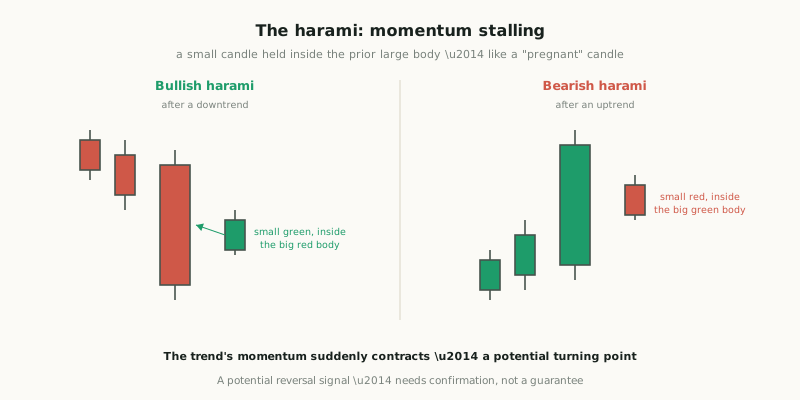
The harami is a two-candle pattern with a distinctive structure: a large candle, followed by a small candle whose body is entirely contained within the body of the prior large candle — the small candle's open and close both fall inside the range of the large candle's body. Visually, the small candle sits "inside" the large one, like the baby inside the "pregnant" mother candle that gives the pattern its name. The two candles are typically of opposite colours. This containment — the second candle's body nested within the first's — is the defining feature, and it comes in two versions depending on the prevailing trend. The table summarises them.
Bullish vs bearish harami
The bullish harami forms in a downtrend: a large red (bearish) candle — reflecting the strong selling of the down move — is followed by a small green (bullish) candle whose body sits inside the red one. It signals a potential bullish reversal. The bearish harami forms in an uptrend: a large green (bullish) candle is followed by a small red (bearish) candle inside it, signalling a potential bearish reversal. In both cases, the pattern requires a prior trend to potentially reverse — a harami in the middle of choppy, directionless price action carries little meaning, since there's no clear momentum to stall. Context, as ever with candlesticks, is essential: the harami is a reversal signal, so it needs an established trend to act on.
What the harami means
The harami's message is about momentum stalling. The first, large candle reflects strong momentum in the trend's direction (heavy selling in a downtrend, heavy buying in an uptrend). Then the second, small candle reveals that this momentum has suddenly contracted — the wide range of the strong move gives way to a narrow, indecisive candle, showing that the trend's drive has paused. After relentless selling (in a downtrend), a small candle that barely moves — and especially one that closes up (green) — signals that sellers have lost their grip and indecision has crept in, raising the possibility that the down move is ending. The sharp contraction of range, from a big candle to a small one nested inside it, is the visual hallmark of weakening momentum and a potential turning point.
It's illuminating to contrast the harami with the engulfing pattern, which is its structural opposite. In an engulfing pattern, the second candle is larger and completely engulfs the first — a strong, decisive reversal where the new direction overwhelms the old. In a harami, the second candle is smaller and is engulfed by (contained within) the first — a gentler signal of momentum merely stalling, not yet decisively reversing. This makes the harami generally a weaker, earlier warning than the engulfing pattern: it flags that the trend's momentum has paused (indecision has arrived), rather than that the opposite side has taken firm control. The harami says "the trend is hesitating"; the engulfing says "the trend has flipped." There's also a notable variant: the harami cross, where the small second candle is a doji (a candle with virtually no body, signalling maximum indecision). The harami cross is considered a stronger signal than an ordinary harami, because the doji represents even more pronounced indecision — the trend's momentum hasn't just contracted, it's reached a near-perfect standstill. A harami cross at a key level is a more compelling warning than a standard harami.
Confirmation and context
As with every candlestick pattern, the harami is a potential reversal signal, not a guarantee — and it's a relatively weak one on its own, precisely because the small inside candle represents indecision rather than a confirmed shift in control. The trend has paused, but it hasn't necessarily reversed; momentum could just as easily resume. This is why the harami should never be traded in isolation, and why confirmation and context are essential to using it well. Confirmation means waiting for the next candle (or price action) to continue in the reversal direction — a green candle closing higher after a bullish harami, for instance, confirms that buyers are indeed taking over, rather than the trend simply resuming down. Trading the harami only after such confirmation greatly improves its reliability and avoids acting on a pause that turns out to be temporary.
Context and location matter just as much. A harami at a meaningful support or resistance level — where a reversal is plausible anyway — is far more significant than one in the middle of nowhere; the level and the pattern reinforce each other. More broadly, the harami works best as part of confluence: combined with other evidence (a key level, supportive indicators, the broader market structure), it becomes a useful piece of a reversal case rather than a standalone trigger. And like all patterns, it can fail — the trend can stall and then continue — so it must always be traded with proper risk management (a defined stop, sensible position size), never on the assumption that the reversal is certain. The honest framing: the harami (bullish in a downtrend, bearish in an uptrend) signals the trend's momentum stalling via a small candle contained inside the prior large one's body; it's a real but relatively weak, early warning — milder than the engulfing pattern, stronger in its harami-cross (doji) form — that needs confirmation, benefits enormously from context (a prior trend, a key level) and confluence, and like all candlestick patterns is probabilistic, not magic. Used that way — as one informative clue among several, confirmed before acting and traded with risk management — the harami is a useful addition to a candlestick reader's toolkit. Treated as a standalone, guaranteed reversal signal, it will frequently disappoint.
How to trade the harami
Putting the harami to practical use follows directly from its nature as a weak-but-early, confirmation-dependent reversal signal. The first step is location: look for a harami forming at a meaningful support or resistance level, against an established trend — a bullish harami at support after a downtrend, or a bearish harami at resistance after an uptrend. A harami in open space, away from any level, is best ignored; the level is what gives the pattern a reason to mark a reversal. The second step is confirmation: rather than entering on the harami itself (the small inside candle is only indecision), wait for the next candle to confirm the turn — a green candle closing higher after a bullish harami, or a red candle closing lower after a bearish one. Entering only on this confirmation filters out many of the haramis that turn out to be mere pauses before the trend resumes.
For stop placement, the logical level is just beyond the extreme of the large (first) candle: on a bullish harami, a stop below the low of the big red candle; on a bearish harami, a stop above the high of the big green candle. This places the stop where the reversal thesis would be proven wrong (price breaking back beyond the move that the harami suggested was stalling), and it lets you size the position by the distance to that stop (the position-sizing approach). A take-profit target can then be set at the next significant level or by a favourable risk:reward multiple. The overall logic is simple: a harami at a key level, confirmed by the following candle, entered with a stop beyond the large candle and sized to your risk — that's a disciplined way to trade what is otherwise a modest signal. And because the harami can and does fail, the stop and sizing aren't optional extras but the core of trading it responsibly. Treated this way — selectively, at levels, with confirmation and defined risk — the harami earns its place; traded impulsively on every occurrence, it disappoints.
The harami ("pregnant") is a two-candle reversal pattern: a large candle followed by a small candle whose body sits entirely inside the large one's body. Bullish harami (downtrend): large red, then small green inside — possible bullish reversal. Bearish harami (uptrend): large green, then small red inside — possible bearish reversal. It signals the trend's momentum stalling (a sharp contraction into indecision) — the structural opposite of the engulfing pattern (where the second candle is larger and engulfs the first), and a milder, earlier signal. The harami cross (small candle is a doji) is stronger. On its own it's weak (indecision, not confirmed reversal), so it needs confirmation (next candle continuing the reversal), context (a prior trend, ideally at support/resistance), and confluence. Probabilistic, not magic — always trade it with risk management.