
"Hawkish" and "dovish" are the two words you'll hear most around any central-bank decision — and for good reason. They describe the policy stance (tighter or looser), and grasping them, plus the crucial role of expectations, is essential to understanding why currencies jump on central-bank news. Get this, and a huge amount of forex's fundamental price action suddenly makes sense. This guide explains hawkish vs dovish: what they mean, how they move a currency, and why it's the surprise that really matters.
It's the practical language of central-bank policy, works through interest rates, and is best understood relatively via policy divergence.
Key takeaways
Q: What do hawkish and dovish mean?
A: They describe a central bank's monetary-policy stance. 'Hawkish' means leaning toward tighter policy — favouring higher interest rates and less stimulus, usually to fight inflation. 'Dovish' means leaning toward looser policy — favouring lower rates and more stimulus, usually to support growth and employment. They sit on a spectrum, and a central bank (or individual policymaker) can be described as more hawkish or more dovish at any time.
Q: How does a hawkish or dovish stance affect a currency?
A: All else equal, a more hawkish stance tends to strengthen a currency (higher or rising rates attract capital seeking yield), while a more dovish stance tends to weaken it (lower rates reduce that appeal). This is one of the most important fundamental drivers in forex. But the effect is about relative stance and, crucially, about expectations — the reaction depends on how the stance compares with what the market already expected.
Q: Why does the 'surprise versus expectations' matter so much?
A: Because markets are forward-looking and price in the expected stance ahead of time. What moves a currency is the difference between what a central bank signals and what was already expected. A bank that sounds 'more hawkish than expected' can send its currency up even if it didn't actually change rates, while one that hikes but sounds dovish about the future can see its currency fall. Trade the surprise, not the headline.
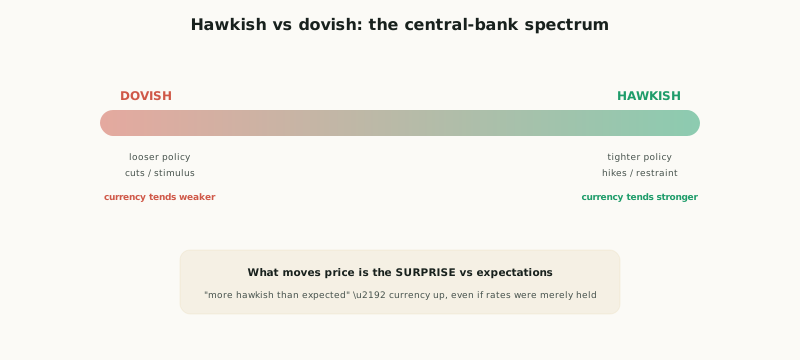
The spectrum
"Hawkish" and "dovish" describe where a central bank (or an individual policymaker) sits on the monetary-policy spectrum.
The hawkish–dovish spectrum
Hawkish means leaning toward tighter policy — favouring higher interest rates and less stimulus, usually to fight inflation (a hawk is vigilant and aggressive against rising prices). Dovish means leaning toward looser policy — favouring lower rates and more stimulus, usually to support growth and employment (a dove is gentler, prioritising the economy over inflation worries). These sit on a spectrum rather than being binary: a central bank can be slightly or very hawkish/dovish, can shift along the spectrum over time, and individual policymakers are often labelled hawks or doves by their typical leanings. The whole vocabulary is just a shorthand for which way policy is leaning — toward restraint (hawkish) or stimulus (dovish).
How it moves a currency — and the expectations key
The currency effect follows from the rates link: all else equal, a more hawkish stance tends to strengthen a currency (higher or rising rates attract capital seeking yield), while a more dovish stance tends to weaken it (lower rates reduce that appeal). This is one of the most important fundamental drivers in all of forex — a great deal of major-pair movement traces back to shifts in the relative hawkish/dovish stance of the two currencies' central banks. So when a central bank turns more hawkish, expect upward pressure on its currency; more dovish, downward pressure.
But here is the single most important nuance, and the thing beginners most often miss: what actually moves the currency is the surprise versus expectations, not the absolute stance. Markets are forward-looking and price in the expected stance ahead of time — if everyone already expects a hawkish hike, that hawkishness is already in the price before the decision. What then moves the currency on the day is the difference between what the central bank signals and what was already expected. This produces the seemingly paradoxical reactions that confuse newcomers: a central bank that holds rates steady but sounds "more hawkish than expected" (hinting at future hikes) can send its currency up, even though it changed nothing — because the market had to reprice toward a more hawkish future. Conversely, a bank that hikes rates (seemingly hawkish) but signals it's done or sounds dovish about the future can see its currency fall — a "dovish hike" — because the market expected more. The headline ("rates hiked!") matters far less than the tone relative to expectations. This is why traders parse central-bank statements, press conferences and projections so obsessively for the shift in stance, and why a currency can move violently on a decision that "did nothing." The practical rule: trade the surprise, not the headline — always ask "how does this compare with what was expected?" rather than reacting to the action in isolation.
As ever, the fundamental caveats hold: the hawkish/dovish stance is one powerful driver among many, it matters relatively (a currency depends on its central bank's stance versus the other currency's — the heart of divergence), expectations are hard to gauge precisely, and the effect interacts with growth, risk sentiment and everything else, so it's never a mechanical rule. But understanding the spectrum and the expectations principle explains a vast amount of forex's fundamental behaviour, and is essential reading of central-bank events — always combined with technicals and risk management. The honest framing: hawkish means leaning to tighter policy (higher rates, anti-inflation), dovish to looser (lower rates, pro-growth), on a spectrum. A more hawkish stance tends to strengthen a currency, more dovish to weaken it — a top fundamental driver. But crucially, markets price the expected stance in advance, so it's the surprise vs expectations that moves price: "more hawkish than expected" can lift a currency even with no rate change, while a "dovish hike" can sink one. Trade the surprise not the headline, judge it relatively (vs the other central bank), and weigh it among many factors with risk management.
Reading central-bank communication
Since the stance (and shifts in it) is what matters, the practical skill is reading central-bank communication for where they sit on the spectrum and, crucially, how that compares with expectations. Several sources carry the signal. The policy statement is parsed word-by-word for changes in language — a phrase added, dropped or softened (e.g. shifting from "further hikes may be needed" to "policy is sufficiently restrictive") can mark a hawkish-to-dovish pivot that moves markets even with no rate change. The press conference tone matters enormously — a governor sounding worried about inflation (hawkish) versus worried about growth (dovish) colours how the decision is read, and off-the-cuff remarks can swing a currency hard. Projections and "dot plots" (where policymakers forecast the future rate path) are a direct read on the expected trajectory — a higher projected path than expected is hawkish. The vote split (how many policymakers dissented, and in which direction) signals the balance of opinion and likely future drift. And individual speeches between meetings, from known hawks and doves, continually update the market's read of the stance.
Tying it back to expectations, this is where the famous "buy the rumour, sell the fact" dynamic comes from. Because the expected stance is priced in advance, a currency often rallies into an anticipated hawkish decision (buying the rumour) and then sells off on the announcement if the bank merely delivers what was expected or sounds less hawkish than hoped (selling the fact) — a move that baffles anyone watching only the headline ("they hiked, why is it falling?"). The disciplined approach is therefore to always frame the event against expectations: before a central-bank decision, know what the market expects (the priced-in stance and path), then judge the actual communication as more hawkish or more dovish than that baseline — the gap is the tradeable surprise. This also means the biggest currency moves come from genuine pivots (a clear shift in stance the market hadn't fully priced), not from expected, telegraphed moves. Reading communication well — statement, press conference, projections, votes, speeches — all through the lens of "versus what was expected," is much of the craft of trading central-bank events. As ever, combine it with the relative picture (the other central bank), technicals and risk management, and respect that the reaction can still surprise. The honest reminder: read the stance from the statement wording, press-conference tone, projections/dot-plots, vote splits and speeches — always judging it as more hawkish or dovish than what was expected; expect "buy the rumour, sell the fact" because the expected stance is already priced, and the biggest moves come from genuine, unpriced pivots.
Hawkish = leaning to tighter policy (higher rates, less stimulus, anti-inflation); dovish = leaning to looser policy (lower rates, more stimulus, pro-growth) — a spectrum, not a binary. A more hawkish stance tends to strengthen a currency (higher yields attract capital), a more dovish stance to weaken it — one of forex's top fundamental drivers. The crucial key: markets price the expected stance in advance, so it's the surprise vs expectations that moves price — "more hawkish than expected" can lift a currency even with no rate change, while a "dovish hike" can sink one. Trade the surprise, not the headline: always ask "how does this compare with what was expected?" Judge it relatively (vs the other currency's central bank — divergence), weigh it among many factors, and manage risk.