
A currency pair is a relationship between two economies — so what drives it isn't one central bank's policy, but the difference between two. When the Fed hikes while the ECB holds, that gap is what moves EUR/USD. Central bank divergence — the widening or narrowing of the policy gap between two central banks — is arguably the single biggest fundamental force in forex, and grasping its relative nature is key to reading major-pair moves. This guide explains central bank divergence: what it is, why it drives pairs, and how markets price it.
It's the relative application of interest rates and policy stance, the engine behind the carry trade, and rooted in interest-rate parity.
Key takeaways
Q: What is central bank divergence?
A: Central bank divergence is when two central banks pursue different monetary-policy paths — for example one raising interest rates while the other holds or cuts. Because a currency pair reflects the relationship between two currencies, it's this difference in policy (and the resulting interest-rate differential) that drives the pair, rather than either central bank's actions in isolation. Widening divergence tends to move a pair in favour of the tightening currency.
Q: Why does divergence drive currency pairs?
A: Because trading a pair is inherently relative — you're long one currency and short the other. If one central bank is tightening (higher yields) while the other eases (lower yields), capital tends to flow toward the higher-yielding currency, strengthening it against the other. So the pair responds to the gap between the two policies. A currency can even strengthen on no change of its own if the other central bank turns more dovish, widening the divergence.
Q: How do markets price central bank divergence?
A: In advance, like all fundamentals. Markets are forward-looking and price in the expected future paths of both central banks, so what moves a pair is a change in the expected divergence — a shift in either bank's outlook that widens or narrows the gap relative to what was priced. This is why pairs move on guidance and projections, not just actual rate changes, and why anticipating shifts in relative policy matters more than reacting to them.
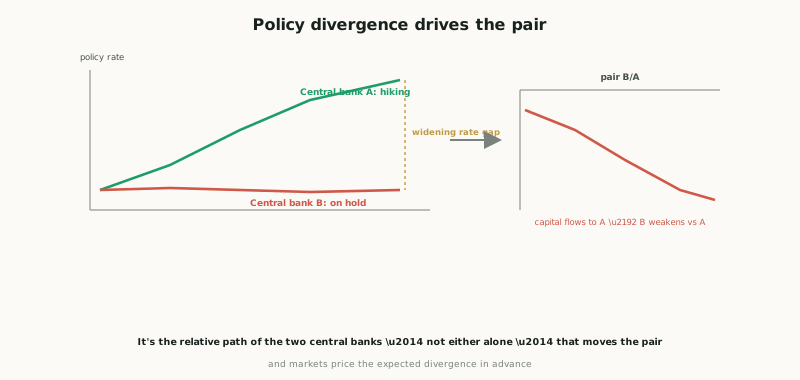
It's the difference that matters
Central bank divergence is when two central banks pursue different monetary-policy paths — say, one raising rates while the other holds or cuts. The crucial insight is that, because a currency pair reflects the relationship between two currencies, it's this difference in policy (and the resulting interest-rate differential) that drives the pair — not either central bank's actions in isolation. This follows directly from the relative nature of forex: trading a pair means being long one currency and short the other, so what matters is always the comparison. A single central bank hiking aggressively tells you little about a pair on its own — you must ask "compared to what the other one is doing?" If both central banks are hiking at the same pace, their policies are aligned and the rate gap is unchanged, so the policy channel exerts little net force on the pair. But when their paths diverge — one tightening while the other eases or lags — the gap widens, and that is what powerfully moves the pair. So a currency can strengthen even when its own central bank does nothing, simply because the other central bank turned more dovish, widening the divergence in its favour. Always think in terms of the relative trajectory of the two central banks: divergence is the force, and it's measured as the difference.
Why it drives pairs, and how it's priced
The mechanism is capital flows chasing relative yield. When one central bank is tightening (pushing its yields up) while the other is easing (yields down or flat), capital tends to flow toward the higher-yielding currency — investors prefer the better return — strengthening it against the other. So a widening divergence in favour of currency A tends to push the pair in A's favour; a narrowing divergence reverses that pressure. This is the same relative-yield logic underlying interest-rate parity and the carry trade (which is essentially a bet on a yield gap persisting). Among all fundamental forces, relative monetary policy is frequently the dominant driver of major-pair direction over the medium term — which is why traders watch both central banks in a pair so closely, tracking not just one but the evolving gap between them.
And, as with every fundamental, divergence is priced in advance. Markets are forward-looking and price the expected future paths of both central banks, so what actually moves a pair is a change in the expected divergence — a shift in either bank's outlook that widens or narrows the gap relative to what was already priced. This is why pairs move on guidance, projections and tone (the hawkish/dovish shifts that change the expected path) as much as on actual rate changes: a hint that one central bank will be more hawkish, or the other more dovish, than expected re-prices the anticipated divergence and moves the pair immediately, well before any rate actually changes. The practical implication is that the edge lies in anticipating shifts in relative policy — forming a view on where the gap between two central banks is heading versus what's priced — rather than reacting to decisions after the fact. The usual caveats remain: divergence is a powerful but not sole driver (risk sentiment, growth, flows and shocks all intrude), expected paths are uncertain and can reverse, and it interacts with everything else, so it's never mechanical. But framing every pair as a contest between two central banks' relative trajectories, priced on expectations, is one of the most clarifying lenses in fundamental forex analysis — used alongside technicals and disciplined risk management. The honest framing: central bank divergence is when two central banks follow different policy paths (e.g. one hiking, one holding), and because a pair is relative, it's this difference — not either bank alone — that drives the pair, via capital flowing to the higher-yielding currency. A currency can strengthen even if its own bank does nothing, when the other turns more dovish and widens the gap. Markets price expected divergence in advance, so pairs move on guidance and tone that shift the anticipated gap, not just actual rate changes — the edge is anticipating relative-policy shifts. Powerful but not the only driver; judge it relatively, on expectations, and manage risk.
Trading the divergence theme
Divergence is valuable partly because it tends to play out as a medium-term theme rather than a one-day event. When two central banks embark on genuinely different paths — one in a hiking cycle, the other cutting or on hold — the resulting trend in the pair can persist for months, as the gap widens meeting after meeting and capital steadily flows toward the tightening currency. This makes divergence a favourite of trend-oriented and macro traders: identify a clear, durable policy divergence, and you have a fundamental tailwind behind a directional view in the pair. The practical work is tracking both central banks — watching both economic calendars, both sets of data, both banks' communication — and forming a view on where the gap is heading versus what's priced, rather than fixating on one side. It dovetails directly with the carry trade (a long position in the higher-yielding, tightening currency earns positive carry and rides the divergence trend) and with reading hawkish/dovish shifts on either side.
But the risks of trading a divergence theme must be respected. First, divergence can narrow or reverse: central banks respond to data, so a tightening bank may pause (or the lagging one may catch up) faster than expected, collapsing the gap the trade relied on — and since the expected path is already priced, the pair can turn sharply when the anticipated divergence shifts, even before any actual policy change. Second, other forces can override the policy theme: a risk-off shock can send capital to safe havens regardless of rate differentials, growth surprises or geopolitics can dominate, and positioning can get crowded and unwind violently. Third, the obvious divergence trade can be over-owned — when "long the tightening currency" becomes a consensus theme, much of the move may be priced and the trade vulnerable to a squeeze. So the disciplined approach treats divergence as a powerful but not infallible medium-term driver: build the view on the relative path versus what's priced, watch both banks for the shift that would change the theme, size for the possibility that sentiment or a data surprise overrides policy, and — as always — combine it with technicals and risk management rather than marrying the macro narrative. The honest reminder: divergence often plays out as a months-long theme (a fundamental tailwind for trend/macro and carry trades), so track both central banks and the gap-versus-priced — but it can narrow or reverse as data shifts the expected paths, risk-off or other forces can override it, and consensus divergence trades can be crowded, so treat it as powerful but not infallible and manage risk.
Central bank divergence is when two central banks follow different policy paths (e.g. one hiking while the other holds or cuts). Because a pair is relative, it's this difference — not either bank alone — that drives the pair: capital flows toward the higher-yielding currency, strengthening it. A currency can strengthen even if its own bank does nothing, when the other turns more dovish and widens the gap. Markets price expected divergence in advance, so pairs move on guidance and tone that shift the anticipated gap, not just actual rate changes — the edge is anticipating relative-policy shifts vs what's priced. Always think in relative terms (both banks, not one), treat it as a powerful but not sole driver, and combine with technicals and risk management. Relative monetary policy is arguably forex's single biggest fundamental force.