You can open a forex account with surprisingly little money — but "how much do I need?" is, in truth, the wrong question. The barrier to entry is low; the barrier to trading sensibly is what matters. The right questions are: how do I start in a way that gives me a realistic chance, while only risking money I can genuinely afford to lose, and what can a small account realistically achieve? This guide answers those honestly — the low technical minimum, the all-important rule of risk capital, why small accounts mean small returns, and how to start in a way that sets you up to last rather than blow up.
It's a companion to how to start forex trading, depends on sound position sizing, and reflects the realistic learning curve.
Key takeaways
Q: How much money do you need to start forex trading?
A: Technically very little — many brokers allow small minimum deposits (sometimes $50–$100), and micro or nano lots let you trade tiny sizes, so the barrier to entry is low. But the more important question is how much you need to trade sensibly while only risking money you can genuinely afford to lose, with realistic expectations.
Q: Can you get rich starting forex with a small account?
A: No — you should not expect to. With sound risk management (risking 1–2% per trade), a small account means tiny absolute risk and returns, and fixed costs like spreads eat proportionally more. Even good percentage returns on a small balance are small in actual money. Realistically, the early goal is to learn and survive, not to earn a living.
Q: What is the most important rule about starting capital?
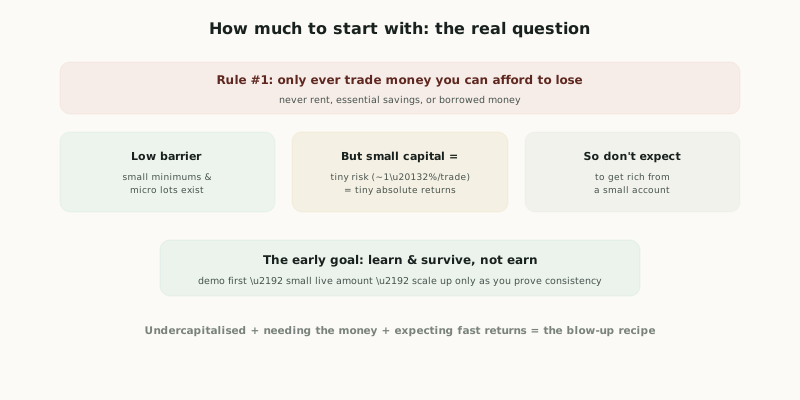
A: Only ever trade money you can genuinely afford to lose — true risk capital whose loss won't affect your finances or wellbeing. Never use rent money, essential savings, or borrowed funds. Being undercapitalised while needing the money and expecting fast returns is the classic recipe for over-risking and blowing up.
The low minimum — and the real question
Technically, you can start with very little. Many brokers allow small minimum deposits — sometimes as low as $50 or $100 — and micro and nano lots let you trade tiny position sizes, so the literal barrier to entry is low. In that narrow sense, "how much do I need?" has an easy answer: not much. But that's not the question that actually matters. The minimum to open an account is not the amount you need to trade sensibly, give yourself a realistic chance, and do so without risking money you can't afford. Reframing the question — from "what's the minimum?" to "how do I start in a way that's sound and survivable?" — is itself one of the most valuable things a beginner can do, because the low minimum tempts people to deposit money they need and expect it to transform their finances, which is exactly the path to ruin.
The one rule that matters most
The single most important principle — above any number — is this: only ever trade with genuine risk capital, meaning money whose loss would not affect your finances or your wellbeing. Never trade with rent or mortgage money, essential savings, an emergency fund, money earmarked for bills or family needs, or — worst of all — borrowed money. Trading is risky, the majority of beginners lose, and you must assume the money you put in could be lost entirely. If losing your trading capital would cause you real financial harm or distress, you've deposited too much (or money that isn't yours to risk). This isn't cautious hand-wringing — it's the foundation of trading sanely. Trading with money you can't afford to lose doesn't just risk your finances; it warps your psychology, because the fear and pressure of needing the money lead directly to over-risking, revenge trading, and the emotional decisions that blow accounts up. Risk capital only — always.
Small capital, small returns — and the right goal
With that rule established, understand the relationship between capital, risk and realistic returns — because it dispels the get-rich fantasy. Sound risk management means risking only a small percentage of your account per trade (commonly 1–2%). On a small account, that's a tiny absolute amount — risking 1% of $200 is $2 — so your potential gains per trade are correspondingly tiny in actual money, and fixed costs like the spread eat proportionally more of a small account. The unavoidable arithmetic: even excellent percentage returns on a small balance are small in real money. A skilled trader making, say, a strong annual return on a few hundred or thousand pounds is making very little in absolute terms — nowhere near a living. So don't expect to get rich from a small account; trading is not a way to turn $100 into financial freedom quickly, however loudly social media suggests otherwise. To make meaningful money you need meaningful capital traded sensibly — which most beginners don't have, and that's completely fine, because the early goal isn't to earn.
That reframes everything: the early goal is to learn and survive, not to earn. The first phase of trading is an apprenticeship (the years-long learning curve), and during it your aim is to develop skill and not blow up — not to make a living. So the sensible path is: start on a demo to learn the mechanics risk-free; then go live with a small amount you can comfortably afford to lose, focused on process and discipline rather than profit; and scale up only gradually, as you prove consistency over a meaningful sample. The amount, then, is whatever lets you trade sensibly (enough to use proper position sizing without costs dominating) while being genuinely affordable — for many that's a modest sum, deliberately kept small while learning. Above all, avoid the trap that destroys so many beginners: being undercapitalised, needing the money, and expecting fast returns all at once — a combination that forces over-leveraging, over-risking and the inevitable blow-up. The honest framing: the technical minimum to start forex is low (small accounts and micro lots exist), but the real question is how to start sensibly. The number-one rule: only trade risk capital — money you can genuinely afford to lose (never rent, essential savings, or borrowed money). With sound risk management, a small account means tiny absolute risk and returns, and costs bite proportionally more — so don't expect to get rich from a small balance; realistic returns on small capital are small. The early goal is to learn and survive, not earn: start on a demo, go live with a small affordable amount focused on process, and scale up only as you prove consistency. Patience, risk capital only, and realistic expectations are worth far more than any starting figure.
Building your account the right way
If a small account can't make meaningful money, how does anyone get to meaningful capital? Honestly, there are only a few legitimate routes, and understanding them dispels another fantasy. The first is simply compounding over a long time — growing the account through consistent profits reinvested — but this is slow precisely because returns are percentages of a small base, and it only works after you've achieved genuine consistency (most beginners haven't). The second, more realistic for most, is adding capital from your income over time — funding your trading account from savings you can afford, gradually, as your skill develops. The key discipline here is that you should only add money you can afford to lose, on a planned basis as you build skill — never deposit more in a panic to "make back" losses or to chase the dream of faster returns. Adding money to a strategy that isn't yet working just funds bigger losses; capital should follow demonstrated consistency, not hope.
You may encounter proprietary ("prop") trading firms as an apparent shortcut to larger capital — firms that, typically after you pass an evaluation (usually paid), let you trade their capital and keep a share of the profits. For a genuinely skilled, consistent trader these can be a legitimate route to trading larger size without risking your own money, but approach them with real caution: many operate primarily as evaluation-fee businesses (profiting from the fees of the many who fail the challenge rather than from trading), the rules are often strict and easy to breach, and the space contains its share of dubious operators. A prop firm is not a way to become profitable — it presupposes you already are; it's a potential route to scaling proven skill, not a substitute for developing it (and certainly not a get-rich shortcut for beginners). The honest path to building an account, then, mirrors the whole realistic picture of trading: develop genuine, consistent skill first (on a demo, then a small affordable live account, over the years the learning curve takes), keep your capital to what you can afford to lose, add to it deliberately as you prove consistency (never to chase losses), and consider scaling routes like prop firms or compounding only once you're genuinely consistent. There's no shortcut that skips the skill — meaningful capital sensibly deployed, by a trader who has earned the right to deploy it, is the destination, not the starting point.
The technical minimum to start forex is low (small deposits and micro lots exist), but that's the wrong focus. The number-one rule: only ever trade money you can genuinely afford to lose — true risk capital, never rent, essential savings, an emergency fund, or borrowed money (needing the money warps your psychology and drives over-risking). Understand the arithmetic: with sound risk (~1–2% per trade), a small account = tiny absolute risk and returns, and fixed costs eat proportionally more — so don't expect to get rich from a small balance; even great percentage returns are small in real money. The early goal is to learn and survive, not earn: start on a demo, go live with a small affordable amount focused on process, and scale up only as you prove consistency. The blow-up recipe is being undercapitalised + needing the money + expecting fast returns. Patience, risk capital only, realistic expectations.