The hardest part of starting is knowing the right order to do things in. Plenty of beginners do it backwards — fund an account, start clicking, and learn the hard (expensive) way — when the sensible path is to learn, practise, plan, and only then risk a little real money carefully. Getting that sequence right is much of what separates beginners who survive their first year from the majority who don't. This guide lays out a sensible, step-by-step path to start forex trading: from learning the basics, through choosing a regulated broker and practising on demo, to building a plan and starting small — with realistic expectations and risk management front and centre throughout.
It builds on the foundations in what is forex trading, leans heavily on demo practice and a sound trading plan, and pairs naturally with the common beginner mistakes to avoid.
Key takeaways
Q: How do I start forex trading as a beginner?
A: Follow a sensible order: learn the basics first, choose a reputable regulated broker, open and fund an account with money you can afford to lose, practise on a demo account, develop a trading plan with strict risk management, and only then start trading real money at a small size. Education and risk management come before profit.
Q: How much money do I need to start forex trading?
A: You can open accounts with relatively small amounts, but the real rule is to only ever use money you can genuinely afford to lose. It's wise to start small regardless of how much you have — trade a small size while you learn, since most beginners lose money early, and risk only a small percentage of your capital per trade.
Q: Can you get rich quick trading forex?
A: No — and you should be deeply sceptical of anyone claiming otherwise. Trading is a skill that takes time to develop, most retail beginners lose money (especially early on), and get-rich-quick promises are a hallmark of scams. Approach it as a long-term skill to build carefully, not a shortcut to fast wealth.
The steps to start
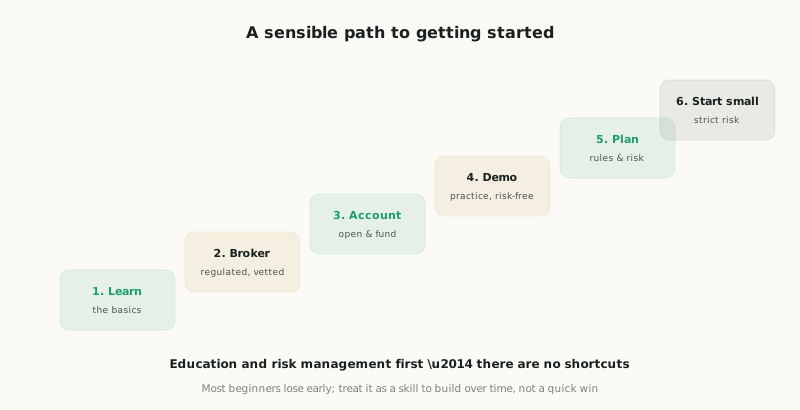
Here is a sensible sequence for getting started — each step building on the last, with no skipping ahead to "the trading" before the groundwork is done. The table summarises it, and the detail follows.
A sensible getting-started sequence
1. Learn the basics first. Before risking anything, understand what forex is and how it works — what you're actually trading, how a trade works, and the key terms (pips, lots, leverage, margin, spreads). The foundational guides cover this: start with what is forex trading and how a forex trade works, get comfortable with pips, lots and leverage, and keep the glossary handy. The principle is simple: don't trade what you don't understand. Education comes first, always.
2. Choose a reputable, regulated broker. Your broker is your gateway to the market, so choose carefully (the choosing a broker guide covers this in depth). The essentials: make sure the broker is regulated by a credible authority, check its costs (spreads, commissions — the cost of trading), and consider its platform and reputation. Critically, be alert to scams — the industry attracts fraudsters, and a regulated broker is your first line of defence.
3. Open and fund an account. Once you've chosen a broker, you'll open an account (there are different account types to understand) and, eventually, fund it. The cardinal rule here: only deposit money you can genuinely afford to lose. Never trade with money you need for living expenses, rent, or debts — trading capital should be money whose loss wouldn't damage your life. 4. Practise on a demo account. Before risking real money, practise on a demo account — a risk-free simulation with virtual money. Use it to learn the platform, get a feel for how trades work, and test your approach without financial risk. This is the step beginners most often skip, and skipping it is a costly mistake; demo practice is where you make your beginner errors for free.
5. Develop a trading plan and strategy. Don't trade randomly. Develop a trading plan — a defined approach with rules for what you'll trade, when you'll enter and exit, and, above all, how you'll manage risk (the risk management material). A plan turns trading from impulsive gambling into a disciplined, repeatable process. 6. Start small with strict risk management. When you do begin trading real money, start small — trade a small position size, risk only a small percentage of your account per trade, and manage risk strictly from the very first trade. Expect to make mistakes (and likely some losses) as you learn, and scale up only slowly as you gain genuine experience and consistency. There's no rush. Beyond these steps, the work is ongoing: keep learning, keep a journal, manage risk relentlessly, and be patient.
Realistic expectations and caution
Just as important as the steps is the mindset you bring — and a few honest truths will serve you far better than the hype you'll encounter online. First, it takes time and effort. There is no shortcut to trading competence; it's a skill developed over months and years, not days. Most beginners lose money, especially early on — this is the well-documented reality of retail trading — so expect a learning curve with losses along the way, and treat early trading as education rather than a path to quick income. Approaching it as a long-term skill to build, with realistic patience, is far healthier (and more likely to succeed) than expecting fast profits.
Second, manage risk from day one. This is the single most important thing, and it bears repeating: only ever risk money you can afford to lose, never over-leverage, and use sensible position sizing and stops from your very first real trade. The beginners who blow up almost always do so through poor risk management — too much leverage, too much risked, no stops — not through bad analysis. Get the risk management right and you give yourself time to learn; get it wrong and you may not survive long enough to. Third, be realistic and sceptical. Be deeply wary of anyone promising easy riches, guaranteed profits, or get-rich-quick systems — these are the hallmarks of scams and hype, and they prey on beginners precisely. Most retail traders lose money; legitimate trading is hard, uncertain work, and anyone telling you otherwise is likely selling something. The honest framing: the sensible path to start is learn → choose a regulated broker → demo practice → build a plan → start small with strict risk management, all underpinned by realistic expectations and the discipline to risk only what you can afford. There's no get-rich-quick; it's a skill that takes time, most beginners lose early, and caution and risk management come first. Start that way, and you give yourself a genuine chance to learn and, eventually, perhaps to succeed — patiently, and on solid foundations.
What to expect along the way
Setting honest expectations about the journey helps you persevere sensibly rather than quitting in frustration or blowing up in over-eagerness. Expect a genuine learning curve. The early phase is about education and practice — understanding the mechanics, getting comfortable on demo, developing and testing a plan — and this takes weeks and months, not days. When you move to real money, expect to make mistakes and to have losing trades; this is normal and part of learning, not a sign you've failed. The realistic picture is that most beginners lose money in their early period, so treat early real-money trading as continued education (at small size, where losses are affordable and instructive) rather than as a source of income. Progress in trading is rarely linear — there are good runs and bad runs — and building genuine, repeatable consistency is the work of a long time. Patience with the process, and with yourself, is essential.
On the practical question of how much money to start with: you can open accounts with relatively modest amounts (some brokers allow small minimums, and micro/mini lots let you trade small sizes), but the real rule isn't a specific figure — it's to use only money you can genuinely afford to lose, never funds needed for living costs, rent or debts. And regardless of how much capital you have, it's wise to start small: trade a small size while you're learning, risking only a small percentage per trade, so that the inevitable early mistakes are cheap lessons rather than serious damage. There's no benefit to risking large sums before you've shown (to yourself, over time) that you can trade with discipline and consistency. Scale up only gradually, as genuine experience and a track record justify it — and never feel pressured to rush, by your own impatience or by anyone else's hype. The market will always be there; your capital, if you protect it, will be there to trade another day. Approached patiently — learning thoroughly, practising properly, starting small, and treating early losses as tuition — you give yourself the time and the foundation that successful trading requires. The beginners who last are almost always the ones who started slowly and protected their capital while they learned.
Start in a sensible order: 1) learn the basics (what forex is, how trades work, pips/lots/leverage), 2) choose a reputable, regulated broker (beware scams), 3) open and fund an account with money you can afford to lose, 4) practise risk-free on a demo account (don't skip this), 5) build a trading plan with strict risk management, and 6) start trading real money small, scaling up only slowly with experience. Bring realistic expectations: there's no get-rich-quick — trading is a skill that takes time, most beginners lose early, so treat it as long-term learning. Manage risk from day one (only risk what you can afford; never over-leverage), and be sceptical of anyone promising easy riches. Education and risk management first — profits, if they come, come later.