Most beginners lose money — and the striking thing is how similar their mistakes are. The same handful of errors account for the great majority of blown-up accounts, which means the encouraging flip side is true too: those mistakes are well-known and avoidable. Learn them in advance, internalise the fixes, and you sidestep the traps that catch most newcomers — giving yourself a genuine chance to survive the learning curve. This guide rounds up the most common beginner mistakes in forex trading, with the fix for each, drawing together the wisdom spread across the rest of the site. Read it as a checklist of what not to do.
The fixes lean on the site's core teachings: risk management, a trading plan, and the sensible getting-started path.
Key takeaways
Q: What are the most common mistakes beginner forex traders make?
A: The most common are over-leveraging and poor risk control, trading without a stop-loss, having no trading plan, overtrading, letting emotions (fear, greed, revenge, FOMO) drive decisions, chasing the market, holding losers while cutting winners, unrealistic get-rich-quick expectations, not practising on demo, and falling for scams. Most trace back to poor risk management and emotional discipline.
Q: Why do most beginner forex traders lose money?
A: Usually not because of bad analysis, but because of poor risk management (too much leverage, risking too much, no stops) and poor emotional discipline (revenge trading, overtrading, chasing losses) — often combined with unrealistic expectations. The good news is these are avoidable: sound risk management and discipline address the root causes.
Q: How can beginners avoid these mistakes?
A: Use sound risk management from day one (sane leverage, small risk per trade, always a stop-loss), trade a written plan, be patient and selective rather than overtrading, keep emotions in check (never chase losses), hold realistic expectations, practise on demo and start small, keep a journal, and be sceptical of gurus and get-rich-quick schemes.
The cardinal mistakes
A few mistakes are so dangerous — so likely to destroy an account quickly — that they deserve singling out before the rest.
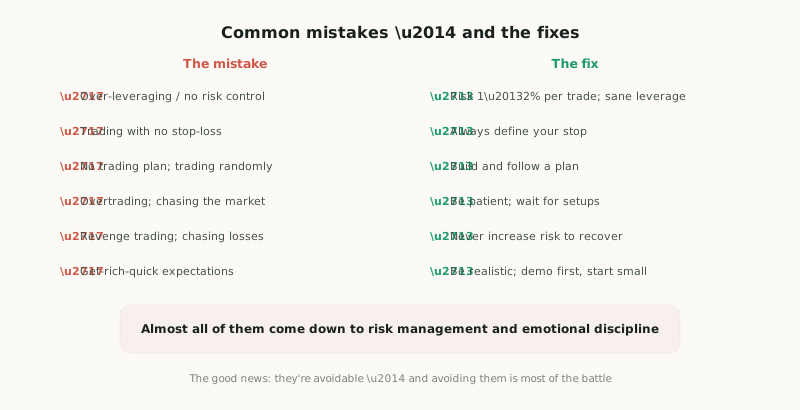
The fastest ways to blow up are: over-leveraging and poor risk control (using excessive leverage and risking too much per trade, so a few losses wipe you out — the dangers of overleverage); trading with no stop-loss (letting a loss run unchecked until it's catastrophic); having no risk management at all (no position sizing, no plan for losses); and chasing losses (increasing risk to "win back" what you've lost — revenge trading and martingale-style escalation). These cardinal mistakes are how the majority of beginners lose their accounts — not through bad analysis, but through reckless risk. Fix these first: sane leverage, always a stop, a small fixed risk per trade, and never chasing losses.
The pattern in the cardinal mistakes is clear and worth stating plainly: beginners are far more often destroyed by poor risk management than by poor analysis. You can have mediocre analysis and survive with good risk management; you can have brilliant analysis and still blow up with bad risk management. This is why the site returns to risk management so relentlessly, and why fixing the account-killers above — leverage, stops, sizing, never chasing — is the highest priority for any beginner. Get these right and you buy yourself the time to learn everything else; get them wrong and you may not last.
The rest of the list
Beyond the cardinal errors, several other common mistakes hold beginners back. No trading plan: trading impulsively, without defined rules — the fix is to build and follow a trading plan (rules turn gambling into a process). Overtrading: taking too many trades, often from boredom or a fear of missing out, rather than waiting for quality setups — the fix is patience and selectivity (the overtrading guide). Letting emotions drive decisions: fear, greed, revenge trading and FOMO, and tilt overriding the plan — the fix is emotional discipline, a focus on process, and stepping away when emotional. Chasing the market: jumping into moves late (buying tops out of FOMO) instead of waiting for a proper entry — the fix is to wait for your setups (e.g. pullbacks rather than chasing).
Cutting winners and holding losers: the natural but destructive disposition effect — the fix is the cardinal rule "cut your losses, let your winners run," enforced by stops and targets. Unrealistic, get-rich-quick expectations: expecting fast riches, which leads to over-leveraging and disappointment — the fix is realistic expectations (trading is a skill that takes time, and most beginners lose early). Not practising on demo, or starting too big: risking real money before being ready, or trading too large a size — the fix is to use a demo account first and start small. Falling for scams and gurus: trusting signal-sellers, fake gurus, and get-rich-quick schemes — the fix is healthy scepticism (the common scams guide). And not keeping a journal or learning from mistakes: repeating errors without reflection — the fix is to keep a trading journal and review it. None of these is exotic; they're the ordinary, predictable ways beginners stumble — which is exactly why knowing them in advance is so valuable.
The unifying theme
Step back from the list and a clear pattern emerges: almost all beginner mistakes come down to two things — poor risk management and poor emotional discipline. Over-leveraging, no stops, no sizing, no plan: risk management failures. Revenge trading, overtrading, chasing, FOMO, holding losers: emotional discipline failures. The analytical side of trading — reading charts, understanding fundamentals — matters, but it's rarely what sinks a beginner; the risk and psychology failures are. This is genuinely good news, because it means the path to avoiding the mistakes that catch the majority is not some elusive analytical edge but the very things this site emphasises above all: sound risk management (sane leverage, small fixed risk, always a stop, never chasing) and emotional discipline (patience, process over outcome, sticking to a plan, managing your emotions). Master those, and you've sidestepped the lion's share of what makes beginners lose.
The honest, encouraging framing: beginners commonly make these mistakes — over-leveraging, no stops, no plan, overtrading, emotional and revenge trading, chasing, unrealistic expectations, skipping demo, falling for scams, not journaling — and the great majority trace back to poor risk management and poor emotional discipline. But they're all well-known and avoidable, and avoiding them is most of the battle. Be patient, manage risk relentlessly from day one, keep your emotions in check, hold realistic expectations, practise and start small, and learn from a journal. You won't trade perfectly — no one does — but you'll avoid the catastrophic, account-ending errors that catch most newcomers, and that alone puts you ahead of the majority. The mistakes are predictable; forewarned, you can simply choose not to make them.
A few more — and the constructive mindset
Beyond the headline errors, a handful of quieter mistakes commonly trip beginners up. Impatience with the learning process: expecting to be profitable almost immediately, then giving up (or going reckless) when it doesn't happen — the fix is accepting that competence takes time and treating early trading as education. Ignoring the costs of trading: overlooking spreads, commissions and overnight financing, which quietly erode returns — especially for those who overtrade — so it pays to understand the cost of trading and factor it in. Trading too many pairs at once: spreading attention thinly across many markets a beginner can't properly follow — the fix is to focus on a small number of pairs and learn them well. Copying others blindly: following signals, tips or "gurus" without understanding the reasoning, which leaves you unable to manage the trade or learn from it — the fix is to develop your own understanding and only trade what you comprehend. And failing to adapt or review: repeating the same approach without honestly assessing what's working — the fix, again, is the journal and periodic review.
It's worth ending on the constructive note, because a list of mistakes can read as discouraging when it shouldn't. The right mindset is not fear of error — you will make mistakes, everyone does, and that's part of learning — but a determination to avoid the catastrophic, avoidable ones and to learn from the rest. Approach trading with humility (you're a beginner; act like one, with small size and careful risk), patience (give yourself time to develop), and a focus on process over quick profits. Be kind to yourself about the small, instructive mistakes, while being uncompromising about the account-killers (leverage, stops, risk, chasing) that you simply must not make. Keep learning, keep a journal, manage risk relentlessly, and treat each error as a lesson logged and not repeated. Framed this way, the inevitability of mistakes isn't cause for anxiety but a normal feature of a learning curve you can navigate sensibly. The goal isn't perfection — it's avoiding the few mistakes that end the journey, surviving the many small ones, and steadily improving. Do that, with discipline and realistic expectations, and you'll have done what most beginners fail to do: given yourself a real chance to learn the craft over time.
Most beginners lose by making the same avoidable mistakes. The account-killers (fix these first): over-leveraging / poor risk control, no stop-loss, no risk management, and chasing losses — beginners are destroyed by poor risk management far more than by bad analysis. The rest: no trading plan, overtrading, emotional/revenge/FOMO trading, chasing the market, cutting winners while holding losers (the disposition effect), get-rich-quick expectations, skipping demo or starting too big, falling for scams and gurus, and not journaling. The unifying theme: almost all of them are failures of risk management or emotional discipline — the very things this site stresses. The fixes are the cure: sane leverage and small fixed risk with stops, a written plan, patience, emotional control, realistic expectations, demo practice, scepticism of hype, and a journal. They're predictable and avoidable — forewarned, choose not to make them.