Becoming a consistently profitable trader is a long, hard journey — measured in years, not weeks, and as much about psychological development as technical skill. It's a path the large majority who set out on never complete. None of that is meant to discourage you; quite the opposite — understanding the road ahead, and why it's hard, makes you far more likely to survive it and to keep going when it gets tough. This guide offers an honest, realistic map of the trader's learning curve: the stages of development, the discouraging middle where most quit, and how to give yourself the best chance of making it through.
It's the realistic counterweight to social-media hype, builds on how to start trading, and demands the resilience and discipline the whole psychology pillar develops.
Key takeaways
Q: How long does it take to become a profitable trader?
A: Realistically, years — not weeks or months — of effort, deliberate practice and experience. The large majority of retail traders lose money and quit. There's no quick path despite what social media suggests; competence is a skill developed over time, and much of the journey is psychological development, not just technical learning.
Q: What are the stages of a trader's development?
A: A common model uses the four stages of competence: unconscious incompetence (you don't know what you don't know — it seems easy), conscious incompetence (you realise how hard it is and lose money — the discouraging 'dip' where many quit), conscious competence (developing skill with deliberate effort), and unconscious competence (disciplined execution becomes more natural and ingrained).
Q: Why do most traders fail?
A: Many quit during the discouraging middle stage, underestimate the time and psychological development required, risk money they can't afford and blow up before they can learn, chase get-rich-quick expectations, or never master the discipline, risk management and emotional control the journey demands. Those who succeed tend to persist with good process, manage risk, and survive long enough to develop.
The honest reality
Let's start with the truth that social media works hard to obscure: trading is hard, and most retail traders lose money and quit. Developing genuine competence takes significant time (often years), sustained effort, and enough capital and survival to learn from experience without blowing up first. There is no quick path — the get-rich-in-weeks narrative pushed by finfluencers is a fiction that sets newcomers up for disappointment and reckless risk-taking. Setting realistic expectations from the outset is therefore one of the most important things a developing trader can do: treat trading as a serious skill or craft to be developed over years, like medicine or a musical instrument, not as a shortcut to wealth. The traders who approach it this way — patiently, as a long-term endeavour — vastly outlast those expecting fast riches, who tend to over-risk, get discouraged, and quit (or blow up) early.
The four stages of development
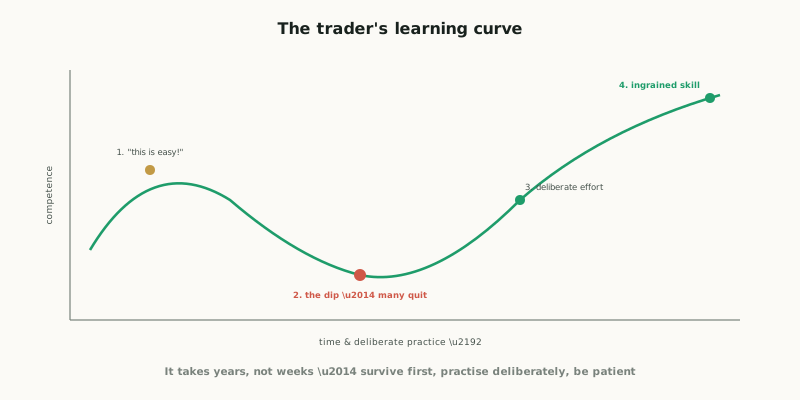
A useful way to understand the journey is the classic four stages of competence model, applied to trading. It's a general, illustrative framing rather than a rigid sequence, but it captures the path well.
The four stages of a trader's development
| Stage | What it is | What it feels like |
|---|---|---|
| 1. Unconscious incompetence | You don't know what you don't know | "This is easy!" — naive confidence |
| 2. Conscious incompetence | You realise how hard it is; you lose | The discouraging "dip" — many quit here |
| 3. Conscious competence | Skill, with deliberate effort | Consistent, but it takes concentration |
| 4. Unconscious competence | Disciplined execution feels natural | Ingrained skill (still needs discipline) |
In unconscious incompetence, the beginner doesn't yet know what they don't know — often buoyed by early "beginner's luck" or naive confidence, they think trading is easy. In conscious incompetence, reality bites: they start losing, realise how hard it actually is, and become acutely aware of their mistakes and gaps. This is the discouraging "dip" or "valley of despair" — and it's where most people quit, defeated by the gap between expectation and reality. In conscious competence, the trader who persists begins genuinely developing skill: following a process deliberately, with real effort and concentration, and starting to achieve consistency — though it doesn't yet come automatically. Finally, in unconscious competence, disciplined execution becomes more natural and habitual — the experienced trader for whom the fundamentals are ingrained (though, importantly, this never means discipline can be abandoned; even here, good trading requires ongoing effort). The key insight from this model is that the dip is normal and expected — it's a stage to push through, not a verdict that you can't trade.
How to progress — and be kind to yourself
The journey is as much psychological and emotional as technical: much of it is learning discipline, managing emotions, and surviving variance — which is why this entire psychology pillar exists. Variance also makes the path confusing: early luck can mislead a beginner into overconfidence, while a run of bad luck can wrongly convince a developing trader they have no edge — so understanding variance is part of navigating the curve sanely. So how do you give yourself the best chance of progressing? Hold realistic expectations (treat it as a multi-year craft). Survive first: above all, don't risk what you can't afford to lose, and trade small while learning — the early goal is to learn and survive, not to get rich, because you can't develop if you blow up (the risk-of-ruin and getting-started links). Practise deliberately: keep a journal, review your trades, and work consciously on your weaknesses rather than just accumulating screen time. Develop the psychology: build the discipline, patience and emotional resilience the journey demands. And persist: the difference between those who make it and those who don't is rarely a secret technique — it's usually persistence, discipline, sound risk management, continuous learning, and simply not blowing up long enough to develop.
Finally, a note on wellbeing, because this journey is genuinely demanding. Be patient and kind to yourself: the curve is hard for almost everyone, the dip is discouraging by nature, and struggling through it is normal, not a sign of personal failure. Don't let the difficulty, or comparison to others' (often fake) success, erode your self-worth — your progress is your own. Manage your expectations and your emotions, keep the stakes to what you can genuinely afford so the process never threatens your financial or mental wellbeing, and if the pressure becomes heavy, step back and lean on people you trust. The honest framing: the trader's learning curve is a long, hard developmental journey — most retail traders lose and quit, and competence takes years of effort, deliberate practice, surviving variance, and (above all) psychological development, not just technical learning. A common model maps four stages — unconscious incompetence ("this is easy") → conscious incompetence (the discouraging "dip" where many quit) → conscious competence (deliberate skill) → unconscious competence (ingrained skill). There's no quick path. Progress by holding realistic expectations (a craft taking years), surviving first (don't risk what you can't afford; small size while learning — the early goal is to learn and survive, not get rich), practising deliberately with a journal, developing the psychology, and persisting. Be patient and kind to yourself — the journey is hard for everyone. Those who succeed do so through discipline, risk management, continuous learning, and not blowing up long enough to develop — not a secret.
What actually speeds it up
Since the journey is long, it's fair to ask what genuinely accelerates it — not to shortcut the work, but to avoid wasting years. The biggest lever is deliberate practice rather than mere screen time. Ten years of unreflective trading teaches far less than two years of deliberate practice: keeping a detailed journal, reviewing your trades honestly, identifying your specific recurring mistakes, and working consciously to fix them. Most traders repeat the same errors for years because they never study their own trading; the ones who improve fastest treat every trade as data and every loss as a lesson. Focus and specialisation help too — trying to master every market, timeframe and strategy at once spreads your learning thin, whereas going deep on one approach, a few instruments and one timeframe builds genuine competence far faster. Depth beats breadth in the early years.
Good sources and, where possible, genuine mentorship can compress the curve by helping you avoid avoidable mistakes — but with heavy caveats from the social-media discussion: a genuinely skilled, honest mentor is rare and valuable, while the far more common "guru" selling a course is not (most who sell can't trade). Vet ruthlessly, and prefer learning from those with nothing to sell you. Two structural factors also matter. Adequate (but expendable) capital and realistic time: you need enough to trade meaningfully and learn, but only money you can genuinely afford to lose, and the patience to give development the years it requires — the under-capitalised trader desperate for quick income and the impatient one expecting fast riches both tend to over-risk and self-destruct. And critically, avoid the things that reset your progress: the single biggest accelerant is simply not blowing up. Every account blow-up sends you back to the start (or out of the game), so disciplined risk management and surviving the inevitable rough patches is, paradoxically, the fastest route forward — you can only compound learning if you stay in the game. The honest synthesis: there's no shortcut past the years of development, but you can use them well — deliberate practice with a journal, focused specialisation, genuinely good (rarely for-sale) guidance, realistic capital and patience, and above all the disciplined survival that keeps you on the curve long enough to climb it. Speed comes not from rushing, but from not wasting the time and not resetting the progress.
The trader's learning curve is a long, hard journey — measured in years, with most retail traders losing and quitting, and as much psychological development as technical. A common model has four stages: unconscious incompetence ("this is easy" — naive/beginner's luck), conscious incompetence (you realise it's hard and lose — the discouraging "dip" where most quit), conscious competence (deliberate, effortful skill), and unconscious competence (ingrained skill — still needing discipline). The dip is normal — a stage to push through, not a verdict. There's no quick path (ignore social-media hype). Progress by: realistic expectations (a multi-year craft); surviving first (don't risk what you can't afford; small size while learning — the early goal is to learn and survive, not get rich); deliberate practice with a journal; developing the psychology; and persistence. Be patient and kind to yourself — it's hard for everyone; success comes from discipline, risk management and not blowing up, not a secret.