
Behind almost every Smart Money idea circulating in modern forex — order blocks, fair value gaps, liquidity sweeps, killzones — sits a single source: the Inner Circle Trader, universally abbreviated to ICT. ICT is the body of concepts taught by Michael Huddleston, and over the past decade it has reshaped how a generation of retail traders read charts. Whether you encounter these ideas under the ICT banner or the broader Smart Money Concepts label, you are working with material that originated here. This guide explains what ICT actually teaches, the concepts that matter most, and offers a clear-eyed look at the considerable controversy that surrounds it.
If you have arrived from the Smart Money Concepts overview, this is the deeper look at where those concepts came from and the additional, ICT-specific models built on top of them.
Key takeaways
Q: What is ICT trading?
A: ICT trading refers to the methods taught by the Inner Circle Trader, a body of concepts about how institutional order flow moves price. It covers killzones, order blocks, fair value gaps, liquidity, optimal trade entry and the power of three, and it is the origin of most Smart Money Concepts.
Q: Is ICT the same as Smart Money Concepts?
A: Smart Money Concepts grew directly out of ICT and shares almost all of its vocabulary. SMC is usually the broader, more generic label, while ICT refers specifically to the original teachings and their particular models and time-based strategies.
Q: Is ICT trading legit?
A: ICT is a widely followed framework with genuinely useful ideas about liquidity and structure, but its institutional narrative is unverifiable and it has a large, sometimes uncritical following. It is best treated as an interpretive lens and risk framework rather than a proven, mechanical edge.
The ICT worldview
ICT starts from the same premise as Smart Money Concepts: that price is driven not by the tug-of-war of supply and demand in the abstract, but by the deliberate actions of large institutions — banks and funds — seeking to fill enormous orders. In the ICT telling, these "smart money" players engineer price toward pools of liquidity (clusters of resting stop orders), use those orders to fill their positions, and then drive price in their intended direction. Retail traders, by contrast, are cast as the liquidity — the ones whose predictable stops get hunted.
From this worldview flows a whole vocabulary for reading the chart as a sequence of institutional manoeuvres. Price does not simply rise or fall; it accumulates, manipulates and distributes. A spike that runs obvious stops is not random volatility but a deliberate liquidity grab. A sharp imbalance left behind by a fast move is unfinished institutional business. The appeal of ICT is that it gives structure and intention to price behaviour that classical analysis often treats as noise — and that coherence is a large part of why it has spread so widely.
The shared building blocks
Much of ICT consists of the same core tools covered across the Smart Money Concepts cluster, because ICT is where they originated. The essentials are worth restating in ICT terms:
- Liquidity — resting orders above highs (buy-side) and below lows (sell-side) that price is drawn to collect. Detailed in liquidity in trading explained.
- Order blocks — the last opposing candle before an impulsive move, treated as where institutions placed orders. See what is an order block.
- Fair value gaps — three-candle imbalances the market tends to return and rebalance. See what is a fair value gap.
- Market structure — read through break of structure and change of character, covered in break of structure explained.
These are the foundation. What distinguishes ICT proper from the generic SMC label is the set of additional, more specific models and — crucially — the heavy emphasis on time, which classical technical analysis largely ignores.
Killzones and the role of time
One of ICT's most distinctive contributions is its focus on when, not just where. ICT teaches that high-probability moves cluster in specific windows of the trading day called killzones — typically around the London open and the New York open, when volatility and institutional participation are highest. The idea is that the manoeuvres ICT describes are most likely to play out during these windows, and that trading outside them means fighting thin, directionless conditions.
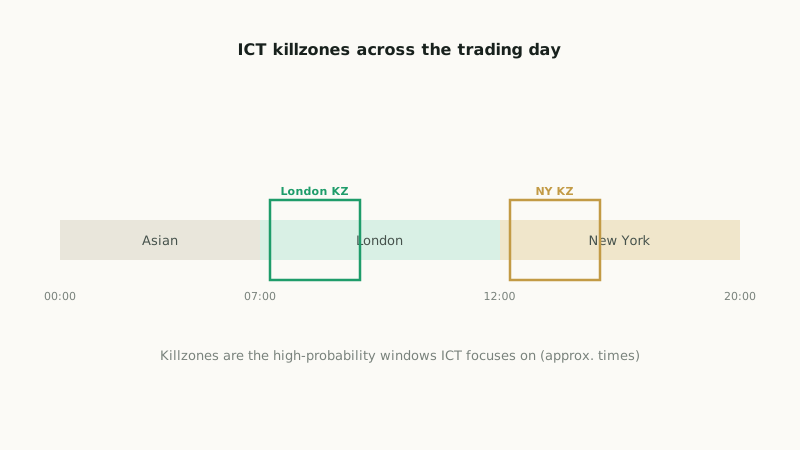
This time-based dimension is genuinely useful regardless of whether one accepts the full institutional narrative, because it is simply true that liquidity and volatility concentrate around major session opens. Focusing analysis on those windows, and being sceptical of moves during the quiet Asian session or the lunchtime lull, is sound practical advice that aligns with how the forex market actually behaves. For a currency trader, respecting session timing is one of the more defensible ideas to take from ICT.
The signature ICT models
Beyond the shared tools, ICT is known for several named models and patterns. The power of three describes how a price move unfolds in three phases — accumulation (a quiet base), manipulation (a false move that grabs liquidity), and distribution (the real move) — and is ICT's template for how a trading day or session develops. The judas swing is the manipulation phase in action: a deceptive early move in one direction, designed to trap traders and collect stops, before price reverses into the genuine move.
The optimal trade entry (OTE) is ICT's preferred entry zone — a retracement into roughly the 62% to 79% area of a move, where price is at a favourable "discount" or "premium" before continuing. The silver bullet is a specific, time-boxed strategy that looks for a fair-value-gap entry within a narrow one-hour window during the killzones. There are many more, but these capture ICT's flavour: precise, often time-specific, and built around the recurring theme of price manipulating liquidity before delivering the real move. The OTE in particular connects directly to premium and discount zones, which formalise the favourable-location idea.
What sets ICT apart from generic SMC is its obsession with time — killzones, sessions, specific windows — and its named models for how manipulation precedes the real move. The time element is its most practically defensible contribution.
The controversy
No honest account of ICT can skip the controversy, which is substantial. ICT has an enormous, intensely devoted online following, and that fervour has drawn criticism that the material is taught with an almost doctrinal certainty that its unverifiable claims do not warrant. The central problem is the same one that dogs all of Smart Money Concepts: the institutional narrative — that specific banks are deliberately engineering these moves — cannot be verified, particularly on decentralised spot forex where no central order record exists.
Critics also point to the framework's sheer flexibility as a weakness. With so many concepts — multiple types of order block, gap, liquidity level and time window — almost any price move can be explained after the fact, which makes the method difficult to falsify and easy to fit in hindsight. The volume of ICT terminology can also create an illusion of sophistication that substitutes for genuine edge. Defenders counter that the time-based discipline, the emphasis on liquidity and favourable entry location, and the structured risk management are real and valuable regardless of the narrative. As with so much in trading, the truth sits in between, and the outcome depends heavily on the discipline of the individual using it.
How to approach ICT sensibly
The sensible stance toward ICT mirrors the one for Smart Money Concepts generally. Take the genuinely useful, defensible elements — respecting session timing and killzones, watching liquidity around obvious levels, insisting on favourable entry location through OTE and premium/discount, and managing risk with defined invalidation. Hold the unverifiable institutional narrative loosely, as a useful mental model rather than literal fact. Be wary of the doctrinal certainty in which the material is often presented, and especially wary of anyone promising that learning ICT guarantees profits.
Treated that way — as a structured, time-aware lens for reading price and managing risk, not as a decoded secret of the banks — ICT can be a coherent and useful approach. Treated as gospel, it sets traders up for the same disappointment that meets every framework sold as a guaranteed system. The discipline, the scepticism and the risk management you bring to it matter far more than the labels themselves, which is the recurring lesson across every framework on this site.
How the concepts fit together in a trade
The individual ICT concepts make far more sense seen as steps in a single sequence rather than as a scattered glossary. A textbook ICT trade unfolds roughly like this. First, the trader establishes a daily bias — a directional lean based on the higher-timeframe structure and where the major liquidity rests. Second, they wait for a killzone, focusing only on the London or New York windows where high-probability moves cluster. Third, within that window they watch for a liquidity sweep — a judas swing that runs the obvious stops in the wrong direction, trapping the crowd.
Fourth, they look for a change of character confirming the real move is beginning in the direction of their bias. Fifth, they drop to a lower timeframe and seek a precise entry — a fair value gap or order block sitting in the optimal trade entry zone of the retracement, in discount for a long or premium for a short. The stop sits beyond the swept liquidity; the target is the next significant liquidity pool. Seen this way, ICT is not a random bag of terms but a single coherent process: bias, time, sweep, confirmation, located entry, defined risk. Whether or not the institutional story behind each step is literally true, the sequence itself enforces patience, favourable location and defined risk — which is most of what disciplined trading requires regardless of framework.
ICT is the origin of Smart Money Concepts: liquidity, order blocks and fair value gaps, plus a heavy emphasis on time (killzones) and named models like the power of three, judas swing and OTE. Its concepts fit a single sequence — bias, killzone, sweep, change of character, located entry, defined risk. The time-based discipline is its strongest contribution; its institutional narrative is unverifiable. Use it as a lens, keep your scepticism, and never treat it as a guaranteed edge.